
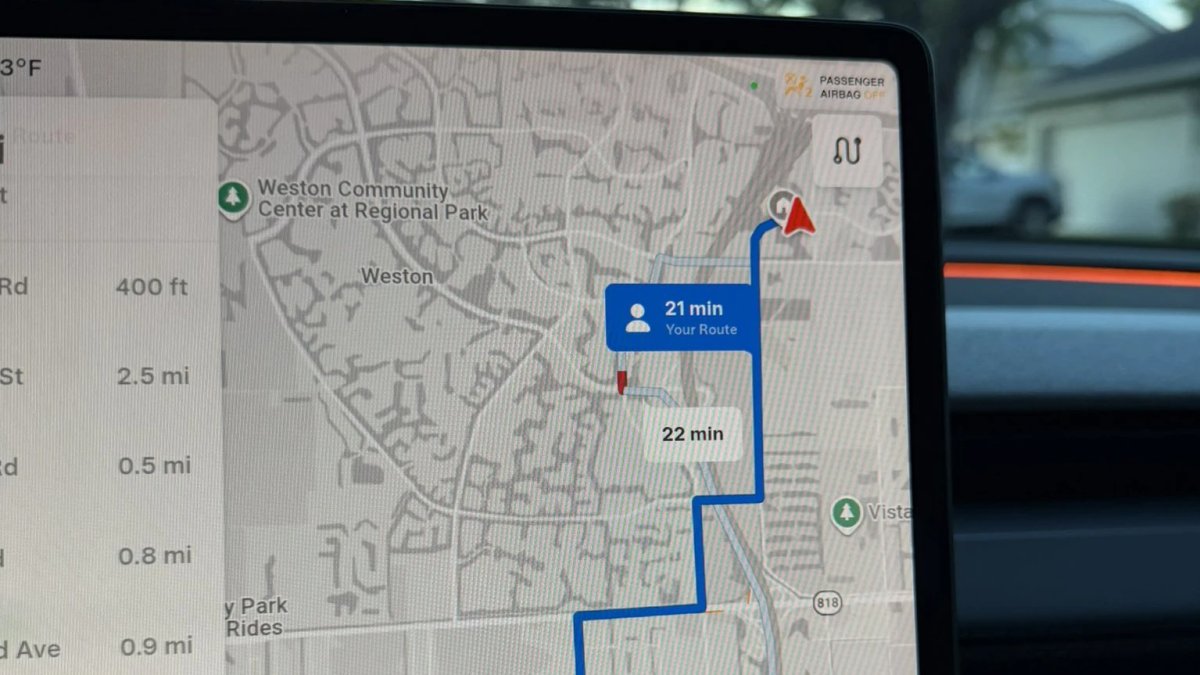

Tesla’s Summer Update this year bundles several new capabilities, including Grok vehicle commands (video), Driving Visualization Zoom, Caraoke singing à la Rock Band, and, notably, personalized navigation routes.
Even though Preferred Routes was showcased as part of the Summer Update, you don’t need the 2026.26 car update to begin using personalized routing.
Preferred Routes
With Preferred Routes, the vehicle records the routes you take most frequently to each destination and then considers your usual path alongside other options. If your route’s travel time is reasonably close to the fastest option, the vehicle will select your preferred path.
This feature builds on Tesla’s Alternate Routes capability, which appears at the beginning of a drive (you can also view alternates anytime by tapping Next Turn at the top of the directions list). Alternate routes arrived in 2022, offering up to three suggested paths to your destination. With this update, once the vehicle has collected enough data, “Your Route” becomes one of the choices.


Requires Map Update
Although the preferred routes capability is highlighted in the summer release, many owners are seeing it appear with the latest maps update. Tesla began rolling out map update 2026.26 in North America last week, and, as with software updates, the rollout is gradual.
The maps install silently in the background, so you won’t receive a notification. To check manually, go to Controls > Software and scroll to Navigation Data.
Who Gets It
For now, Tesla is limiting Preferred Routes to the United States. Even if you’ve received map update 2026.26, you must be in the U.S. to see your personalized routes.
If your vehicle already has the 2026.26 maps, you should start seeing personalized routes after you navigate to the same destination a handful of times.
Tesla states that online routing must be enabled to see preferred routes; that setting is on by default and does not require Premium Connectivity. Tesla also states that your location data is anonymous to Tesla and is not associated with your vehicle.
How It Works
The vehicle likely tracks locally which turns you take to a given location and how often you follow that exact path. When you select a destination, the car likely sends your most-used route for that destination to Tesla. Tesla then responds with the best routes to that destination, including travel time for your most traveled route.
While Tesla sources many map-related elements from Google—such as map tiles, satellite imagery, Points of Interest, and traffic data—the navigation app itself is built by Tesla. Tesla also computes routing to each destination on its own instead of relying on Google, enabling features like preferred routes and accounting for Supercharging.
This feature is available on all Tesla models with Intel or AMD infotainment units. You’ll recognize it when “Your Route” appears as a label among the alternate routes shown at the beginning of a drive.













Partager:
Tesla Issues Physical Recall for 20,349 Model 3 and Model Y Vehicles Over Headlights
A Look at What a Refreshed Tesla Model 3 Could Look Like