

Tesla is ramping up its commercial logistics efforts. The company recently kicked off high-volume production of the refreshed Semi at its facility in Sparks, Nevada, with a long-term goal of producing 50,000 electric trucks per year.
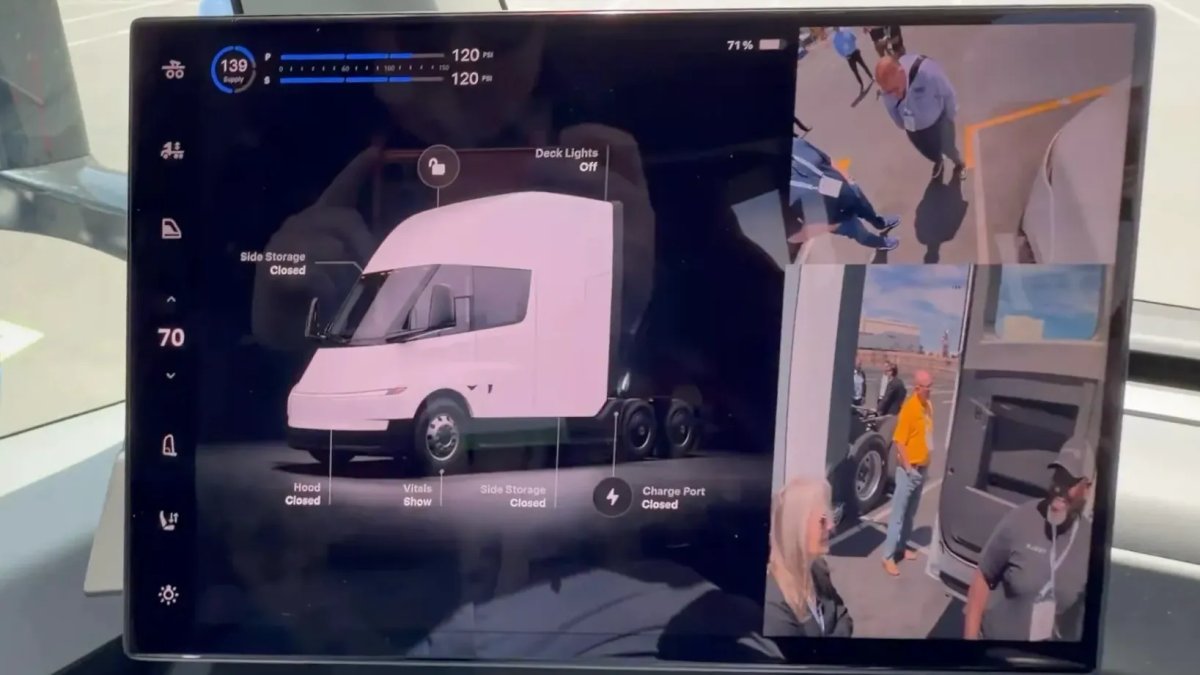
As fleet deliveries pick up after multiple large commercial orders for the redesigned hauler, there is now a clearer view of the in-cab experience. David Moss (@DavidMoss) shared a video on X after riding in the vehicle, showing the dual-display interface designed for an all-electric class 8 commercial vehicle.
A Dual-Screen Cockpit Layout
Unlike Teslas consumer models that rely on a single center display, the redesigned Tesla Semi uses two large screens positioned to either side of the drivers central seat. The software separates primary operational telemetry from secondary functions.
The left screen serves as the main instrument cluster with an emphasis on trip metrics, critical vehicle system indicators, and mechanical status. It also presents a high-fidelity park visualization on its left side. While Teslas latest consumer vehicles recently received higher-quality Unreal Engine-based park visualizations through the Spring 2026 Software Update, the Semis implementation appears to match that fidelity while being tailored for industrial fleet navigation.

The right display is largely dedicated to non-essential apps. Here, operators handle navigation maps, climate settings, various menus, and media streaming apps such as Apple Music and Spotify.
Customized Controls and Vertical Docks
The UI differs from a Model 3 or Model Y. Instead of a horizontal app dock along the bottom, the Semi features mirrored vertical docks that run down the outside edge of each screen.
Given the rapid-access needs of commercial trucking, these docks include additional hardware-oriented controls. Examples include quick toggles for high-intensity overhead deck lights, digital seat height adjustments, and fast access to display the digital side-mirror camera feeds.
Close look of Tesla Semi Screens in action!
— David Moss (@DavidMoss) May 5, 2026
I just got to ride in one pic.twitter.com/cNO2UuAqim
Climate controls are handled differently than in consumer Teslas, which tie heated side mirrors to the rear defroster circuit. The Semi adds a dedicated heated-mirror button so drivers can manage visibility independently during harsh winter conditions.
Building an Industrial Charging Moat
These interface refinements arrive alongside supporting infrastructure for heavy-duty trucking. As manufacturing increases, the company recently unveiled the "Basecharger," a 125kW localized solution designed to simplify home depot overnight charging for regional fleets.
For interstate operations, Tesla is rolling out dedicated industrial megawatt charging, and it opened its first public Semi charging station this spring. A full deep-dive into the refreshed Tesla Semi highlighted a carefully balanced combination of mechanical hardware updates and optimized software. By delivering a dual-display interface that reduces day-to-day friction for long-haul work, the company is adapting its tech stack to commercial use and setting a new benchmark for fleet ergonomics.






Partager:
FSD 14.3.2 Disaster: Why Tesla's Latest Update Has Owners Furious
First Look at Tesla's Virtual Queue Feature for Superchargers [Photos/Video]