

Tesla’s autonomous ride-hailing program is rolling out software aimed at testing and validation. Retrofitted production Model Y vehicles operating the Robotaxi service in select cities now display new in-car controls on the touchscreen.
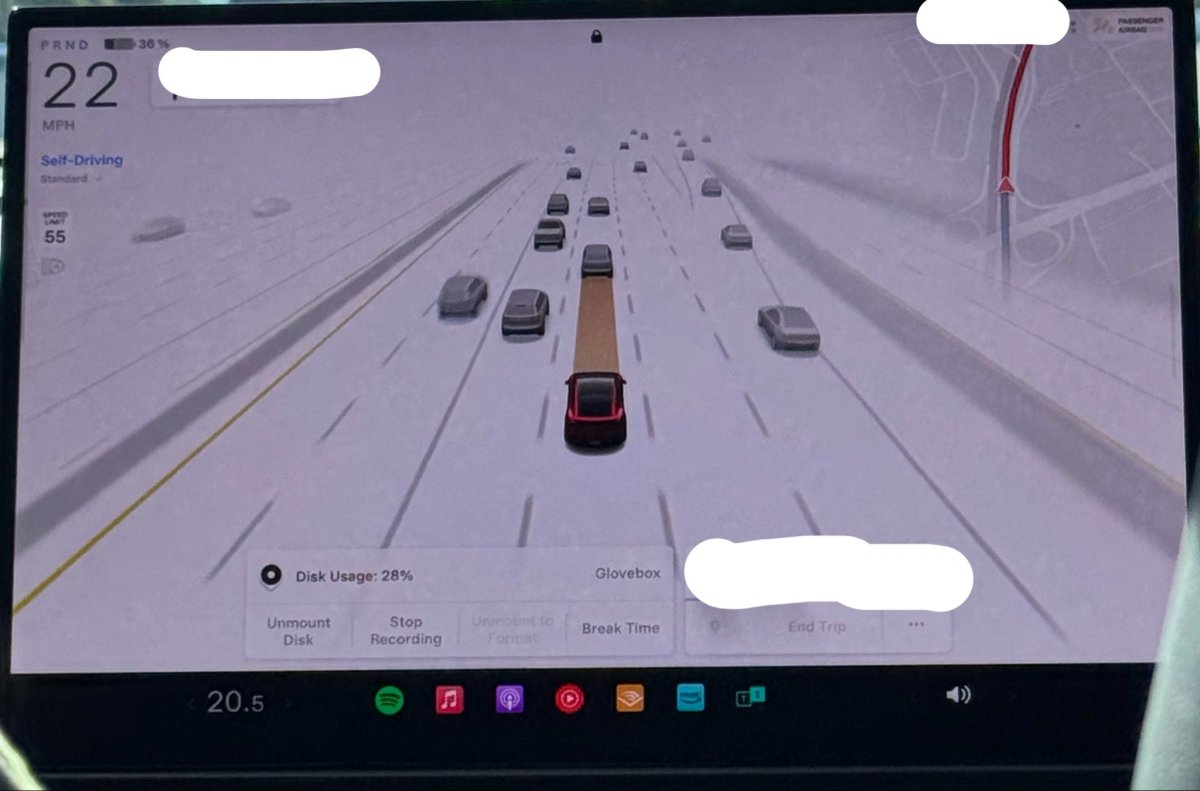
X user @Josh143574359 shared images of a dedicated recording card on the center display during a supervised Robotaxi ride and wrote: “Roughly 20 minutes of driving equated to 10% disk usage in my @robotaxi. I haven’t seen these options before, seems like it’s only for staff,”
Internal Logging for Safety Monitors
The recording options are designed for supervised Robotaxi rides, giving onboard safety monitors the ability to capture telemetry and record drive sessions directly. Tesla’s job listings for “AI Safety Operators” for its Robotaxi vehicles identify responsibilities such as starting and stopping recording devices and handling related equipment, and these options support that workflow.
Currently, supervised Robotaxi rides operate only in areas where Tesla is validating the service and commercially in the Bay Area and parts of Austin, with human safety operators ready to take over in an emergency. In contrast, most of the Robotaxi network is fully unsupervised:
- Austin: Mix of unsupervised Model Y rides and supervised rides
- Bay Area: Supervised rides only
- Dallas: Unsupervised Model Y rides only
- Houston: Unsupervised Model Y rides only
- Miami: Unsupervised Model Y rides only
- Orlando: Unsupervised Model Y rides only
- Tampa: Unsupervised Model Y rides only
The on-screen recording widget shows live disk usage as a percentage and offers options to unmount the drive, stop recording, or initiate a break-time cycle. The interface also indicates the storage drive is connected through the glovebox USB port, where consumer vehicles use USB sticks for media storage and for Dashcam/Sentry Mode recordings.

Given that a 20-minute trip consumed 10% of total disk space, the system is likely capturing multi-camera feeds from every external angle for validation and AI training. Safety monitors likely need to swap high-capacity storage drives multiple times per shift to keep recording.
Tailoring Vehicles for Fleet Operations
These additions illustrate how retrofitted Model Y robotaxis are diverging from consumer vehicles. Beyond the recording interface, Tesla recently removed blinker and hazard sounds from unsupervised Robotaxis to keep the passenger cabin quiet.
Tesla’s data gathering underpins broader expansion. The company recently said its Robotaxi fleet has crossed 380,000 unsupervised miles. Fully unsupervised rides also launched in three new markets this month, first in Miami and later in Orlando and Tampa.
As steering wheel-less Cybercabs undergo public testing in Austin, extensive real-world Robotaxi ride logging continues to refine Tesla’s neural networks before the purpose-built vehicle takes over commercial fleets.



Partager:
Exclusive: Tesla Model 3 and Model Y Are Getting Upgraded Wireless Phone Chargers
Tesla Builds 10 Millionth EV: A Look Back at Each Milestone