
Tesla has begun deploying a new Full Self-Driving branch called v14 Lite, bringing elements of the latest autonomy architecture to Hardware 3 (HW3/AI3) vehicles. This rollout follows the end-of-June target previously shared by Ashok Elluswamy and marks the first FSD update for HW3 in roughly 14 months.
The build is currently reaching early access testers via software update 2026.20.5.1, with a wider release planned after initial validation. Tesla is labeling this simply as v14 Lite without a point version number.
How FSD v14 Lite Works
To bridge newer capabilities onto older compute, the team leaned on knowledge transfer from newer hardware. As noted by the @Tesla_AI account on X, they "distilled the intelligence from HW4 V14 into HW3. This allows HW3 to directly learn how to handle scenarios using HW4 V14 as a guide. This process unlocks the improvements that have been made to HW4 including Reinforcement Learning (RL) and offline models for HW3."
In practice, v14 Lite runs a compressed model that imitates the real-time decisions of the primary network on newer platforms. Elon Musk pointed out that "the AI3 computer only has ~15% of the effective memory bandwidth of AI4," underscoring the challenge of fitting the approach onto HW3.
Nice work by the @Tesla_AI team!
— Elon Musk (@elonmusk) June 29, 2026
The AI3 computer only has ~15% of the effective memory bandwidth of AI4, so this was a tough challenge. https://t.co/UvngWxzIvC
Because HW3 must run a model architecture derived from newer chips, some users may notice slightly longer decision-making in especially complex scenes. Early feedback indicates that overall smoothness and performance are still a major improvement over prior HW3 builds. According to the release notes, v14 Lite has "improved both proactive and reactive responsiveness across a wide variety of categories including navigation handling, merges and forks, pedestrian interactions, traffic lights, and vehicle cut-in scenarios." It also delivers "improved general comfort in nominal scenarios through fewer false slowdowns, smoother steering and more consistent lane centering."
FSD v14 Lite is now rolling out to AI3 early-access customers. Based on the feedback, will rollout to more customers over the next few weeks.
— Ashok Elluswamy (@aelluswamy) June 29, 2026
This build distills the driving behavior from AI4’s v14 series into both the camera and compute config of AI3. It includes destination…
What Features Are Included
Despite being a distilled build, v14 Lite brings several long-requested capabilities to older vehicles. FSD (Supervised) can now be initiated from Park on HW3 for the first time. The vehicle can automatically shift into Reverse, back out of a space, and transition into Drive.
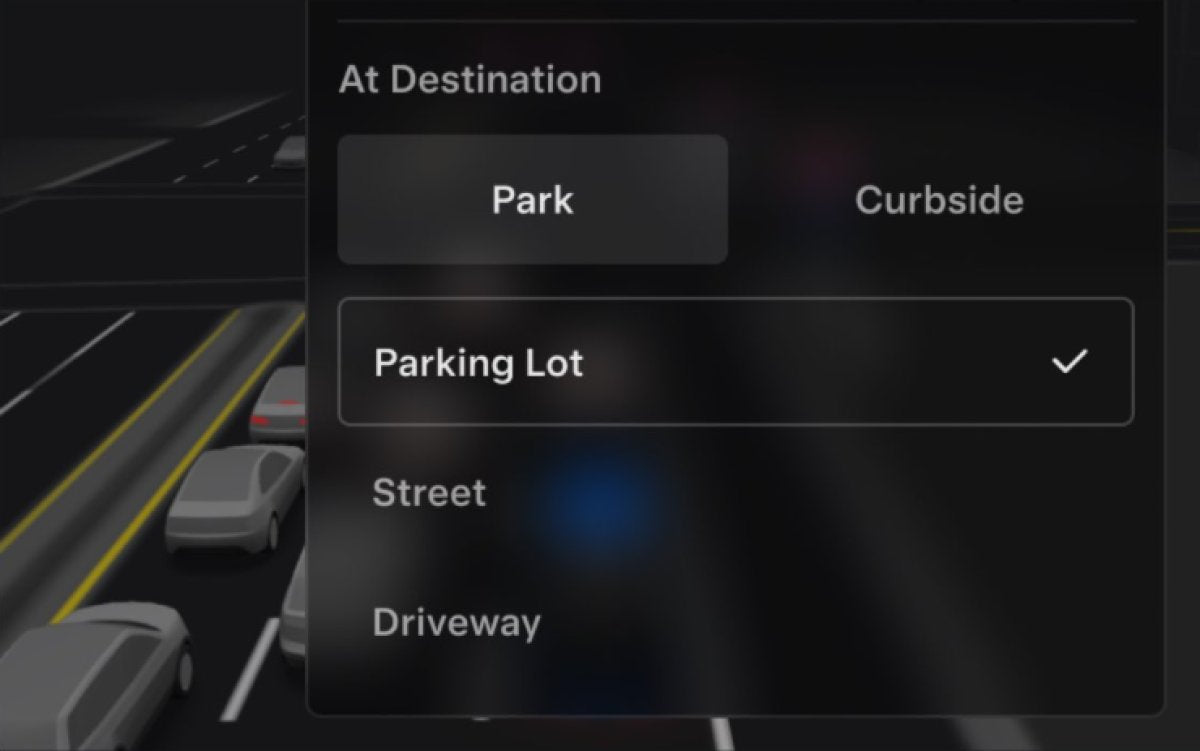
Arrival Options are also included, letting drivers specify where the trip should end. Tesla "Added Arrival Options for you to select where FSD should park: in a Parking Lot, on the Street, in a Driveway, or at the Curbside." The system selects a default based on its reasoning about the destination.

Speed Profiles are now available on HW3 at all times. The notes state, "Speed Profiles are now available at all times, to further customize driving style preference." Standard profiles apply across city and highway driving. Options like Sloth Mode are present, while the more aggressive Mad Max mode is not included in this build. This aligns with earlier expectations for v14 Lite.

What Got Left Behind
Given HW3’s constraints, several items are absent. Actually Smart Summon (ASS) does not receive the recent speed and performance upgrades seen on newer hardware. On the main v14 branch, Tesla unified the ASS, FSD, and commercial Robotaxi models to improve Summon behavior, but that unification is not part of v14 Lite.
The standalone Self-Driving App does not appear in the UI for v14 Lite. In addition, there are no FSD streaks or total mileage driven on FSD under Controls > Self-Driving.

Arrival Options in v14 Lite also lack the optimization where the navigation pin dynamically adjusts based on the chosen parking type. This suggests the Lite branch was distilled from an earlier v14 build, before those pin adjustments appeared around v14.2.2.
Looking Forward and International Expansion
This release serves as a bridge for older cars while the fleet advances toward autonomy. Tesla has confirmed that AI3 will not achieve unsupervised autonomy, and hardware upgrades are planned for affected vehicles.
Frequent updates to the Lite branch are unlikely. The upcoming FSD v15, expected later this year or early next year with ten times the parameters of current builds, is limited to HW4 and AI5, which removes the possibility of an "FSD v15 Lite."
International availability is slated to follow initial validation. Once approved, deployment could extend to markets that already have FSD v14, including recently approved EU countries and Australia, New Zealand, and South Korea, in the coming weeks.
Hardware retrofits for HW3, likely using AI4+ or AI5, are not expected until 2027 at the earliest. Until then, this distilled model is the primary path for HW3 vehicles to access modern FSD capabilities.


Condividi:
Cybercab vs Consumer Teslas: Door, Window, and Seat Controls
Tesla Exec Says Big Giga Texas Announcement Coming July 7