
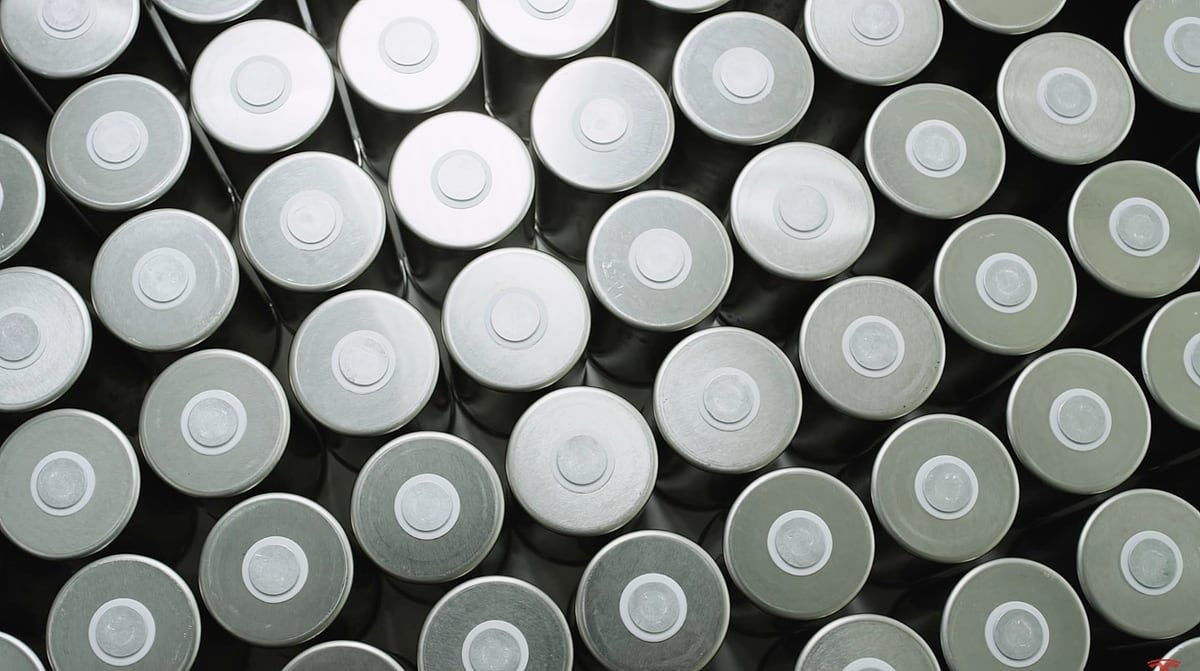

In a low-profile USPTO filing, Tesla reports it has overcome one of its toughest hurdles: the dry cathode.
Today, most battery cells rely on a costly, wet-slurry method to make the cathode, while the anode typically uses a simpler dry-coating approach. For nearly three years, Tesla pursued a dry cathode process to cut costs and streamline production of this key cell component.
The latest in a string of dry-cathode patents, published in early 2026, describes how the company has industrialized a fully dry cathode for the newest version of the 4680 cell.
The Spider Web Patent
The main obstacle to scaling a dry cathode was the material behavior itself: dry cathode powder was too brittle and abrasive to coat onto metal foil at high speed without toxic solvent assistance.
Patent US 2025/0364562 outlines the remedy: a composite binder that pairs PTFE (Teflon) with higher-stability polymers such as PVDF (an extremely resistant material).
Subjected to high-shear jet milling, this binder fractures into a microscopic "spider web" that mechanically meshes the active electrode particles without any solvent, producing a flexible, self-supporting film.
To enable this, Tesla also tuned particle size. Using larger active particles lowers total surface area, keeping binder content below 2% so lithium ions can move freely and maintain performance.
Solving the Throughput Nightmare
Beyond chemistry, manufacturing speed had capped progress on the 4680 line. Early trials with pure PTFE demanded up to ten passes through high-pressure rollers to yield a usable film—far too slow for automotive production.
With the new composite binder, a cohesive film forms in just three passes, and the reduced roll count roughly triples manufacturing speed.
Slashing Costs and Footprint
Conventional wet-slurry lines need hundreds of feet of energy-hungry drying ovens and expensive solvent-recovery systems.
Eliminating these steps can shrink a battery factory’s physical footprint by up to 50 percent. Manufacturing analysis also indicates that dropping the wet process cuts capital equipment spending by over 40 percent and reduces overall electrode production costs by nearly half.
Performance data shows the savings do not come at the expense of longevity: dry-processed cells retain approximately 90 percent of their initial capacity after 2,000 charge cycles.
On the Road Today
This advance has moved into production. During the Q4 2025 earnings call in January, Tesla confirmed that Gigafactory Texas is actively mass-producing fully dry cells. Bonne Eggleston, Tesla's Vice President of 4680 batteries, stated that both electrodes now use the dry process.
These Gen 2 cells are already installed in select Model Y vehicles built in Austin, with broader deployment for the Cybertruck, Cybercab, and Semi expected throughout 2026 and 2027.





Partager:
Tesla's Cybercab is Finally Here: Real-World Sightings and What Owners Need to Know
Tesla is Planning a Dedicated Robotaxi Hub in Texas [VIDEO]