
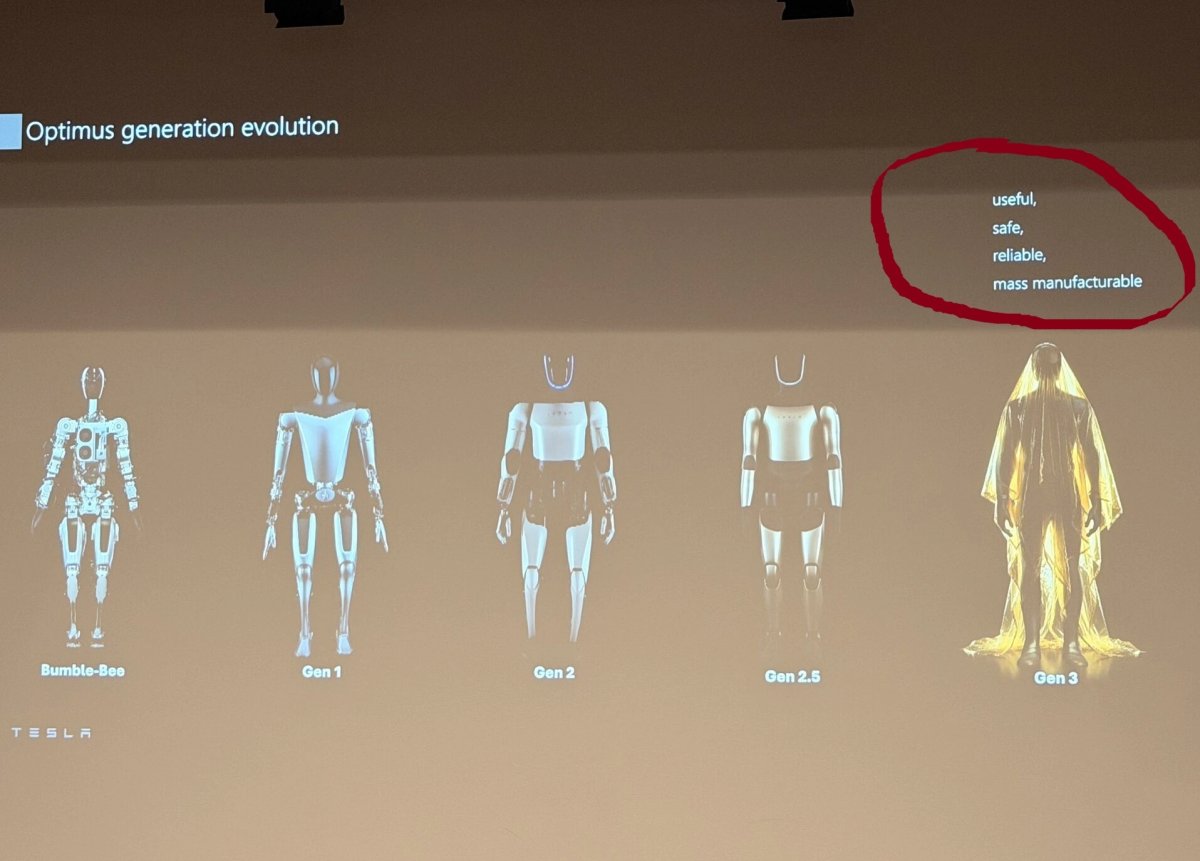
Tesla fait passer son robot humanoïde du stade de prototype à celui de déploiement à grande échelle. Lors d'une conférence organisée par l'ETH Robotics Club à Zurich, Konstantinos Laskaris, responsable du programme Optimus, a montré une diapositive de présentation qui semble révéler la silhouette du futur Optimus Gen 3.
Comme l'a noté TheHumanoidHub sur X, la présentation de Laskaris a indiqué que la Gen 3 sera le premier modèle d'Optimus produit en série par Tesla. Cela marque un tournant, les versions Bumblebee et Gen 2 étant davantage axées sur la recherche, vers une conception privilégiant la vitesse, la sécurité et la fiabilité à l'échelle mondiale.
Un facteur de forme plus humain
La silhouette indique une mise à jour notable du design. Bien que la Gen 2 semblait déjà raffinée, la Gen 3 paraît plus proche d'un profil humain. Les avant-bras semblent plus épais et les mains paraissent plus avancées et réalistes. L'illustration est également dépourvue des bords mécaniques saillants observés précédemment, suggérant un possible revêtement extérieur souple, conforme à l'esthétique d'un humain dans une combinaison de super-héros évoquée par les ingénieurs de Tesla.

La recherche d'une précision de niveau humain est motivée par une nouvelle conception des mains. Les ingénieurs de Tesla ont récemment souligné que la main de la Gen 3 dispose de 22 degrés de liberté, se rapprochant de la forme et de la fonctionnalité humaines. Cette dextérité permet d'effectuer des tâches délicates auparavant inaccessibles aux robots, comme pocher un œuf ou serrer avec précision de petits boulons sur une chaîne de montage en mouvement.
La voie vers la production de masse
L'entreprise réorganise ses opérations autour d'Optimus. Elle a récemment abandonné ses modèles phares Model S et Model X pour libérer de l'espace dans l'usine de Fremont pour une ligne de production Optimus. Tesla vise une capacité de production d'un million d'unités par an à Fremont, avec un début de production en volume prévu avec la Gen 3 dans le courant de l'année. Plus loin dans l'avenir, l'entreprise prévoit une ligne de production de 10 millions d'unités par an à la Gigafactory Texas.
Le déploiement initial se concentre sur un usage interne. Tesla a l'intention de déployer les robots dans ses propres usines pour effectuer des travaux répétitifs ou dangereux, en utilisant ses opérations internes pour perfectionner le système avant de le proposer à des clients externes à un prix estimé entre 20 000 et 30 000 dollars.
Quand le verrons-nous ?
La conférence de Zurich a servi d'aperçu, le dévoilement complet restant à venir. La Gen 3 devait initialement être révélée au premier trimestre 2026, mais l'événement a été retardé. Elon Musk a récemment déclaré que le robot se déplaçait déjà et que la conception nécessitait encore quelques finitions avant un lancement officiel.
Avec la préparation des lignes de production en Californie, le retard semble être une question de semaines plutôt que de mois. Si la Gen 3 s'avère utile, sûre et fiable, comme le décrivait la diapositive de Laskaris, cela marquerait une nouvelle phase pour Tesla dans le domaine de l'IA et de la robotique. L'attention se porte désormais sur un possible événement au deuxième trimestre pour la première apparition publique du robot.









Partager:
Ce qui pourrait arriver dans la mise à jour FSD v14.3 de Tesla
Tesla commence les préparatifs pour le lancement du Robotaxi à Phoenix