

The Cybertruck Range Extender was canceled last year, but a recently published patent application indicates that Tesla has been developing the software architecture needed to support secondary battery packs.
Titled “Electric Vehicle Range Extender Integration,” patent application US2026/0048683 describes a sophisticated control system that manages power flow, thermal conditioning, and high-speed charging between a vehicle’s primary high-voltage battery and an auxiliary Range Extender pack. It explains how two distinct battery packs communicate and share load in a dual-battery electric vehicle.
Coordinating Two Battery Packs
Adding a separate battery pack to an EV is complex. In this case, the primary battery operates at 800V (as in the Cybertruck and the patent), while the auxiliary pack operates at 400V. These must be managed carefully to avoid voltage mismatches, inefficient energy draw, and thermal imbalances.
The patent outlines a dynamic control approach that switches between two strategies based on vehicle operation: State of Energy (SoE) Balancing and Open Circuit Voltage (OCV) Matching.
SoE Balancing for Everyday Driving
During normal, unnavigated driving, the system uses SoE Balancing. Controllers for the primary and auxiliary batteries coordinate to keep their discharge rates proportional. If the auxiliary pack has a higher relative State of Energy than the main pack, the vehicle draws more power from the auxiliary pack to even them out.
If the driver suddenly calls for high output—such as rapid acceleration or heavy towing—the system can temporarily override the balance and pull maximum power from both packs at once. After the high-demand event, a catch-up routine draws heavily from the auxiliary pack until the energy levels are rebalanced.
OCV Matching When Heading to Charge
When a route includes a Supercharger stop, the system switches from SoE Balancing to OCV Matching. Because the packs operate at different voltages (800V and 400V), charging them together without aligning their voltages could trigger catastrophic in-rush currents or damage components.
As the vehicle approaches the charger, it controls the discharge rates of both packs to equalize their Open Circuit Voltages. If the OCVs are aligned when the plug is connected, a series of high-voltage contactors close to place the packs in parallel, allowing the Supercharger to deliver energy to both simultaneously and drastically reduce time at the plug.
If the voltages are not matched on arrival, the system isolates the packs and uses bypass contactors to charge the lower-voltage pack independently until it reaches the main pack’s voltage.
Beyond an In-Bed Pack
The patent references mounting the auxiliary battery in the Cybertruck’s bed, but the architecture extends further.
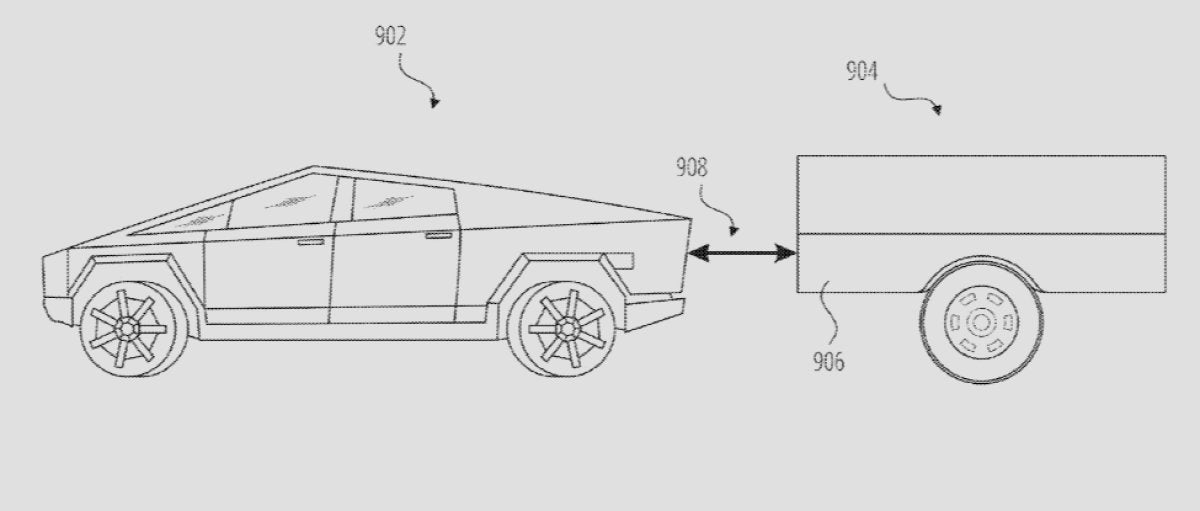
Drawings and examples in the filing show the auxiliary pack installed within a towed trailer. Through a specialized high-voltage interface, a trailer equipped with this system could power the towing vehicle, completely eliminating the massive range degradation typically associated with towing heavy loads.
The patent also mentions an MC4 connector so solar panels on the truck or trailer can trickle-charge the auxiliary pack. Although the Cybertruck Range Extender has been shelved, the filing indicates substantial engineering work behind these systems.
Future applications could include range extenders for the Semi or a Tesla-branded trailer, enabling a towed battery that doesn’t require its own motor, like the Pebble Trailer.




Partager:
Everything Announced at Tesla's Terafab Event
Tesla Asks Colorado Court to Dismiss Autopilot Lawsuit, Citing Drunk Driving and Inactive FSD