
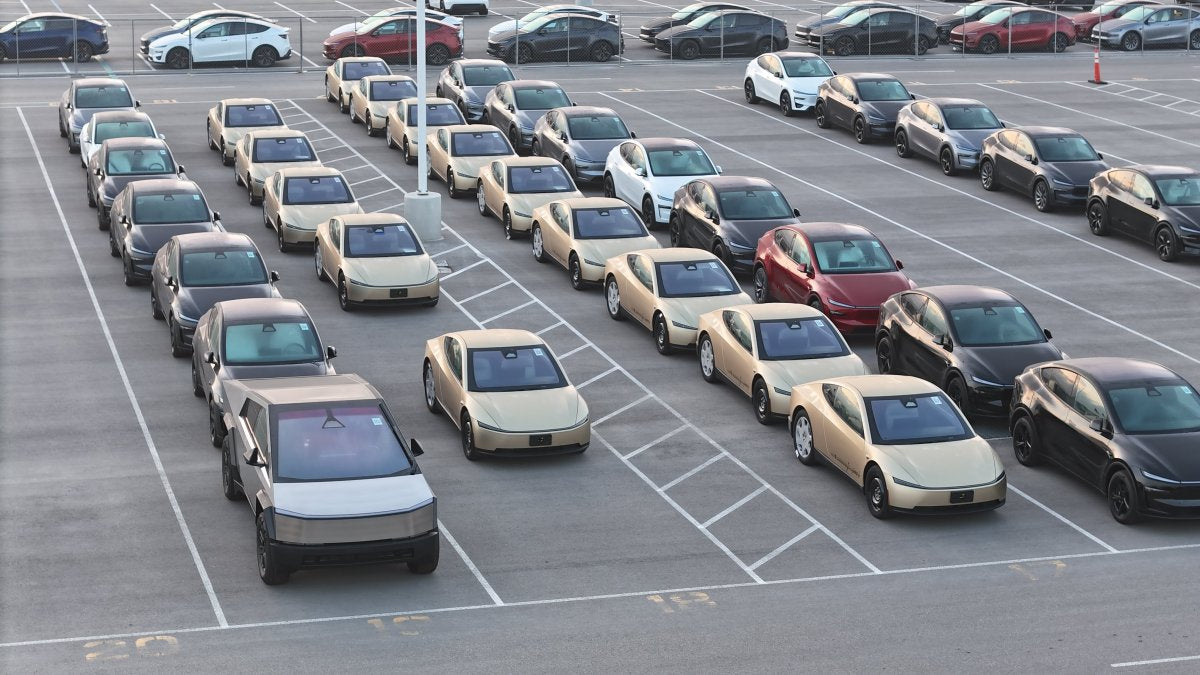

Le futur autonome promis depuis longtemps par Tesla est passé des rendus et prototypes isolés à des véhicules réels à la Giga Texas. Une flotte de Cybercabs récemment construits a été aperçue sur le parking de sortie de l'usine, et contrairement aux récentes observations, ces unités sont dépourvues de volant.
L'entreprise passe des voitures de test modifiées à la version de production dotée du matériel sans commandes manuelles, présenté pour la première fois lors de l'événement « We, Robot ».
L'observation sur le parking de sortie
La découverte, partagée par Joe Tegtmeyer, observateur de longue date de la Giga Texas et pilote de drone, montre une activité sur la zone de stockage de sortie de l'usine. Le vendredi 17 avril, Tegtmeyer a capturé des images aériennes d'environ 14 Cybercabs nouvellement fabriqués stationnés sur ce parking.
Quelque chose d'important a changé à la Giga Texas avec la production des Cybercab… ~ 14 sur le parking de sortie SANS VOLANT !
— Joe Tegtmeyer 🚀 🤠🛸😎 (@JoeTegtmeyer) 17 avril 2026
Plus tôt cette semaine, la ligne de production a commencé ce que nous attendions tous et je m'attends à en voir beaucoup plus à partir du lundi 20 avril 🤠
Une grande étape… pic.twitter.com/K17ZzBlQ8k
Les images et la vidéo montrent des véhicules élégants à deux places dans ce qui semble être leur forme de production finale. Outre les roues caractéristiques et les autocollants sur les pneus, les 14 véhicules présentent des intérieurs minimalistes sans commandes de conduite : pas de volant, pas de pédales et pas de rétroviseurs latéraux.
Au-delà de la flotte de test
L'abandon du volant marque une étape majeure. Depuis le début des essais routiers, les candidats à la mise sur le marché du Cybercab aperçus sur les routes publiques en Californie, au Texas et dans d'autres États testeurs étaient équipés de volants, de pédales et de rétroviseurs temporaires.
Le vice-président de l'ingénierie des véhicules, Lars Moravy, avait précédemment déclaré que ces commandes manuelles étaient strictement destinées aux tests et n'étaient pas prévues pour la vente. La prévalence de véhicules de test équipés de volants avait alimenté les spéculations selon lesquelles Tesla pourrait introduire une version conduisible manuellement pour contourner les obstacles réglementaires.
Les véhicules du parking de sortie contredisent cette idée. En produisant à grande échelle l'intérieur sans commandes, Tesla montre sa confiance dans son logiciel de conduite entièrement autonome sans supervision (« Unsupervised Full Self-Driving ») qui alimentera le réseau. La suppression des commandes manuelles réduit également les coûts et la complexité de fabrication, abaisse le poids du véhicule et maximise l'espace intérieur de l'habitacle.
Montée en puissance de la production face à la bureaucratie
Depuis que la première unité de production est sortie de la ligne de la Giga Texas mi-février, la chaîne d'assemblage du Cybercab n'a cessé de monter en cadence. Ce dernier lot de 14 véhicules sans volant est l'indication la plus forte à ce jour que la fabrication en volume commence ce mois-ci.
Cependant, la production n'est qu'une partie du défi. Selon les normes fédérales actuelles de sécurité des véhicules automobiles (FMVSS), les constructeurs automobiles, sans exemption spéciale, sont limités à la production de seulement 2 500 véhicules par an dépourvus de volant traditionnel et de commandes manuelles.
Tesla travaille dans le cadre de ce plafond tout en cherchant à obtenir des allégements fédéraux. La proposition de loi « Self Drive Act » de 2026, qui créerait un cadre fédéral pour autoriser de tels véhicules, a récemment progressé au sein d'une sous-commission de la Chambre des représentants.
Alors que l'entreprise poursuit l'obtention de l'approbation réglementaire, le matériel attend déjà à l'usine. La semaine dernière, Tesla a ajouté Dallas et Houston comme marchés pour ses robotaxis, et si la production augmente comme prévu dans les semaines à venir, certains de ces véhicules pourraient bientôt rejoindre la flotte autonome.


Partager:
Les rapports d'accident de la NHTSA sur les systèmes de conduite automatisés révèlent des différences entre les opérateurs de robotaxis
Aperçu des améliorations météo, de la mise en file d'attente musicale et des fonctionnalités non documentées de la mise à jour 2026.14