
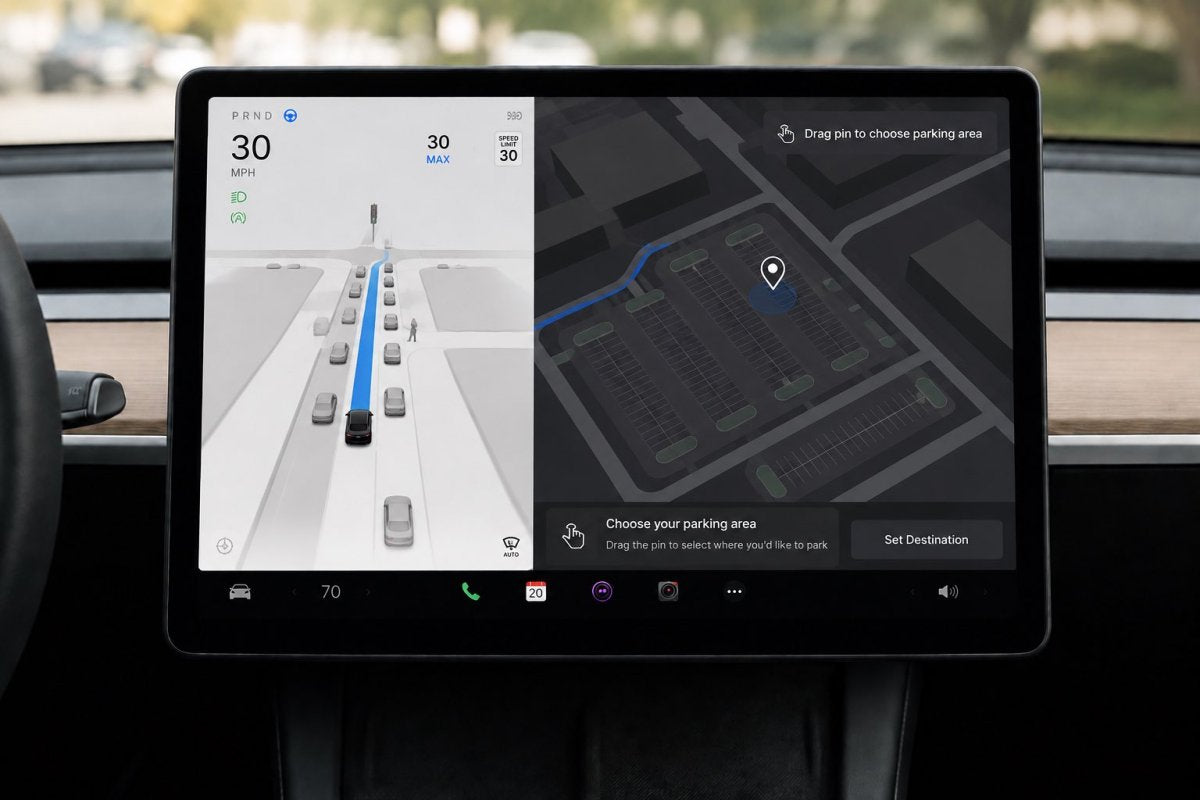
FSD has become highly capable on complex city streets, yet the last 50 feet of a trip often remain problematic. Automated parking is currently one of the most frequent reasons for driver disengagements.
On arrival, FSD can choose unsuitable spaces—such as parking very far from an entrance in an empty lot or pulling into a designated handicap or reserved spot.
To address this, community designers have proposed intuitive user interface ideas, aiming to make parking the next significant FSD improvement.

Granular Spot Selection
Recent community mockups present several ways to tackle parking, including options for drivers to set preferences before reaching their destination.
One approach uses a drag-and-drop pin on a top-down satellite map so the driver can indicate a specific aisle or general area.
Another, more detailed concept depicts a rendered parking lot with selectable blue boxes for "Spot A," a designated handicap space, and a private driveway.

In an ideal scenario, this level of control could eliminate end-of-drive disengagements: the driver specifies the target location and the vehicle completes the maneuver smoothly.
The Mapping Bottleneck
Despite their polished appearance, these mockups would likely be impractical to implement as pre-arrival selectors.
To enable granular spot selection ahead of time, Tesla would need exact, up-to-date layouts of virtually every parking lot in every country—an almost impossible task given how quickly lots and roads change.
Relying on satellite imagery, similar to how Actually Smart Summon works today, is also challenging because images can be outdated or obscured by trees.
Using the fleet to crowdsource and map lots over time is another option, but creating and maintaining a high-fidelity database of every parking lot just for a selection menu is a complex engineering effort that likely outweighs the benefit.
The Likely Solution
Instead of bespoke map-based parking, a simpler path is to let the vehicle’s cameras detect open spaces in real time upon arrival and filter those options using saved user preferences.
Rather than tapping a specific space on a map, a more comprehensive parking settings menu could request parking as close as possible to the entrance or in an area away from other cars.
Drivers who have permits could tag the vehicle as eligible for handicap-accessible parking—similar to the HOV lane toggle—to streamline accessibility.
Tesla has already been exploring ways to enable Grok to interact with FSD, and it may eventually be possible to simply tell Grok about parking preferences as well.
By shifting from complex pre-mapping to real-time, preference-based vision, Tesla can address the FSD parking issue without reinventing its navigation architecture.


Partager:
Tesla Quietly Lowers Acceleration Time and Other Specs for Canadian Model 3
Tesla FSD Learns to Slow Down for Police [VIDEO]