
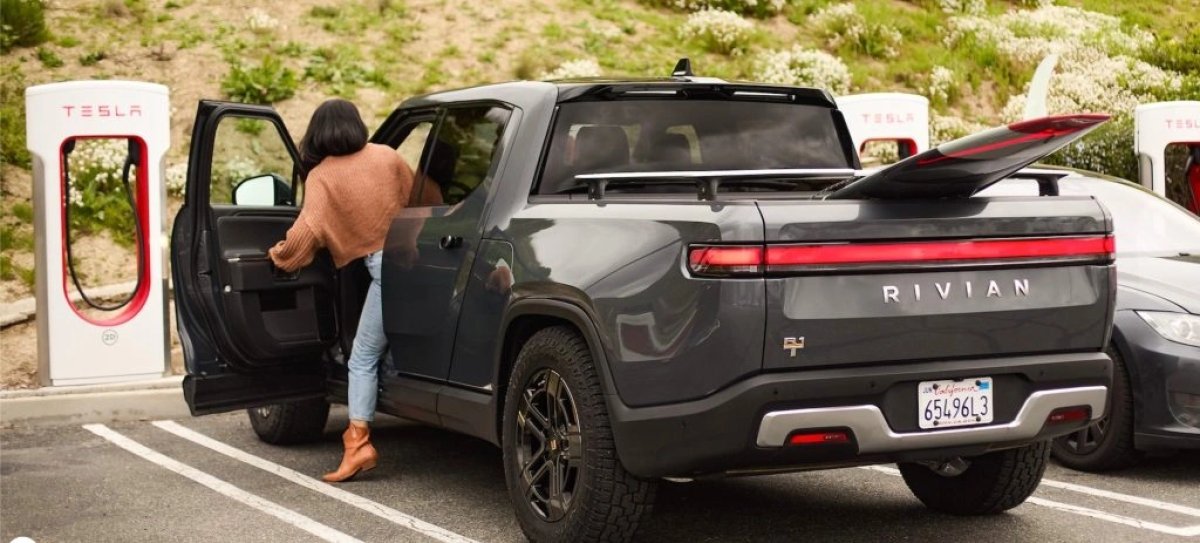

During a recent interview with Virgin Radio’s Chris Evans on The Chris Evans Breakfast Show, Rivian CEO RJ Scaringe addressed the idea of Tesla acquiring his company. Asked whether he would sell if Elon Musk made a massive buyout offer, Scaringe smiled and said, “I’d prefer not.”
The exchange was highlighted in a clip shared by Virgin Radio UK on X. Scaringe said he sees the brand as having “a tremendous amount of upside from where we are today” and that it would be “a shame to have the company be sold” before the work since its 2009 incorporation can fully bear fruit.
Rivian founder RJ Scaringe would prefer if Elon Musk did NOT try to buy his company 🚙💰❌
— Virgin Radio UK (@VirginRadioUK) June 18, 2026
Download the Virgin Radio UK app ⬇️ https://t.co/nBoiFJobuf @Rivian @RJScaringe pic.twitter.com/9Mc2qMuszV
Talk of consolidation in the electric vehicle sector surfaces frequently. With Tesla valued at $1.23 trillion—more than 50 times Rivian’s $23.85 billion—Elon Musk’s personal wealth, boosted as he recently became the world’s first trillionaire after SpaceX’s blockbuster IPO rocketed his net worth, could allow a bid few corporate boards would ignore. Still, Rivian’s leadership doesn’t appear to be waiting for that call.
Surviving Musk’s Dire Predictions
Scaringe’s preference to remain independent follows Rivian outlasting some bleak forecasts. In 2024, Musk publicly questioned Rivian’s finances on X, saying their path would leave them bankrupt in about six quarters. It has now been 10 quarters since that prediction, and Rivian is not only operating but also working to transition from a niche adventure EV brand to a mass-market player.
Current trajectory has them bankrupt in ~6 quarters. Maybe that trajectory will change, but so far it hasn’t. pic.twitter.com/tNNijQ3KwT
— Elon Musk (@elonmusk) February 22, 2024
Since then, Rivian has posted some notable results. In 2025, Tesla delivered 20,237 Cybertrucks, while Rivian delivered 42,247 R1T and R1S vehicles combined. Even under a conservative 50-50 split between the truck and SUV, that’s just over 21,000 R1Ts—meaning Rivian outsold Tesla in the electric pickup segment last year.
Competing Against the Model Y
The competitive landscape is shifting. Rivian is aiming at the core EV market with its new midsize SUV, taking on Tesla’s Model Y. R2 customer deliveries officially began last month, and the company beat its internal guidance for the quarter. To keep momentum, Rivian has revealed R2 order windows for all reservation holders so those on the waitlist can start configuring orders as production ramps.


The R2 launched with a top-of-the-line Performance Launch Package, but the real test will come when lower-priced versions, including a $45,000 Standard variant, enter production. Challenging the best-selling vehicle in the world across all powertrains will be formidable. For perspective, Tesla far exceeded Q2 2026 delivery estimates with 480,126 vehicles delivered globally, while Rivian delivered 12,194 vehicles in the same three-month period.
Given today’s scale, there’s little incentive for Musk to absorb a rival unless uniquely valuable technology or standout talent emerges. A tie-up is viewed as likelier closer to home: a Tesla-SpaceX (or SpaceX-Tesla, considering SpaceX’s $2.134 trillion market cap) merger has long been rumored, and the companies have evolved from occasional collaboration and synergies to operating with a clear path to convergence. For now, Scaringe appears free to continue charting his own course.


Partager:
Tesla China Sales Hit New 2026 High With 25% Surge in June
Tesla Launches USB-Powered Model 3 Air Mattress for Camping