
Cybercab Teardown: Modular 4680 Pack, New Inverter, 500,000 Miles
Munro Live published a full deep dive into the Tesla Cybercab, featuring a vehicle teardown and a tour of the Cybercab production line at Giga Texas. The walkthrough was led by VP of Vehicle Engineering Lars Moravy, Cybercab lead Eric Earley, and members of the engineering team.
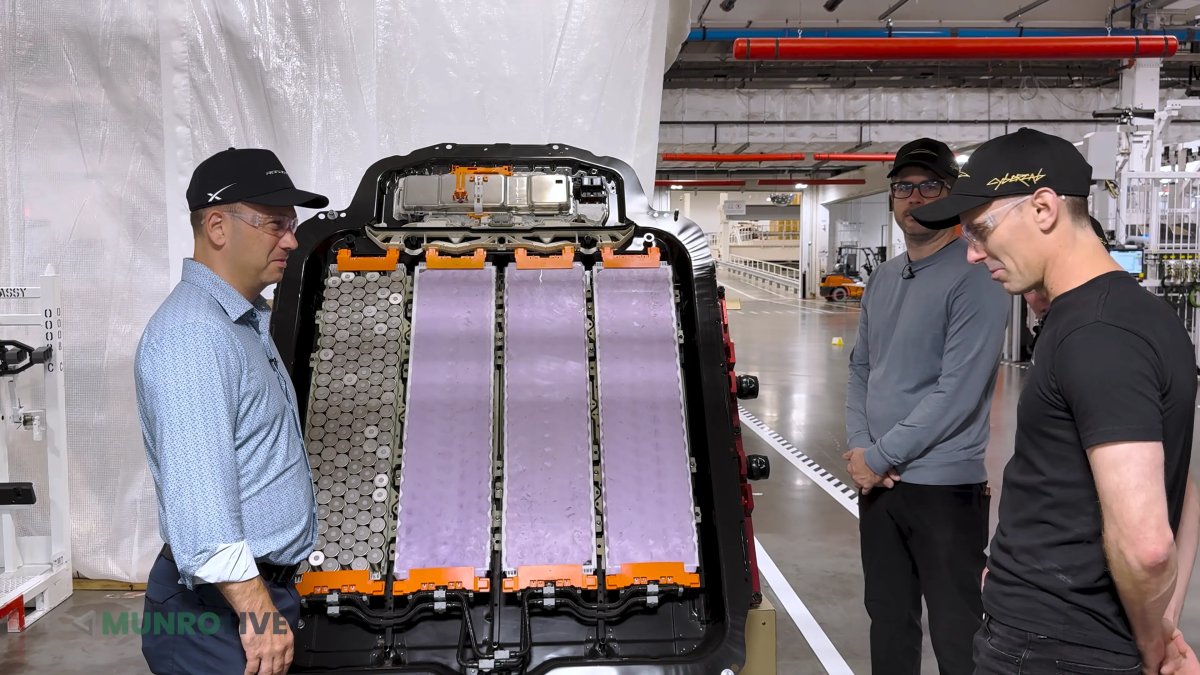
Repairable Battery Pack With Modular 4680 Design
The Cybercab continues to use Tesla’s 4680 cells, but instead of a single potted structural block like the Model Y, the pack is divided into individual potted modules. If a module fails, it can be replaced without swapping the entire pack.
Tesla’s battery director said, “I’m going to give our Model Y structural battery a grade D,” describing it as a strong customer product that is difficult and costly to manufacture. He graded the Cybertruck pack a B-minus and the Cybercab pack an A-minus. Although a fully structural pack can fit about 10% more cells, the service burden made it unsuitable for a commercial robotaxi operating 24/7. As Earley put it, “replacing an entire pack before half a million miles is a killer on cost.”
- The pack enclosure is steel, which is heavier but costs about $1.90 per kilogram versus $5 to $8 for alternatives.
- There is added space around and beneath the modules, both because fewer cells were needed than expected and to allow room for lower-cost LFP cells later.
- Battery management boards communicate wirelessly, eliminating a wiring harness.
- The pyro fuse has been removed; Tesla filed a patent for the new approach. New contactors can cut power quickly under load, and many pyro fuse trips stem from “low-speed crashes where the HV system is actually healthy,” which would otherwise trigger a pack replacement.
- Electronics for the battery are serviced from underneath, based on data showing the cells are more reliable than surrounding electronics.

Drive Unit And Inverter Updates
The Cybercab is front-wheel drive and features a new drive unit with an 11:1 gear ratio, up from roughly 9:1 in most Teslas, reflecting its lack of a high top-speed requirement. The new inverter has fewer parts than the current design, and every component has at least two qualified suppliers.
According to Tesla’s head of drive units, Nick Verzani, the new inverter’s circuit board and power stage will ship from Fremont this year, and the full inverter can swap directly into a Model Y drive unit. Asked if it is actually going into the Model Y, Moravy said, “I plead the fifth.” Tesla also said the same unit goes into the Semi.
Additional changes include a new lubricant that will cut gear losses by 7% later this year, a lower-cost mechanical oil pump, and top-access servicing for the inverter so the car does not need to be lifted and the drive unit does not need to be removed.

Body, Materials, And Finish For Longevity
The Cybercab skips a traditional paint shop. Moravy said a paint line costs a few hundred million dollars and around a million man-hours to build. Tesla is not e-coating the front and rear modules because the aluminum alloys used in those castings do not weaken over time like other aluminum. Only the side modules, which use boron steel door rings for side-impact protection, are coated.
Instead, exterior panels receive color during reaction injection molding, and Tesla says scratches can still be repaired like standard paint. Moravy added that Tesla is at least doubling vehicle life, noting that “the car is going to run half a million miles at least.”

Unboxed Manufacturing: Key Metrics
Reflecting on previous automation efforts, Moravy said, “the problem wasn’t the automation, the problem was the design.” The Cybercab uses an unboxed process that builds and tests front, rear, side, and center modules separately before joining them, making the flow well-suited to automation.
- Final assembly consists of 25 fully automated stations, versus roughly 5–10 times that on a Model Y line.
- The Cybercab line is about 78% automated, with work continuing toward 100%.
- Unboxed manufacturing requires about 50% less floor space per vehicle.
- The front module, which contains about half the vehicle’s parts, sits on a pallet while the body is lowered onto it.
- It is Tesla’s first brake-by-wire vehicle, enabling separate front and rear brake tests.
- Wheels are installed at the second-to-last station by a robot named Hulk Hogan, so the car first touches the ground as it exits the line.
The line is currently fast enough to outpace Robotaxi deployments, so it does not run every day.

Gull-Wing Doors And Thermal System Details
On the gull-wing doors, Tesla acknowledged that “the fundamental reason was ‘cause it’s cool.” Practical benefits include a seat height that matches a standard wheelchair, more room to swing feet out thanks to the upward opening, and some rain protection.

The thermal system shifts complexity to the coolant side, keeps the refrigerant loop sealed, and mounts the AC compressor directly to the Supermanifold. This layout improves serviceability and makes robotic assembly easier.
Watch Munro Live’s full teardown and production walkthrough:
What’s Next
There are more than 300 Cybercabs operating in Austin, with Dallas rides expected to launch this month. Tesla is also aiming to deliver the first Cybercabs to customers before the end of the year.
With the production line already ahead of deployments and the new inverter set to ship from Fremont this year, some of the Cybercab’s engineering could show up in Tesla’s other vehicles soon.


Partager:
RDW Approves 10% Speed Offset Cap and Tesla Assisted Driving Name
Tesla 2026 Shareholder Meeting: Three Proposals, Vote by December 2