
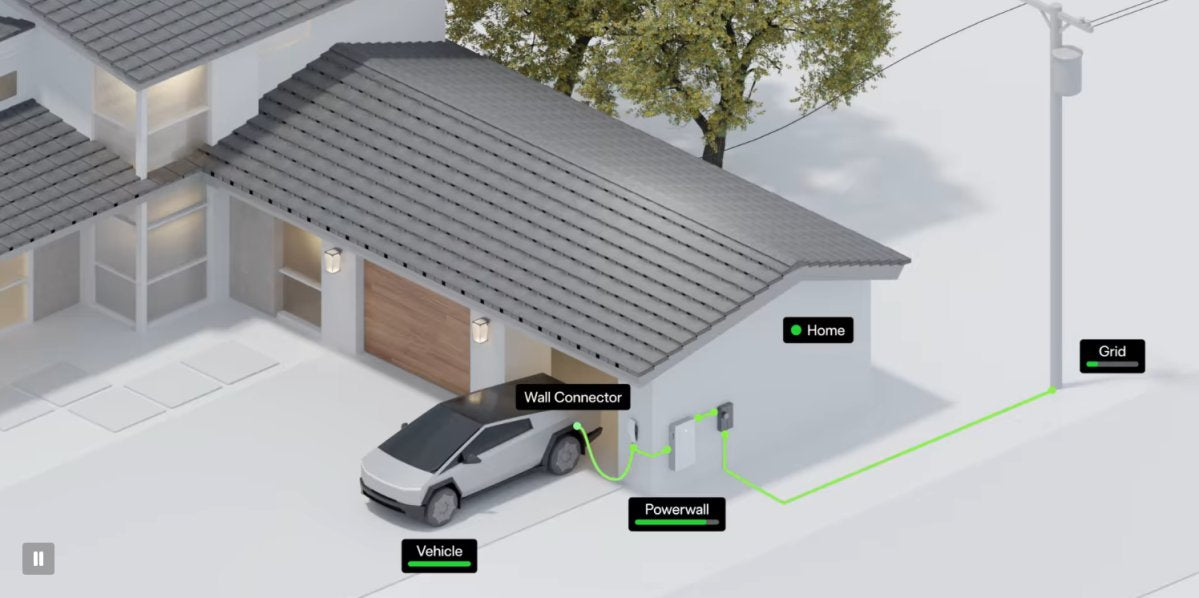
Vehicle-to-home (V2H) capability is now available for Tesla’s residential Powerwall batteries, allowing owners to draw energy from their vehicle pack to keep household appliances running during grid outages. The feature arrives with software update 2026.27.10, which adds native Powershare communication between Cybertruck and Powerwall.
How Powershare and Powerwall Work Together
Once enabled on the center touchscreen, the integration operates automatically. You can turn on Powershare by navigating to Charging > Powershare in the vehicle’s settings.
When active, a plugged-in Cybertruck will automatically share its battery with Powerwall during an outage. This significantly extends whole-home backup for users in Tesla’s energy ecosystem. For Powershare to function, the vehicle must be parked and have more charge than the set discharge limit.

Powershare first launched on Cybertruck, turning its large battery into a mobile energy reservoir. Tesla has since expanded bidirectional charging to select Model Y trims with a dedicated Powershare adapter, but Powerwall integration encountered challenges.
Initially, Cybertruck owners needed a dedicated Powershare Gateway to enable vehicle-to-home backup, and that setup was incompatible with homes already equipped with a Powerwall. Unifying the two systems was targeted for late 2025, but engineering teams had to resolve software conflicts and navigate local utility regulatory requirements before delivering the integration.
Hardware Requirements and Expanded Compatibility
With update 2026.27.10, Powerwall 3 owners can plug in a Cybertruck to supply energy directly to the home electrical panel. The update also allows recharging Powerwall from the Cybertruck battery.

The software unification reduces hardware complexity. Existing Powerwall installations already use the Powerwall gateway for grid isolation during blackouts. Because that unit contains the transfer switch, a separate Powershare Gateway is not required — saving thousands on hardware and labor.
To use Powershare with Powerwall, you’ll need either a compatible Tesla Universal Wall Connector or a Wall Connector 3. The functionality is currently limited to Powerwall 3 setups, with support expanding to Powerwall 2+ “later this year.”
Update 2026.27.10 also includes FSD v14.3.10, and its release notes remain unchanged from previous FSD builds.






Share:
Tesla Reopens Roadster Reservations Ahead of Public Reveal
Tesla Closes Texas Airspace for Roadster Launch Event