
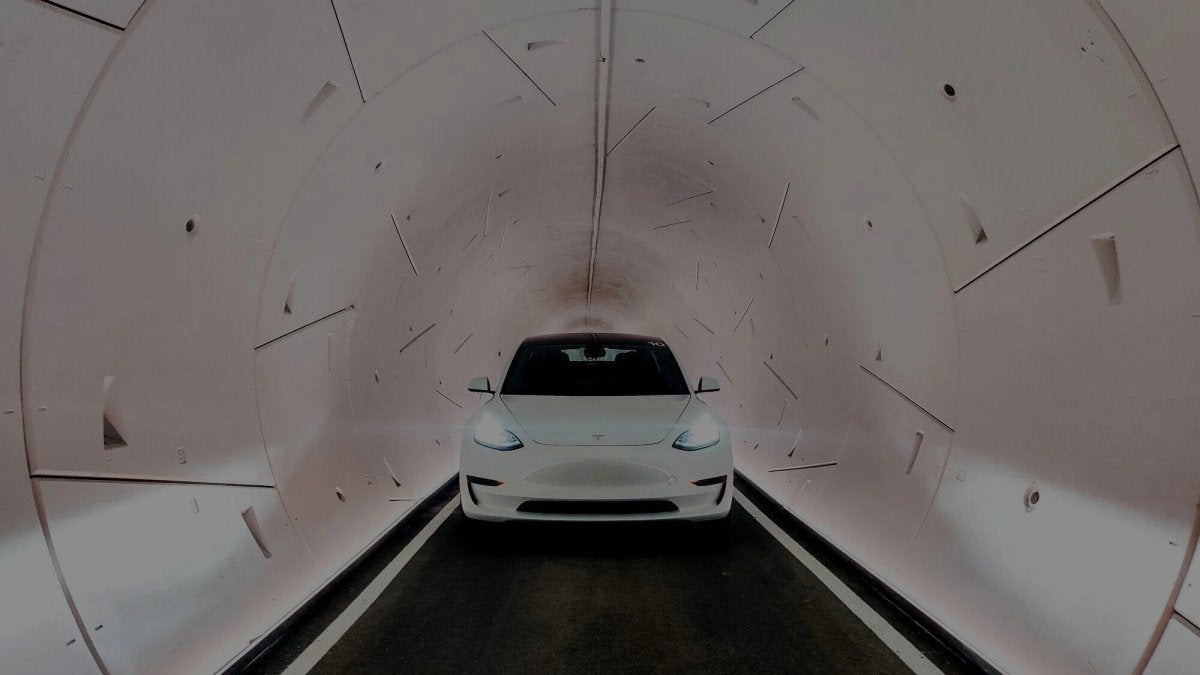

The Boring Company is aiming to extend its underground transportation vision beyond the Las Vegas Strip. After a nationwide search for new sites, Elon Musk’s tunneling firm named the winners of its "Tunnel Vision Challenge," identifying three major U.S. cities that could host high-tech transit loops.
According to a recent update from The Boring Company (@boringcompany), the selected proposals are the NOLA Loop in New Orleans, the Ravens Loop in Baltimore, and the University Hills Loop in Dallas. These were chosen from submissions opened in January, and the company added, "If all 3 projects are feasible, will fund/build all 3 — this would be awesome," as it stated on X.
Expanding the Underground Network
Before construction can begin, the company will fund a due diligence program that includes meetings with elected officials, geotechnical borings, and reviews of existing subsurface infrastructure. Beyond the three passenger loops, it is also evaluating a utility tunnel in Hendersonville, Tennessee, and a specialized tunnel for Morgan's Wonderland in San Antonio, Texas.
These efforts add to a growing pipeline. While the Vegas Loop is currently the only fully operational system — having transported over two million people since 2021 — the firm is broadening its reach. It has been tapped for an underground system at Universal's theme parks in Orlando, unveiled plans for a “Music City Loop” in Nashville, Tennessee, last summer, and recently confirmed that its first international Loop in Dubai will begin construction soon.
The Role of Tesla and FSD
Tesla provides the backbone for each project. Rather than subway cars, the loops exclusively use Tesla vehicles to carry passengers through narrow tunnels, enabling a more point-to-point experience instead of stopping at every station.
The company has begun integrating Tesla's Full Self-Driving (FSD) system into tunnel operations. Drivers are still present, but the objective is to reach fully unsupervised autonomy. Because the tunnel setting is a "closed loop" with no pedestrians, cross-traffic, or unpredictable weather, it offers a controlled environment to advance FSD. As Tesla moves toward the mass production of its Cybercab next month, these tunnels could become a prominent showcase of how driverless operations work.
A Forward-Looking Transit Solution
By self-funding these projects, the company aims to sidestep common bureaucratic delays in public transit. If feasibility studies in New Orleans, Baltimore, and Dallas are favorable, construction could start much sooner than a traditional light rail project.
If the new loops mirror the success of the Vegas network, "tunnel vision" could quickly become a standard way to avoid gridlock in major U.S. cities.


Share:
Tesla Sets Model S/X Order Deadline in South Korea As End of Production Nears
Tesla Semi Is Finally Ready for Mass Production — Here’s What’s Changed