
What to Expect from Tesla's FSD V14 Lite This Month
June is expected to bring a major update for HW3 Tesla owners. Over recent earnings calls and other company events, Elon Musk, Ashok Elluswamy, and additional executives have said that FSD v14 lite is planned to roll out to legacy HW3 vehicles this month.
Owners with HW3 have been on FSD v12 since mid-2024, with HW3 cars currently running FSD v12.6. Significant improvements arrived with FSD v13 and v14, but those enhancements have not been available on v12.6.
FSD v14 lite is set to deliver more than smoother driving and improved choices. It is also expected to add the ability to reverse, shift gears automatically, and park at the destination.
Below is a summary of what has changed since FSD v12.6 and what is anticipated to be included in FSD v14 lite.
FSD v13 Features
FSD v13 marked a substantial step beyond v12. It introduced point-to-point driving features such as “Start from Park” and “Autopark at Destination.”
With these capabilities, a driver can press the large Start Self-Driving button, supervise, and the vehicle will navigate to the destination, then seek out and complete a parking maneuver.
V13 also added the ability for FSD to reverse and to switch between drive and reverse automatically. This enabled backing out of parking spaces or garages and creating room to exit a parallel parking spot without driver-initiated gear changes.
These features are expected to be part of FSD v14 lite.
Full-Resolution Video and Bigger Models
Another pair of key additions in v13 were full-resolution video support for higher-resolution AI4 cameras and larger neural network models.
Although HW3 vehicles will not gain higher-resolution video without future camera improvements, they are expected to receive quantized and refined versions of the faster, smarter, and smoother models that make FSD v13 and v14 feel safer and more human-like.
FSD v14 Features
FSD v14 advanced autonomy with full end-to-end logic across the entire driving stack, including low-speed maneuvers in parking lots, garages, and other tight areas.
It also delivered major upgrades in high-speed, reactive decision-making, enabling current obstacle-avoidance behavior and briefly introduced pothole-avoidance behavior that is expected to return.
Speed Modes
Version 14 also overhauled speed handling. The driver-set maximum speed was removed and replaced by speed profiles.
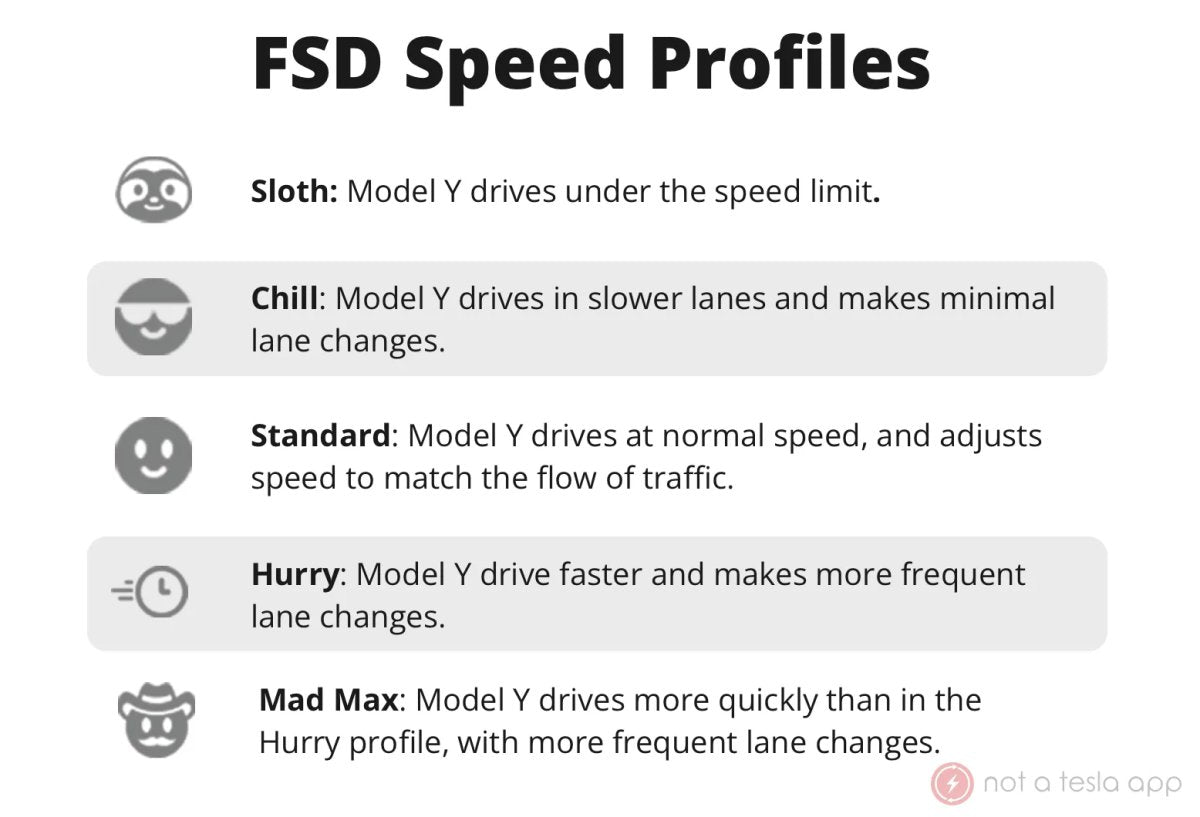
Tesla introduced profiles ranging from Sloth, Chill, Standard, Hurry, and the infamous Mad Max:
Sloth: Model Y drives under the speed limit.
Chill: Model Y drives in slower lanes and makes minimal lane changes.
Standard: Model Y drives at normal speed and adjusts speed to match the flow of traffic.
Hurry: Model Y drives faster and makes more frequent lane changes.
Mad Max: Model Y drives more quickly than in the Hurry profile, with more frequent lane changes.

FSD App, Streaks, and More
FSD v14.3 has been rolling out broadly to customers with AI4 vehicles. It adds a new Self-Driving app and FSD streaks for distance and daily use. The update also brings numerous improvements to Actually Smart Summon by moving it from the older v12 stack to a more modern, faster, and more responsive v14 stack.
Tesla has stated that FSD v14 lite will include the full set of v14 features. That statement preceded the introduction of the Self-Driving app and streaks; these are expected to be included as well, but they have not been explicitly confirmed.
Lane Selection & Highway Dynamics
Notable changes include better highway speed handling, improved follow distance, and refined highway dynamics.
On FSD v13—and especially on v14—the neural networks react faster to surrounding events, which improves the experience. The system can shy away from vehicles encroaching on the lane and dodge debris at highway speeds.
Lane selection has also been upgraded so the vehicle generally avoids lingering in the left lane and prepares for exits earlier, resulting in smoother driving.
Emergency Vehicle Handling & Relaxed Monitoring
Enhancements in handling emergency vehicles, school buses, and speed zones arrived in v13, including the capability to use in-vehicle speakers to listen for approaching sirens.
V14 improved emergency vehicle responses further and introduced relaxed driver monitoring and additional safety features.
FSD v14 Lite Features
FSD v14 lite is expected to include support for Start FSD from Park, automatic parking at destination, emergency vehicle handling, reversing, automatic shifting between drive and reverse, and more. However, some limitations are likely due to the smaller AI model used on these vehicles.
Tesla has said that unsupervised FSD will not be achievable on HW3 vehicles and that a compute and camera upgrade is planned.
The smaller model may influence reaction time, smoothness, or decision-making. The final level of parity with the full v14 experience will become clear when v14 lite ships this month.
| Feature | FSD v12.6 | FSD v14 |
|---|---|---|
| Speed Profiles | Limited | Yes |
| Start FSD from Park | No | Yes |
| Pull Over for Emergency Vehicles | No | Yes |
| Relaxed Monitoring | No | Yes |
| Improved Smoothness | No | Yes |
| Self-Driving App | No | Yes |
| FSD Streaks | No | Yes |
| Reverse | No | Yes |
| Shift Automatically Between Drive/Reverse | No | Yes |
| Park at Destination | No | Yes |
| Arrival Options | No | Yes |
FSD v14 Internationally
FSD v14 lite is planned to expand internationally, representing a major update for legacy HW3 vehicles worldwide. The release is especially significant outside North America, where approved regions have largely limited FSD to HW4 vehicles. With v14 lite, Tesla is expected to offer FSD to HW3 vehicles in at least some markets.
FSD V15
The next release will be FSD v15, which Tesla says will run on HW4. It is unlikely to arrive on HW3. FSD v15 will introduce the 10x parameter upgrade.
It is expected to be released at the end of 2026 at the earliest, with a likely slip into 2027. Tesla has said it will wait for FSD v15 before launching Robotaxi at scale.
Release Date for FSD V14 Lite
The North American rollout for FSD v14 lite is slated for late June. Tesla noted that it cannot provide firm dates for international expansion at this time.
Following future rollout of FSD V14 Lite for HW3 vehicles in the US, we plan on expanding V14 Lite to additional international markets.
— Tesla (@Tesla) April 29, 2026
This update ensures that HW3 vehicle owners will continue to benefit from ongoing software updates.
Since international rollout is subject to…
International adaptation is complex. During earlier expansions, the system had to be trained per region to account for local road markings, unique traffic signs, and regional driving behaviors. Because HW3 and HW4 use different cameras, models will need retraining for HW3.
Regulatory approval can also be a challenge. Where HW4 FSD is already approved, the process may be simpler if regulators determine that HW3 performance is on par with HW4.


Teilen:
Tesla Expands Unsupervised Robotaxi Service Across Austin
Tesla Launches Cybertruck-Themed Glasses and Chilling Stones