
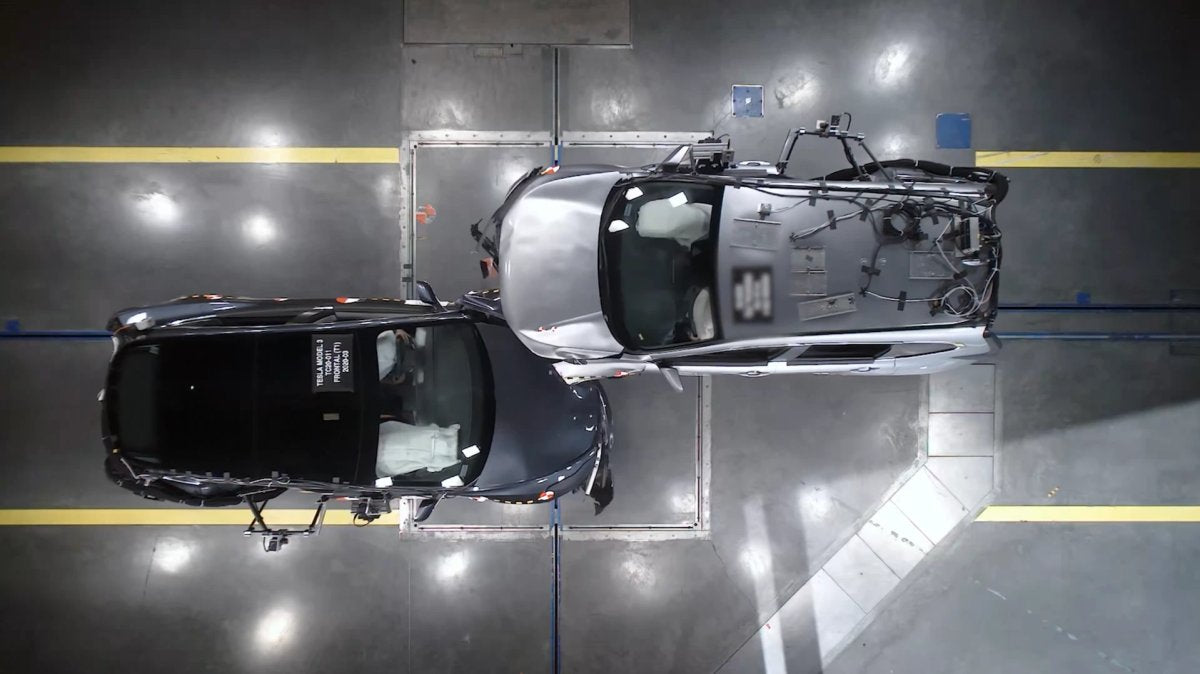
Tesla is expanding its safety toolkit with a vision-based system that can trigger airbags up to 70 milliseconds sooner than traditional designs. The company is applying a software-first strategy to enhance protection. The Model Y recently became the first vehicle to pass the NHTSA’s brand-new advanced driver assistance system tests.
The Power of 70 Milliseconds
In high-speed crashes, every millisecond is critical. Conventional vehicles depend on accelerometers mounted in the bumper and chassis to detect a collision, but those sensors must register the physical impact before commanding airbag deployment. By the time the system is certain a crash is underway, occupants may already be moving forward.

Tesla’s vision-driven approach looks ahead to anticipate an unavoidable impact. According to an X post from the official Tesla account, "Tesla Vision allows us to deploy airbags up to 70 milliseconds earlier if your Tesla detects an unavoidable collision." The added time lets the front airbags start inflating and the seat belt pretensioners tighten before an occupant moves out of position. As noted in the post, this "can be the difference between serious injury & walking away from a crash."
Real-World Data vs. Lab Tests
The capability is enabled by data from Tesla’s large fleet. Whereas traditional automakers tune safety systems primarily around a limited set of regulatory crash tests, Tesla analyzes information from millions of real-world miles. Wes Morrill, Tesla’s lead Cybertruck engineer, said the company uses a human body model in simulations to replay actual fleet crashes, highlighting a significant reduction in injury severity. He also described how physical sensors alone employ a filter to avoid unwanted deployments (such as striking a pothole). With Vision, the vehicle can see the impending collision, giving the system confidence to reduce that filter and act earlier. Morrill discussed the results in detail in an X post.

Elon Musk also commented that Tesla’s AI Vision triggers airbags before impact, which reduces the likelihood of injury or death.

Iterative Safety Through Software
The feature was delivered to a large portion of the fleet via over-the-air updates. Vision-based deployment first rolled out with software version 2025.32.3 last September and is available on 2023 and newer Model 3 and Model Y vehicles, as well as some 2022 models, and newer Model S and X units (including 2026 models).

Owners of older Teslas that do not support the full vision-based deployment also benefited from earlier improvements. In 2021, Tesla used fleet data to enhance the restraint systems in older vehicles to better detect a wider range of side-impact collisions, delivered with software version 2021.36. Tesla continues to iterate with high-resolution cameras and advanced AI, aiming to uncover additional safety margins as the fleet grows and the models improve.


Teilen:
Tesla's Last Model S/X Units Ever Hit the Production Line
Tesla Semi’s Official Battery Capacity Revealed in CARB Filing