
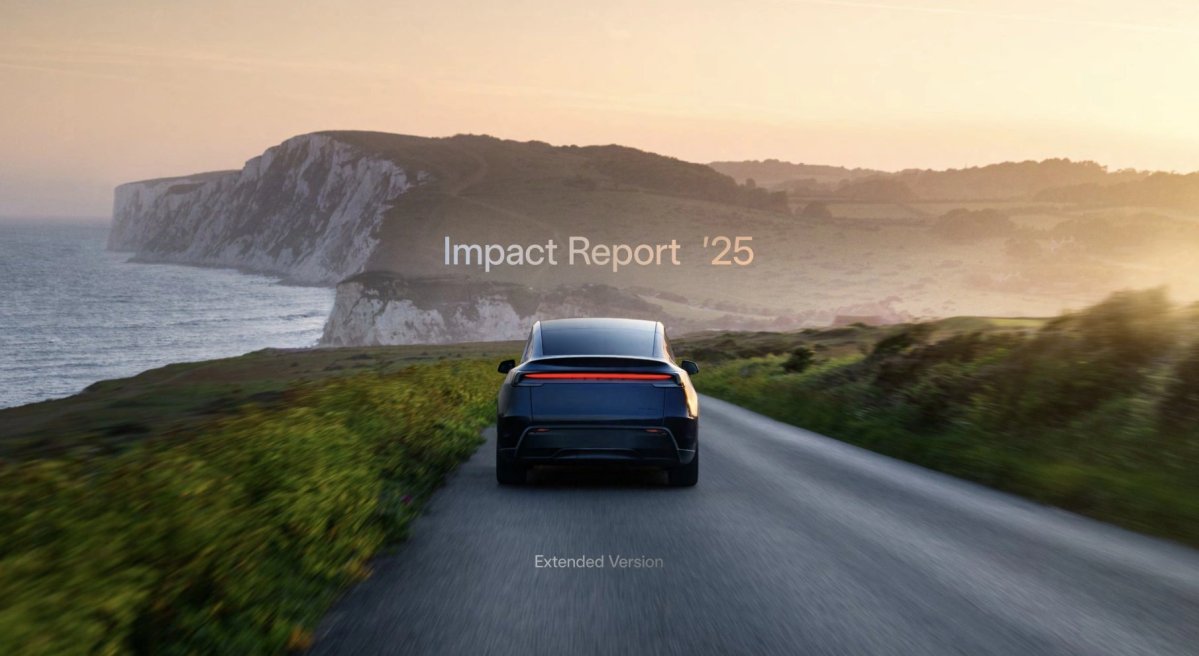

Tesla has published its comprehensive 2025 Impact Report, presenting recent progress toward its mission of “amazing abundance.” The 216-page document spans the company’s vehicles, energy products, and manufacturing footprint. A central theme is the current lineup’s reduction of environmental impact, with forthcoming autonomous Cybercab fleets expected to extend those efficiency gains.
The report states that in 2025, Tesla customers avoided nearly 37 million metric tons of CO2e. That is comparable to driving an internal combustion engine vehicle about 90 billion miles. Over a full lifespan, Tesla estimates each vehicle prevents roughly 32 tons of emissions across 17 years of use.

Clean Energy and Growing Battery Recycling Numbers
In 2025, Tesla Solar customers generated more than 2.1 times the electricity required to power all of the company’s manufacturing, support, sales, research, service, and delivery locations worldwide.

“In 2025, we recycled over 14,000 metric tons of battery material through a combination of in-house processing and through our network of recycling partners,” Tesla said in the report. That equals the material in approximately 46,000 long-range battery packs and represents a 20% increase over 2024.
Factory Efficiency Wins at Berlin and Texas
Resource efficiency advanced at major production hubs. At Gigafactory Berlin, water conservation stood out: “While Tesla is permitted to consume 1.4 million cubic meters of water per year, we only consumed a fraction of that in 2025 - about 0.3 million cubic meters, down from 0.45 million cubic meters in 2024,” the report noted. The site cut usage by launching an on-site industrial water recovery and recycling plant that can recycle up to 100% of process wastewater.

Meanwhile, Giga Texas is addressing data center energy use. “At Gigafactory Texas, we are planning to implement a waste heat recovery system in our data center,” Tesla said. “This system captures waste heat and repurposes it to provide process heating water to our vehicle coatings and paint shops, reducing the need for water from our chiller plants.”

In 2024, the company also began building a water-cooled supercomputer cluster at Giga Texas to support AI development. Additional data center optimizations include improving chiller efficiency during colder and drier months to maintain effective cooling while reducing power use.
Software-Driven Efficiency and Next-Gen Hardware
Software is a major contributor to energy savings on the road. Based on 65 million miles of driving data, Tesla FSD uses roughly 5% less energy than the average human driver to cover the same distance, reducing emissions at the power generation source.
Looking ahead, the upcoming Cybercab is expected to amplify these gains. The 2025 Impact Report highlights its record efficiency of 6.1 miles per kWh, fully autonomous operation, and 48-volt architecture.







Teilen:
New Jersey bill would require Tesla robotaxis to add sensors beyond cameras
Tesla expands in-house vehicle rentals to four more U.S. states