
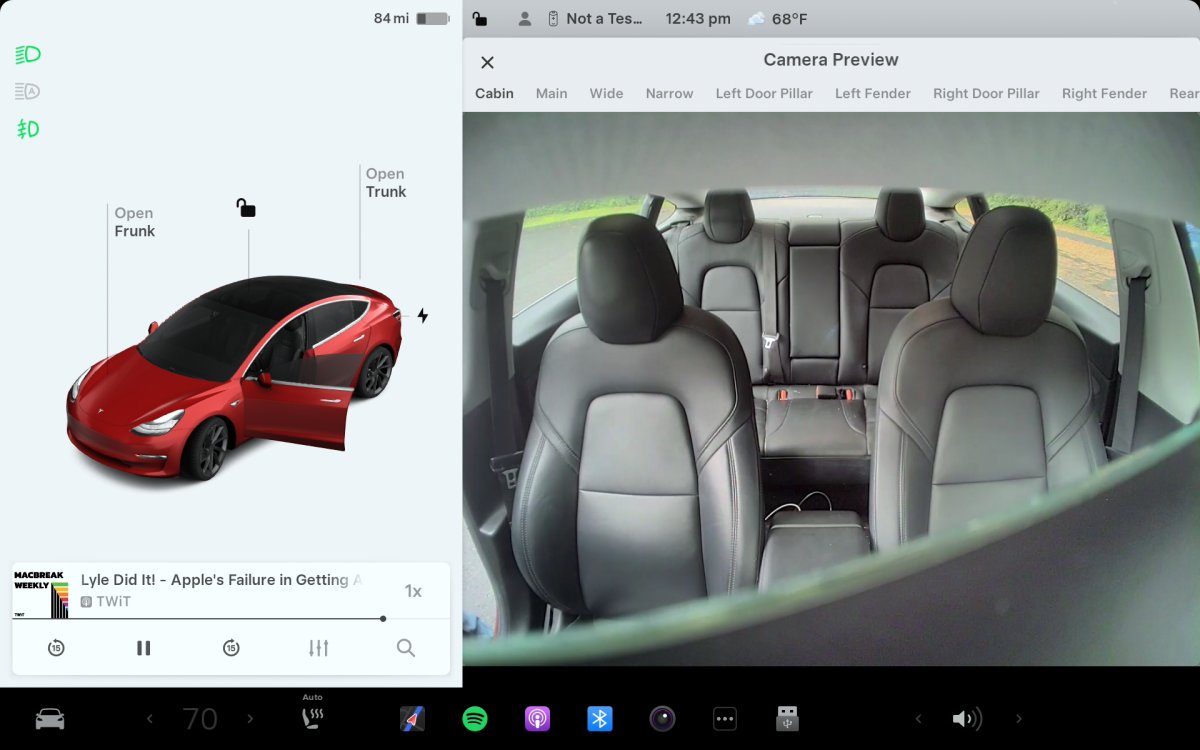

Tesla is preparing to elevate driver monitoring by confirming who is in the driver’s seat before allowing advanced autonomous capabilities. To date, the interior camera has primarily ensured you keep your eyes on the road when using Full Self-Driving (Supervised). A recent finding now suggests FSD could be placed behind a biometric check.
Strings discovered in Tesla mobile app version 4.58.5 point to a feature that uses the cabin camera to verify the driver before FSD can be enabled. The app now references fsdIdentityCheckFailedMessage and showFsdIdentityCheckFailedDialog. If the camera identifies a face that does not match an authorized driver profile stored in the vehicle, FSD would be prevented from engaging and the user would be alerted on their phone about unauthorized access.

Face ID for FSD
Tesla already uses the cabin camera for occupancy detection in place of seat sensors, and this expands on that direction. It also aligns with code noted in software update 2026.8.6 for Tesla vehicles, which indicated the company might begin using cabin cameras to assess driver age through facial analysis.
Once deployed, facial recognition could help in several scenarios: stopping teenagers or other unauthorized family members from activating FSD, verifying that a Robotaxi passenger matches the account that booked the ride, and ensuring that only the renter can enable FSD in a rental vehicle.
Potential Uses
There is no announced release date. Because the app is only part of the solution, any rollout would also require a vehicle firmware update. Further details in the app or an official release will clarify the exact advantages.
The capability could be used to block FSD use by someone borrowing your car who may not have accepted FSD’s terms or be familiar with its controls and requirements. It could also restrict underage use, and it may potentially link FSD to an owner’s account regardless of the specific vehicle.
This is not expected to replace your phone key or the standard PIN to Drive. Facial recognition with a standard RGB cabin camera is not as secure as the infrared depth-mapping hardware Apple uses for Face ID on the iPhone. Instead, it would act as an additional permission check to keep FSD access tightly controlled.


Condividi:
Tesla Smashes Q2 2026 Delivery Estimates
Tesla Vehicles Now Use Internal Mics to Detect Squeaks and Rattles at Factory