
Tesla has extended its fully driverless Robotaxi service to central and western Florida, adding Orlando and Tampa just weeks after launching in Miami.
The @robotaxi account announced on X that rides are now available in both cities. Residents can use the official Robotaxi app on Android or iOS to request an unsupervised Model Y. There is no human driver or a safety monitor in either service zone.

Breaking Down the New Service Zones
Both cities are launching with defined geofenced areas that are expected to expand over time.
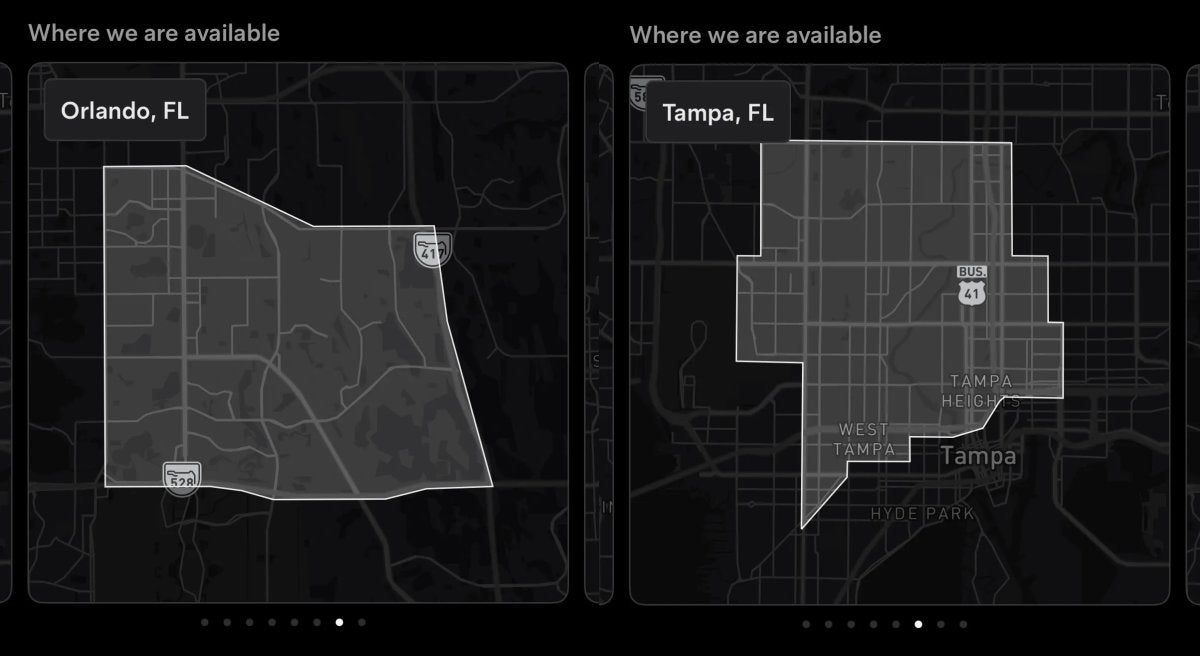
In Orlando, the unsupervised Robotaxi zone covers roughly 12 to 15 square miles across eastern and southeastern neighborhoods, including Conway and Lee Vista. The general boundaries include the Beachline Expressway (FL-528) to the south and the Central Florida GreeneWay (SR 417) to the east.
Tampa’s initial service area measures about 4 to 5 square miles. It spans central neighborhoods north of Downtown and Hyde Park, including West Tampa, Tampa Heights, and key portions of Seminole Heights along the US 41 Business corridor.

At the same time, the Bay Area Robotaxi network—operating with a safety monitor in the driver seat—now offers trips to and from San Francisco International Airport (SFO), as confirmed by @Tesla_AI on X.
The New Tesla Robotaxi Footprint
This is the second Florida launch this month, following the debut of unsupervised rides in Miami. The rapid rollout comes as Tesla marks one year of its Robotaxi service, which began as a pilot in Austin, Texas, in June 2025.
With the latest additions, the active Robotaxi network spans seven markets across three states:
- Miami: Unsupervised Model Y rides only
- Orlando: Unsupervised Model Y rides only (NEW)
- Tampa: Unsupervised Model Y rides only (NEW)
- Dallas: Unsupervised Model Y rides only
- Houston: Unsupervised Model Y rides only
- Austin: Mix of unsupervised Model Y rides and rides with safety monitors
- Bay Area: Safety monitor Model Y rides only (now serves SFO as well)

Looking ahead, the service is likely to expand to additional markets in the coming weeks and months. Potential launches include Nevada, where permits have been filed for 5,000 ride-hailing vehicles, New Orleans, where Robotaxi vehicles were recently seen testing, and Arizona.
Tesla leadership has said large-scale expansions will wait for Full Self-Driving version 15. FSD v15, slated to roll out later this year or early next year, is the next major architectural step and is expected to feature 10x more parameters than current builds.
While Texas and Florida are allowing fully autonomous ride-hailing, a bill moving through the New Jersey legislature could effectively ban Tesla’s camera-only robotaxis unless additional sensors such as radar and LiDAR are added.
On hardware, Tesla’s Cybercab—intended to become the backbone of the network and replace retrofitted Model Y robotaxis for faster scaling—has begun public-road testing without a steering wheel, pedals, or other manual driving controls. For now, riders in Florida can take driverless Model Y trips in Orlando and Tampa.


Condividi:
Tesla Diner Celebrates Turning One With Signed Franz Merch
Tesla FSD V14 Lite for HW3 Vehicles Begins Public Rollout