
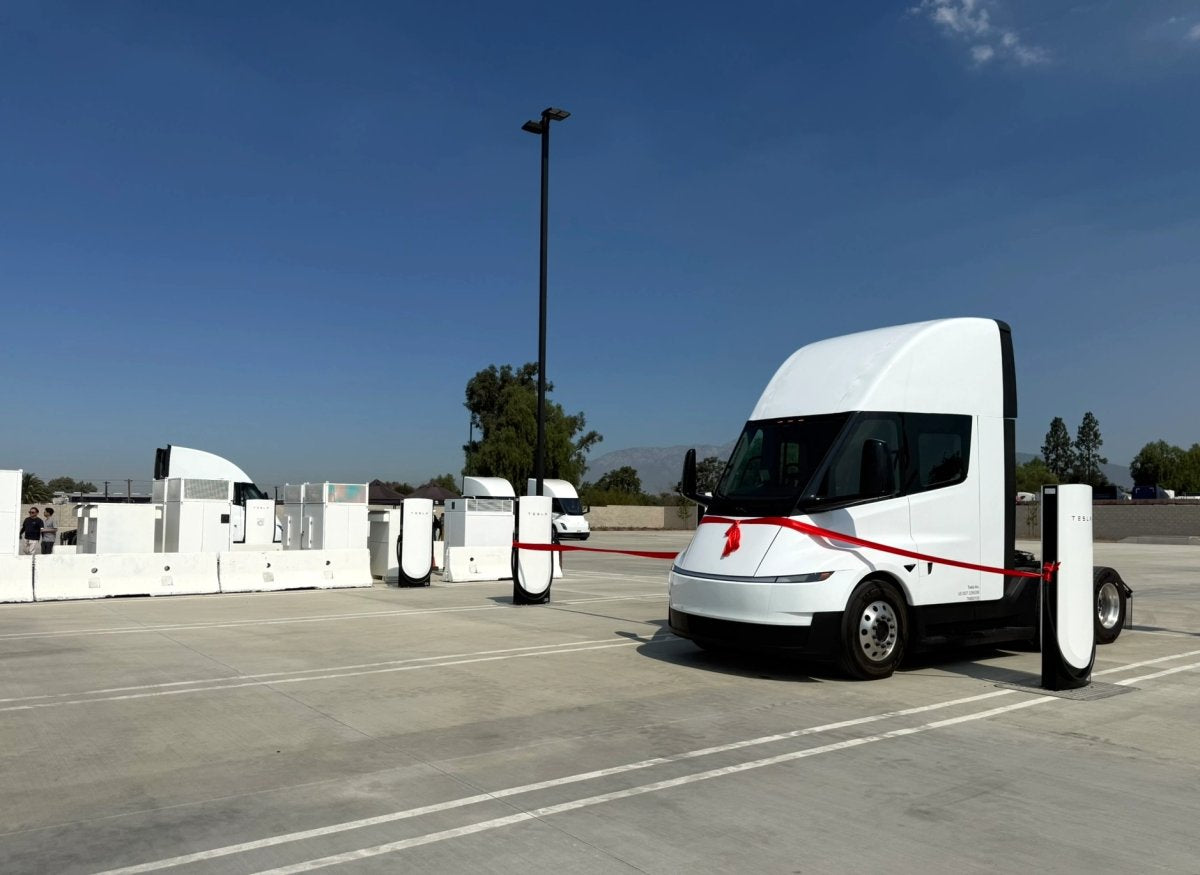

The charging network needed for Tesla’s heavy-duty electric trucks is moving into the public sphere. Until now, most early operators relied on private depot equipment to power their Tesla Semis, but a key infrastructure site has just gone live in California.
As noted on X by Sawyer Merritt (@SawyerMerritt), Tesla has opened the world’s first public Megacharger in Bloomington, California, roughly an hour east of Los Angeles. The station is located at 18434 Valley Blvd, Bloomington, CA. It has six charging stalls and is open to all Tesla Semi customers.
Taking Megawatt Charging Public
The first public Megacharger Tesla filed construction plans for was at 9300 S Hamilton Avenue in Carson, CA, but the Bloomington hub became the first to enter service. Megacharger connectors look different from Supercharger plugs used by passenger vehicles, featuring a large, square-shaped design instead of the consumer NACS plug.

The thicker hardware is designed for Tesla’s Megawatt Charging System (MCS). Each stall can deliver up to 1.2 MW (1,200 kW) of peak power to a single vehicle, enabling a Tesla Semi Long Range to recover 60% of its 500-mile range in about 30 minutes. Making this capability publicly accessible cuts downtime and helps fleets spend less time plugged in.
Building a Global Big Rig Charging Network
This opening coincides with increasing Tesla Semi production at the Nevada factory to meet a steady stream of commercial fleet orders. Customers include PepsiCo, WattEV, and Forum Mobility, which are building out cleaner freight corridors. Tesla unveiled its refreshed Semi last fall, offered in Standard (325-mile range) and Long Range (500-mile range) versions.

To support trucks as they move onto public routes, Tesla plans to produce pre-assembled Megachargers to speed deployment. The approach mirrors the Supercharger rollout, which recently reached 80,000 stalls worldwide. Plans also call for expanding the Megacharger network to Europe.



Condividi:
Tesla Had Its Own Category on 'Jeopardy!' in 2014
Tesla FSD Investigation: NTSB Confirms Driver Pressed Accelerator in House Crash