

Tesla debuted FSD v14 Lite for legacy Hardware 3 (HW3/AI3) vehicles last month, with release notes highlighting a boost in responsiveness, stating: “Improved both the proactive and reactive responsiveness across a wide variety of categories including navigation handling, merges and forks, pedestrian interactions, traffic lights, and vehicle cut-in scenarios.”
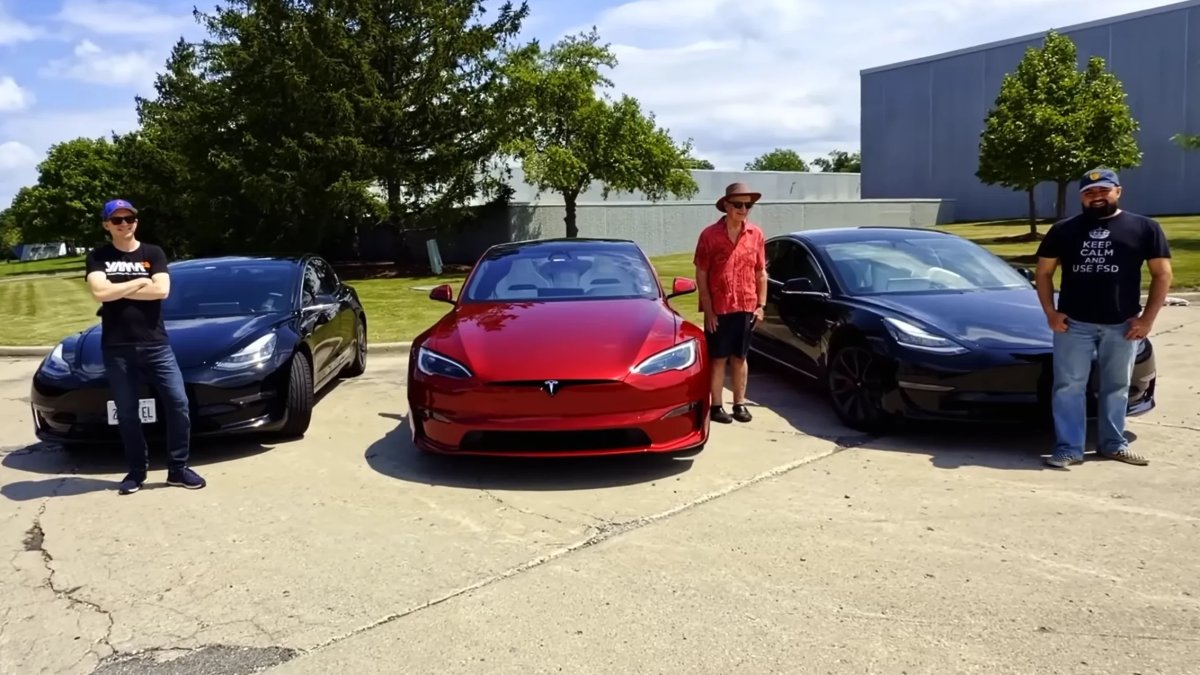
To evaluate those claims, TechGeek Tesla conducted a real-world comparison of reaction times for FSD v12.6.4 and FSD v14 Lite on HW3, as well as FSD v14.3.4 on a Hardware 4 (HW4) vehicle.
Testing Responsiveness With a Roadside Dummy
The experiment used a pulley system to pull a custom dummy into the roadway directly in front of oncoming vehicles. Each car approached under Full Self-Driving at the same speed, while telemetry software measured the precise interval between the dummy’s movement and the vehicle initiating braking or a swerve.
Multiple runs were performed per vehicle to produce consistent averages across software versions. Results are summarized below:
| FSD Version & Hardware | Average Reaction Time | Performance Difference |
|---|---|---|
| FSD v12.6.4 (HW3) | 1.065 seconds | Baseline |
| FSD v14 Lite (HW3) | 0.675 seconds | 37% faster than v12.6.4 |
| FSD v14.3.4 (HW4) | 0.450 seconds | 33% faster than v14 Lite |

FSD v14 Lite places between v12.6.4 and the main v14 branch, delivering a 37% improvement in obstacle reaction time on HW3. This is notable given that HW3 reportedly has only 15% of the memory bandwidth of HW4, per Elon Musk. The full test video is below:
A Stopgap Solution Until Hardware Upgrades Arrive
FSD v14 Lite is a distilled, compressed model derived from Tesla's primary v14 architecture. It is tailored for memory-constrained HW3 systems while bringing the same feature set seen on current-gen HW4 vehicles — including starting FSD from Park and Arrival Options for destination parking — to legacy cars. FSD v14 Lite started rolling out publicly earlier this month after Tesla released an updated build with additional improvements and new features.
Tesla previously cautioned that FSD v14 Lite could feel slower in certain areas than the main v14 branch due to the difference in compute capability between HW3 and HW4. Performance that falls between FSD v14 and FSD v12.6.4 aligns with its role as a temporary bridge until Tesla can figure out hardware upgrades to enable legacy vehicles to achieve true autonomy.
While reaction time is only one aspect of driving quality, cutting obstacle response by 37% to about 0.67 seconds establishes a smoother, safer baseline for HW3 vehicles. Despite some early issues — including an elevated risk of low-speed collisions due to FSD v14 Lite having trouble seeing objects in reverse — feedback from HW3 owners for their first FSD update in over a year has been largely positive.


Condividi:
Tesla Builds 10 Millionth EV: A Look Back at Each Milestone
Unreleased Tesla FSD V14.3.7 Found in Tesla Vehicle