
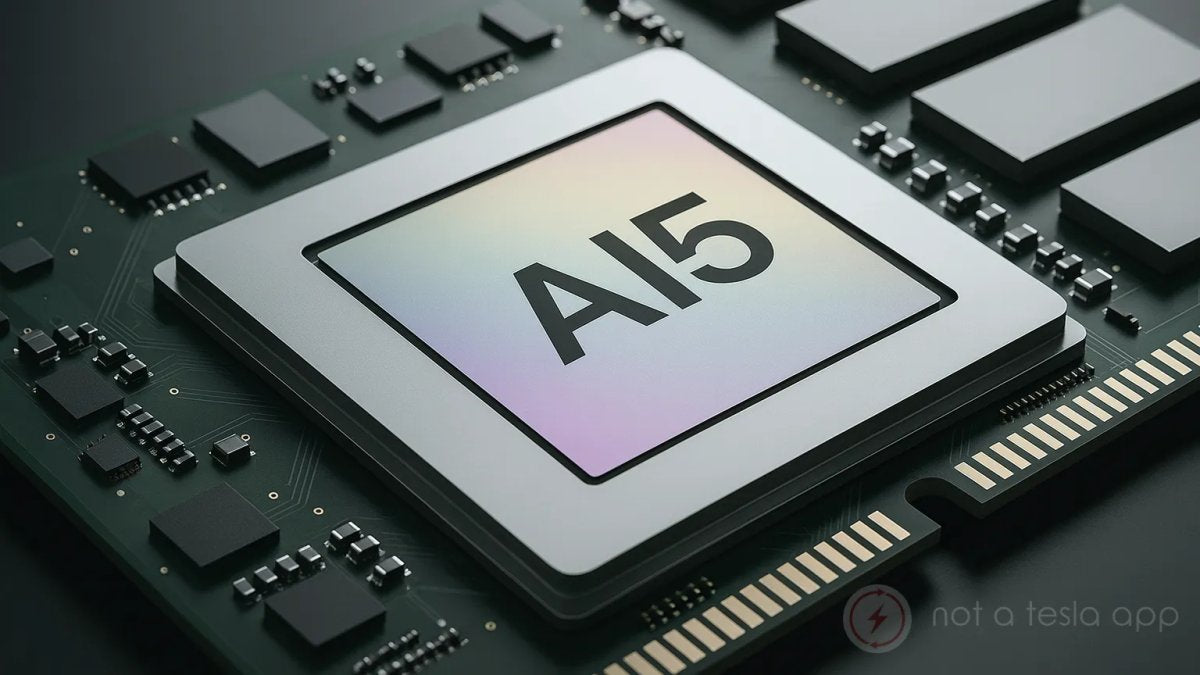

Samsung Electronics has confirmed that it will produce Tesla’s AI5 chips at a new semiconductor plant in Texas. The announcement was made by Han Jin-man, President and Head of the Foundry Business at Samsung Electronics, during a recent shareholders’ meeting.
Han stated that high-volume mass production at the Texas facility is scheduled for the second half of 2027. The arrangement is intended to provide Tesla with a localized, large-scale supply of compute hardware for upcoming vehicles and robots.
A Dual-Foundry Approach
The plan matches guidance from Tesla CEO Elon Musk, who said in November 2025 that Tesla would split manufacturing of its next-generation compute hardware between TSMC and Samsung to distribute the workload.
Slightly different versions of the Tesla AI5 chip will be made at TSMC and Samsung simply because they translate designs to physical form differently, but the goal is that our AI software works identically.
— Elon Musk (@elonmusk) November 4, 2025
We will have samples and maybe a small number of units in 2026, but high…
By securing lines at both TSMC and Samsung’s new Texas plant, Tesla aims to guard against geopolitical and logistics-related risks.
The Timeline: 2026 Samples vs 2027 High Volume
Although Samsung had previously indicated a late 2026 start, the 2027 timeline reflects that early AI5 runs will be prototype batches to finalize design, improve manufacturability, and generate samples for Tesla to begin training.
“We will have samples and maybe a small number of units in 2026, but high volume production is only possible in 2027,” Elon clarified in his November post.
Those initial 2026 batches, likely small runs from TSMC, are expected to support validation in early vehicle builds, Cybercab prototypes, and Optimus units. The large-scale output needed for millions of consumer vehicles is expected to depend on the Texas facility’s ramp in the second half of 2027, as Han indicated.
Rivaling Nvidia’s Best
The AI5 rollout is central to Tesla’s push toward generalized autonomy and its Digital Optimus infrastructure, which are driving rapidly increasing compute requirements.
AI5 is designed to compete with Nvidia’s flagship $30,000 AI processors. It is expected to be about ten times more capable than the current Hardware 4 (AI4) computer, drawing slightly more power while delivering a major upgrade in on-vehicle processing.
Tesla’s focus has been extreme specialization: AI5 is tailored to execute FSD’s specific computational workloads at very high speed, making it more effective for that purpose than general-purpose AI hardware. Nvidia has also confirmed that they’re entering the robotaxi space with a combined software and hardware offering.
AI5 will punch far above its weight, because the entire Tesla AI software stack is designed to make maximally effective use of every circuit. We co-signed our AI software and hardware.
— Elon Musk (@elonmusk) March 19, 2026
Bear in mind that AI5, while it can be used for training in data centers, is primarily…
With mass production assigned to the Texas site, Tesla is setting up the infrastructure to bring server-class supercomputer capabilities directly into its vehicles.
Cybercab First
The Cybercab is expected to be the first vehicle to ship with AI5, enabling close monitoring of the platform and supporting the Robotaxi network’s growth in Las Vegas, Dallas, and additional U.S. cities.






Condividi:
Tesla app 4.55.0 updates
Everything Announced at Tesla's Terafab Event