
Emergency Drive Away Arrives in 2026.38.3 for U.S. Superchargers

Tesla has introduced an emergency override for Supercharging situations. Historically, Tesla vehicles have prevented shifting into gear while a Supercharger cable is connected to avoid damage. That safety interlock, however, can leave drivers exposed if they need to depart immediately due to a threat or urgent hazard.
Announced on X by @TeslaCharging, Emergency Drive Away allows a vehicle to shift into Drive while still connected to a Supercharger, providing a rapid means of escape during dangerous situations.
How Emergency Drive Away Works
If confronted with an immediate risk—such as aggressive individuals at an empty site or another imminent danger—you no longer need to exit the vehicle to unplug the NACS connector.
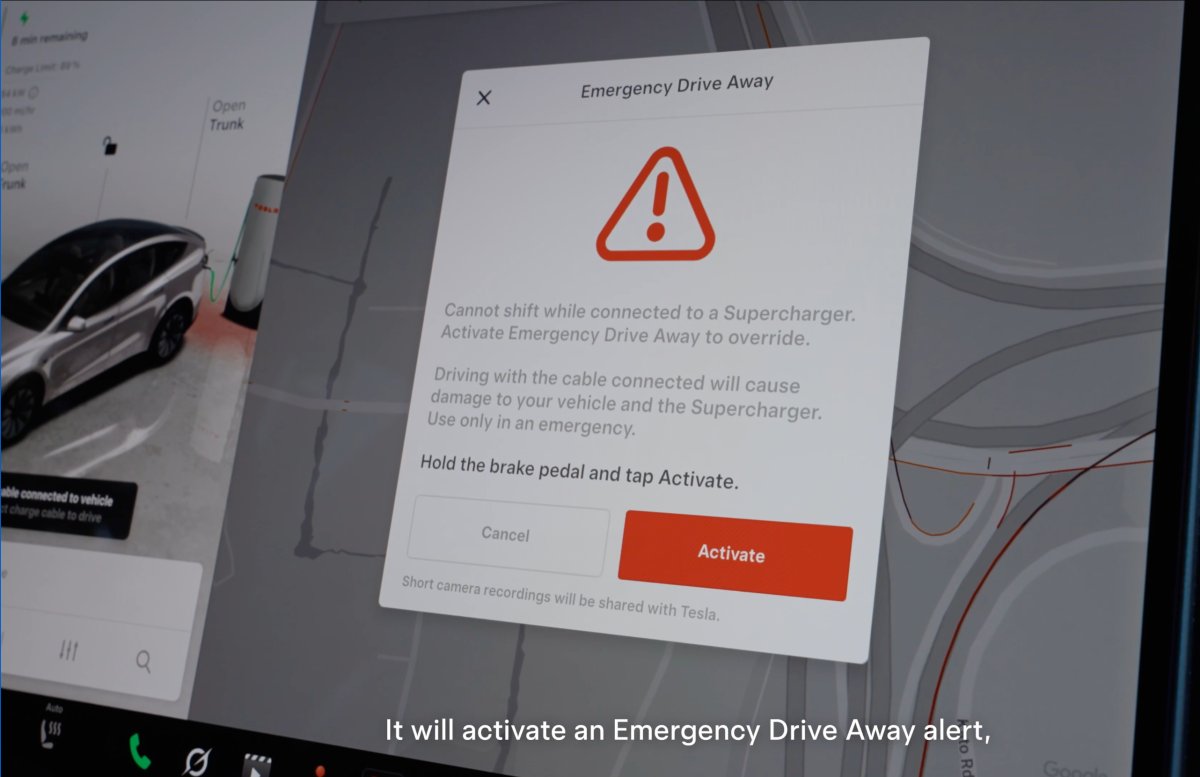
Attempting to shift into gear while plugged in brings up a red “Emergency Drive Away” prompt on the center touchscreen. Holding the brake and tapping “Activate” bypasses the interlock. As the vehicle accelerates forward, the charging handle breaks away from the charge port so you can leave immediately.
This maneuver causes damage to both the vehicle’s charge port and the Supercharger pedestal. In Tesla’s demonstration, liquid glycol coolant is seen leaking from the severed cable.
Afterward, a service appointment is required to repair the vehicle’s charge port. Tesla also confirmed that fixing the electrical and civil infrastructure at the affected Supercharger stall can cost up to $25,000. Short camera clips are automatically transmitted to Tesla to confirm emergency circumstances, and deliberate misuse will result in strict penalties.
Tesla said it plans to refine the feature quickly based on feedback. The capability provides an official, built-in alternative to third-party breakaway accessories such as the EVject Escape Connector, which Tesla previously challenged in court.
Requirements and Rollout Details
Emergency Drive Away is rolling out over the air with software update 2026.38.3. It requires no aftermarket adapters and is currently limited to Superchargers in the U.S.
On the vehicle side, all modern models are supported, while legacy Model S and Model X vehicles built before 2021 are excluded.
With the global Supercharger network now exceeding 80,000 stalls, broader availability is expected over time as regional regulations allow.






Condividi:
Tesla FSD To Add Pothole Avoidance and Smarter Navigation
Tesla Previews Halloween Mode With Spooky UI and Zombie Visuals