
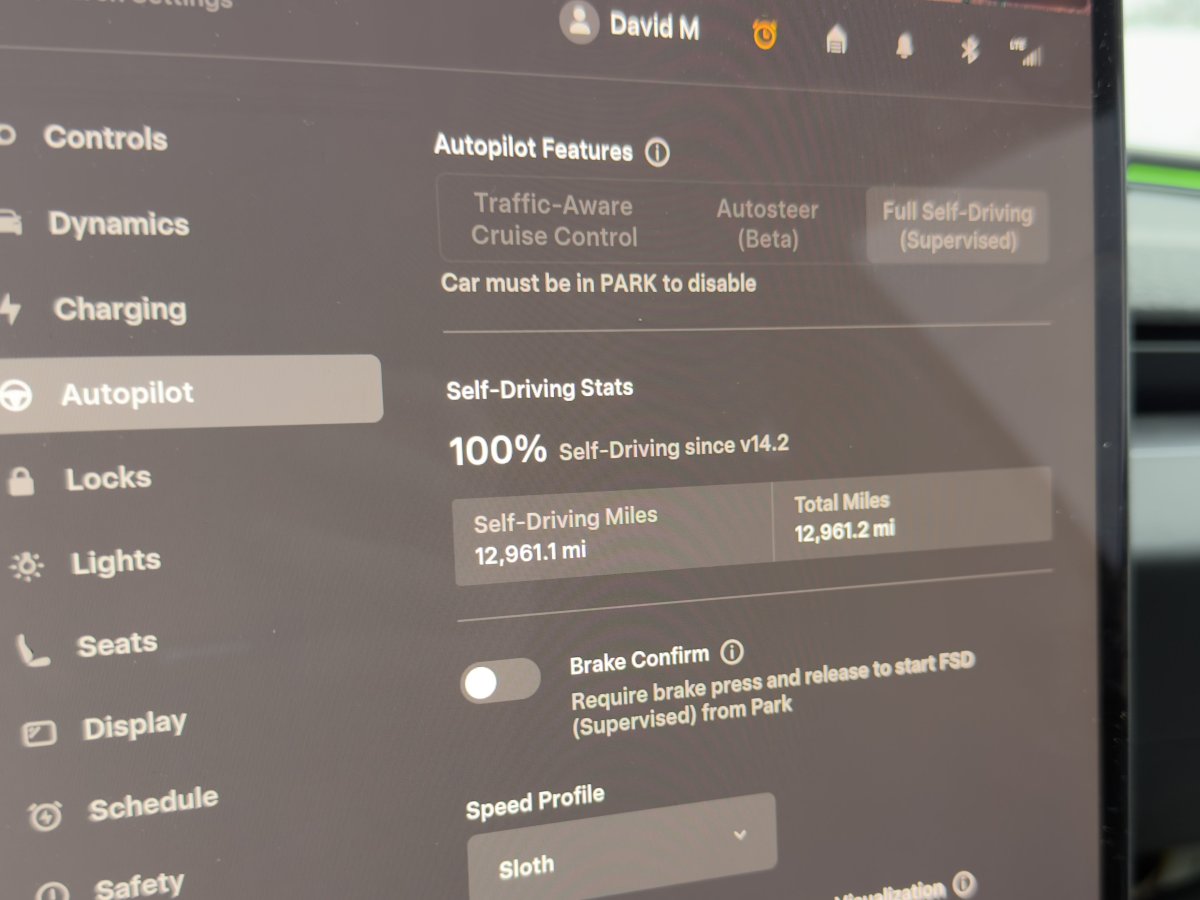

David Moss, the Tesla owner who has been pushing FSD v14.2 to its limits, announced on X that his intervention-free streak since picking up his new vehicle has finally ended.
David recorded 12,961 miles—intervention-free, coast-to-coast across the United States and beyond.
The Winter Factor
While FSD v14.2 successfully navigated complex city streets, thousands of miles of highway, roundabouts and parking lots across the United States, it met its match in a harsh environment: rural Wisconsin in January.
According to David, snow-covered roads combined with temperatures in the teens created conditions that required a human takeover. He intervened to keep the vehicle under control; there was no accident or near-miss.
Here’s more detailed look at the weather condition today in Rural Wisconsin that caused my Tesla FSD intervention free streak at 12,961 miles pic.twitter.com/pM7XXOQqMr
— David Moss (@DavidMoss) January 17, 2026
The video David posted after the disengagement shows challenging winter conditions: snow thick enough to cover lane lines, low temperatures, and likely ice or black ice beneath the surface—conditions that are difficult for both humans and autonomous systems.
Coast-to-Coast Intervention Free
Although he stopped just short of 13,000 miles, the scale of David’s achievement is significant. Over about 7.5 weeks, he traveled through 30 states without providing a single steering, braking, or acceleration input.
Notably, he became the first person to complete a coast-to-coast trip fully autonomously with zero interventions: enter a destination, press the blue Start Self-Driving button on-screen, and the Tesla handled the journey.
In ~2 years, summon should work anywhere connected by land & not blocked by borders, eg you're in LA and the car is in NY
— Elon Musk (@elonmusk) January 10, 2016
Elon Musk once predicted that a Summon feature could work coast-to-coast; David’s trip demonstrates that autonomous coast-to-coast travel is now achievable in practice.
FSD is the Future
For skeptics and supporters alike, this streak provides a tangible benchmark for what Tesla’s neural networks can do in 2026. A year ago, a 13,000-mile intervention-free run would have been unlikely. Today, it took a combination of challenging rural infrastructure and severe winter weather to end the streak.

David Moss with his car, after completing his coast-to-coast journey.
@DavidMoss
This 12,961-mile journey is strong evidence that supervised FSD is approaching maturity: it can handle cross-country travel, complex urban driving, and 30 different state road networks without failure. The remaining focus is on how the software handles extreme edge cases, such as severe winter weather, that still challenge skilled human drivers.
As Tesla’s neural networks continue to learn from these edge cases and we approach the 10-billion-mile mark, the gap between human and machine capabilities will continue to narrow.

















Partager:
What Should Tesla Launch This Year? Here's What We'd Love to See
Musk Targets 9-Month Chip Cycle for Tesla; Talks AI5, AI6 and Space-Based AI