

In a series of posts on X, Elon Musk laid out a much faster hardware roadmap for Tesla than the company has followed historically. Instead of updating full self-driving (FSD) hardware every four to five years, Tesla plans to move to roughly nine-month hardware cycles.
These hardware updates will not be limited to cars — the plan covers humanoid robots, data center equipment, and ultimately on-orbit compute platforms.
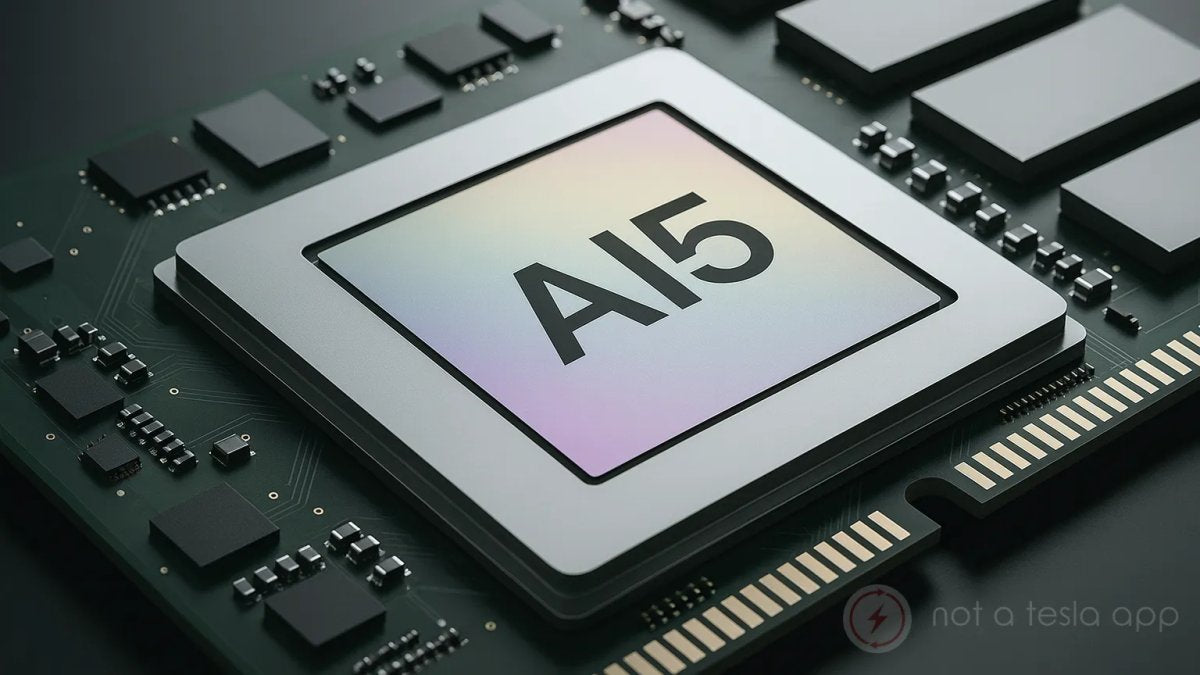
Musk said the finalized design for the next-generation chip, AI5, is nearly complete, and work on AI6 has already begun. The ambition extends further: Tesla intends to progress through AI7, AI8 and AI9 at a pace that could outstrip major chipmakers such as Intel, AMD and NVIDIA.
AI4 by itself will achieve self-driving safety levels very far above human.
— Elon Musk (@elonmusk) January 18, 2026
AI5 will make the cars almost perfect and greatly enhance Optimus.
AI6 will be for Optimus and data centers.
AI7/Dojo3 will be space-based AI compute.
Responding to questions about why so much compute is necessary, Musk outlined a generation-by-generation purpose for each chip. The current AI4 generation is focused on delivering self-driving performance well beyond human drivers.
AI5
The next-generation AI5 chip is intended to bring vehicle autonomy very close to perfection and to substantially improve Optimus’s reasoning and environmental understanding. That chip is still aimed for early 2027, roughly 12 months away.
AI6 No Longer For Vehicles
Musk now says AI6 will be devoted to Optimus and Tesla’s data centers rather than being a vehicle component. That represents a shift from earlier statements that suggested AI6 and later, more powerful hardware would be deployed in cars.
Under this approach, AI5 appears to be the last major architecture and hardware jump planned for vehicles in the near term, with subsequent capacity focused on enhancing the neural networks that power FSD and improving Optimus.
Although that may sound like a scaling-back for cars, it implies Tesla believes AI5 can achieve level‑5 autonomy across weather and road conditions.
Perhaps the most striking announcement was AI7: Musk has previously discussed low‑Earth‑orbit, space‑based AI compute, and the proposal now appears to be advancing from concept toward practical planning.
AI7 in Space
Placing AI7 compute in orbit suggests closer technical coordination between Tesla and SpaceX. As Starlink satellites gain capability and Starship enables larger payloads, hosting inference compute in orbit becomes more feasible.
Space-based inference would enable edge processing for satellite imagery, astronomical data and complex communications without the round-trip latency of sending raw data to Earth. It could also lower the cost of large-scale training or inference tasks: power is comparatively abundant in space, although cooling and thermal management for dense compute remain real engineering constraints to solve.
Moore’s Law on Steroids
For context, traditional automakers typically follow a five- to seven-year hardware cycle, while chipmakers like NVIDIA, Intel and AMD generally introduce major architectural changes every 18–24 months. A nine-month cadence for physical silicon would be unprecedented.
If Tesla achieves that speed, hardware will be less likely to constrain software advances. As FSD neural networks grow in complexity, both vehicle and Optimus compute could be updated rapidly to keep pace.
The immediate payoff of Tesla’s chip efforts is AI5, which Musk says will deliver a step change in inference performance — on the order of tens of times the capability of AI4.
The Chip Volume King
Musk concluded by predicting Tesla’s silicon will become the highest-volume AI chips globally. Rather than competing only in high-margin server racks, Tesla’s strategy is to deploy chips at scale across millions of cars and, eventually, billions of Optimus robots to build a vast distributed inference fleet.
If Tesla implements distributed inference training, devices that are idle and plugged in could contribute to model training remotely without being colocated with traditional data centers.
That vision aligns with Musk’s previously stated idea of a vertically integrated chip manufacturing effort to support massive volumes.
Seems to be the only option for super high volume
— Elon Musk (@elonmusk) January 18, 2026








Partager:
Tesla Owner Reaches Almost 13,000 Miles of Intervention-Free FSD Driving
How Your Tesla Really Knows the Speed Limit: It's Not Just Reading Signs