

Tesla has begun rolling out Full Self-Driving version 14.3.2. While minor point releases often focus on bug fixes and polish, this update introduces a major architectural shift that changes how the system’s neural networks operate.
According to the official release notes, the most significant item in the v14.3.2 changelog is that Tesla has officially "unified the model between Actually Smart Summon, FSD, and Robotaxi for more capable and reliable behavior."
This change applies to Model S/X and Model 3/Y, but excludes the Cybertruck.
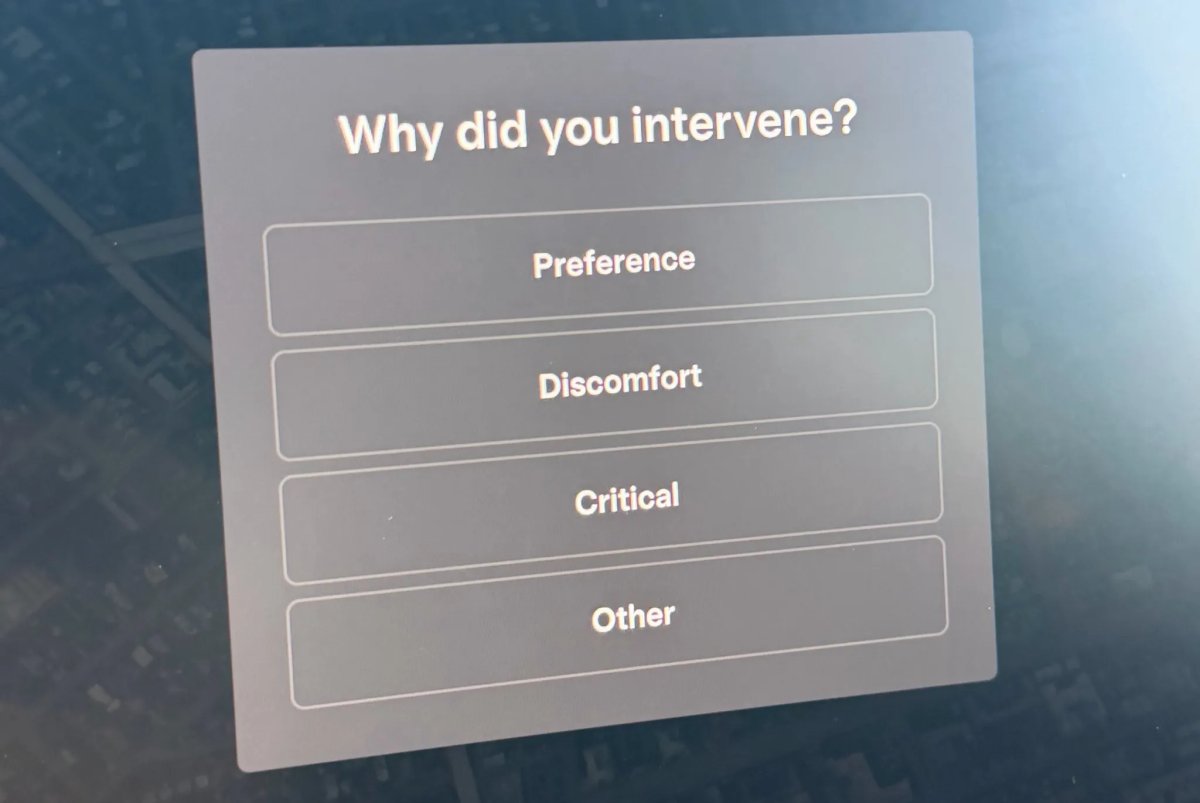
Disengagement Menu
The changelog also adds: "Help Tesla improve Self-Driving by selecting an intervention reason on the main screen after taking over."
The new prompt lets drivers choose from a predefined list of issues after an intervention or manual takeover. It serves as a faster tap-to-submit alternative to leaving a voice note at disengagement. It is likely very similar to the internal feedback tools currently used by Tesla’s QA engineering fleets when testing Supervised Robotaxis. Drivers can still leave a voice note if they’d like, in addition to selecting a reason for the disengagement.
By standardizing how reasons are reported, Tesla can categorize and feed edge-case data back into training more efficiently.
One Unified Model
Historically, various autonomous features relied on different neural network architectures or segmented models depending on the task. For example, navigating a low-speed parking lot with Actually Smart Summon (ASS) used a different context than highway driving on FSD.
With unification, those systems are now combined into a single end-to-end neural network. The same foundational AI operating the unsupervised Robotaxi fleets in Dallas and Houston now also handles daily commutes and parking-lot maneuvers.
This especially benefits Actually Smart Summon, which previously used an older model. Early access users report substantial improvements, with better handling of complex situations and much quicker activation.
One of the biggest improvements with Actually Smart Summon is the connection/responsiveness from the phone to the car.
— Dirty Tesla (@DirtyTesLa) April 23, 2026
The car immediately responds to your button press, even right after stopping the last session, which it would have a big delay on in the past. pic.twitter.com/E7HyfYEucd
Uses Robotaxi Model
This consolidation brings multiple advantages for both drivers and Tesla’s engineering team.
With a single model, vehicles don’t need to switch when moving from a parking lot (Summon) to a public road (FSD).
Driving behavior should feel more fluid and consistent from the moment the car is called until it parks at the destination. FSD and ASS will also be ready faster, since the vehicle no longer needs to load and unload different models for similar tasks.
Here’s how quickly Actually Smart Summon starts/reacts on FSD v14.3.2. It’s instant the moment you press start on your phone.
— Zack (@BLKMDL3) April 23, 2026
Huge improvement @Tesla_AI! pic.twitter.com/YformXfYWl
Because all three systems share the same underlying architecture, training data becomes universally applicable. A complex edge case solved by an unsupervised Robotaxi in Texas can instantly improve Actually Smart Summon for a customer in New York.
For the Autopilot engineering team, maintaining one model reduces software complexity. Instead of patching and updating multiple models, the team can focus compute and engineering resources on a single system, accelerating the overall pace of future V14 and V15 updates.
As iteration on the V14 architecture continues, the line between consumer driver assistance and fully autonomous Robotaxi capability is clearly blurring.
Bringing Summon to the Cybertruck
The Cybertruck still doesn’t have Actually Smart Summon and does not include this note in its FSD v14.3.2 release notes. Based on the release notes alone, it’s not clear whether the Cybertruck is using the new unified Robotaxi model, but there’s a chance it is and simply lacks Actually Smart Summon for now.
This release could serve as the foundation for future versions that add A.S.S. to the Cybertruck, a feature notably missing since the vehicle launched two years ago.
Customers have been waiting for this feature on Tesla’s now-flagship vehicle for a long time, and this was one of the key steps to finally enable it.


Partager:
Tesla Announces Model S/X Signature Edition Delivery Event
Tesla Confirms FSD v15 Will Run on HW4, Shares Release Timeline