
Tesla Enables Dashcam Video Encryption in Update 2026.20
Tesla has begun rolling out software update 2026.20, adding a new privacy layer to the video footage the vehicle records. According to the release notes for firmware version 2026.20, the vehicle now automatically encrypts all dashcam and Sentry Mode footage stored on a USB drive.

How the New Encryption Works
With this change, recorded clips are protected for privacy and cannot be viewed on an unauthorized device without the proper encryption key. You can still view recordings in the car using the built-in Dashcam Viewer or through the Tesla app.

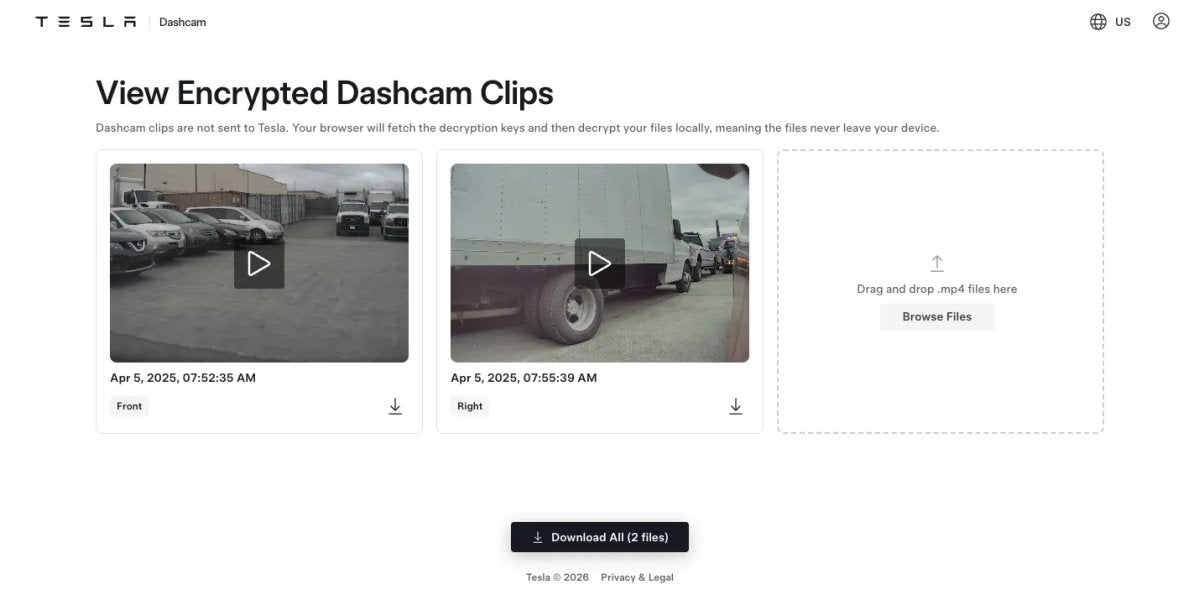
The encryption key is tied to your Tesla account, so connecting the USB drive to a random computer will no longer reveal playable files. To enable access on a computer, Tesla has introduced a web-based tool at dashcam.tesla.com. After you sign in with your Tesla account, the site retrieves the encryption keys associated with your account so you can decrypt and view clips. The interface operates locally on your machine, and videos are not uploaded to Teslas servers or any external cloud infrastructure.

Encryption is enabled by default, but owners can turn it off using the "Encrypt Dashcam Recordings" toggle in Controls > Safety.
Why This Security Layer is Necessary
Tesla recently expanded the dashcam recording buffer up to the last 24 hours (from just 60 minutes), an upgrade that rolled out globally with the Spring 2026 Software Update. When using a 1TB or larger drive, the car continuously logs the last 24 hours of driving footage, even if you never manually save clips.
Before update 2026.20, if someone broke into the vehicle, they could unplug the USB drive and access the data on it. With 24 hours of continuous history, that would expose a significant portion of your daily activity, including common locations and routes.
Recent camera-related updates also added zoom and pan in the Dashcam Viewer and a telemetry overlay that shows real-time vehicle data alongside video playback. By enabling automatic encryption, Tesla closes a physical security gap, ensuring that even if the storage drive is stolen, personal data and location habits remain protected.









Partager:
Tesla Improves Parental Controls in Update 2026.20
Tesla Model 3 Plunges 300 Feet Off Cliff, Passengers Survive