
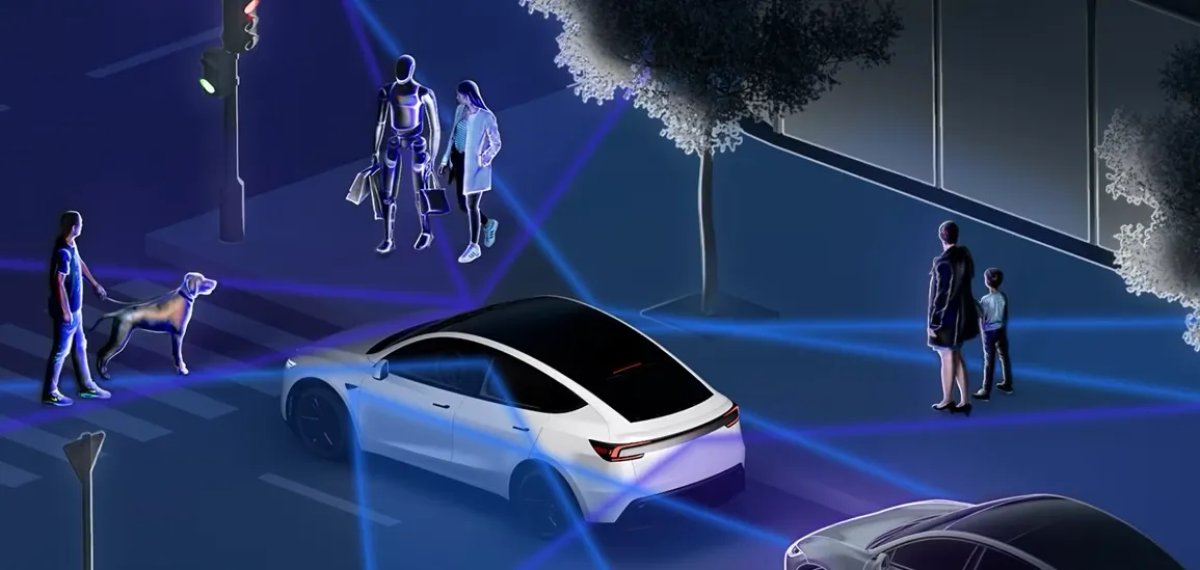

As Tesla advances toward unsupervised autonomy, the company released an updated Vehicle Safety Report covering the most recent 12 months of collision data across all North American road classes. The results align with what frequent FSD users report day to day.
The safety performance gap between human drivers and artificial intelligence is widening, and the trend is accelerating.
NEWS: Tesla has released new FSD (Supervised) safety data.
— Sawyer Merritt (@SawyerMerritt) February 18, 2026
Total major collisions:
• Teslas with FSD (Supervised): 830
• Teslas driven manually with Active Safety: 16,131
• Teslas driven manually without Active Safety: 250
• U.S. average: 4,989,713
Miles per major… pic.twitter.com/KnId83gXXb
Alongside the new safety data, Tesla confirmed a major milestone: the global fleet has surpassed 8.2 billion cumulative miles driven on FSD. For context, Voyager 2 has traveled approximately 13.2 billion miles from Earth, and Mars is about 220 million miles away.
The Safety Breakdown
To objectively assess safety, Tesla tracks major collisions, defined as impacts severe enough to deploy airbags, trigger seatbelt pyro restraints, or set off the high voltage battery pack pyro fuse.
The report categorizes results to compare FSD against human driving and the broader national average.
Miles Driven Per Major Collision:
- Teslas with FSD (Supervised): 1 crash every 5,300,676 miles
- Teslas driven manually (With Active Safety): 1 crash every 2,175,763 miles
- Teslas driven manually (Without Active Safety): 1 crash every 855,132 miles
- U.S. Average: 1 crash every 660,164 miles
With FSD engaged and an attentive driver, Teslas experience far fewer major collisions than when driven manually, traveling more than eight times farther between major crashes than the U.S. average.
Manual driving still benefits from Tesla’s standard active safety features such as Automatic Emergency Braking and Lane Departure Avoidance, yielding a crash rate roughly three times better than the national average.
Vehicles in the “Without Active Safety” category are pre-2014 Teslas that lack active safety systems.
Compared to last year, the FSD figure improved from 1 crash every 5.1 million miles. The manually driven numbers declined year over year: previously 1 crash every 2.3 million miles with active safety features and 1 crash every 927k miles without. Some natural variability is expected.
Data Scope
A common critique is that safety and autonomy results stem from small samples. For this 12-month period, however, the volume of telemetry used is exceptionally large for the automotive industry.
Total Miles Logged (Latest 12 Months):
- Teslas with FSD (Supervised): 4.39 billion miles
- Teslas driven manually (With Active Safety): 35.09 billion miles
- Teslas driven manually (Without Active Safety): 213.78 million miles
- U.S. drivers overall: 3.29 trillion miles
Across those miles, Tesla recorded 830 major collisions while FSD was engaged, versus more than 16,131 from manually driven Teslas. Non-Tesla vehicles accounted for about 5 million recorded incidents, on average, across the United States.
The dataset spans all road classes in North America, including complex city streets, rural roads, and unmarked intersections. If FSD was active at any point within five seconds before an impact, the incident is counted as an FSD collision.
8.2 Billion Miles and Counting
Tesla reports that owners have now driven over 8.2 billion miles on FSD (Supervised).
This trove of real-world driving provides the training data used to refine FSD—covering edge cases, weather conditions, and unpredictable human behavior—fed back into neural networks for improvement.
Elon Musk has estimated that roughly 10 billion miles of training data is the threshold needed to achieve true, unsupervised autonomy. With miles accruing at an accelerating pace, Tesla appears on track to reach that level soon.






Share:
Musk Confirms Tesla Will Sell the Cybercab This Year to Consumers
How to Get Your Tesla on FSD to Take the Path You Want