

Tesla has deployed a new machine learning model to improve the accuracy of Supercharger wait times displayed in vehicles. In a recent update shared by the official Tesla Charging account on X, the company outlined how it is enhancing in-car Trip Planner forecasts by more accurately predicting driver behavior.
The Mixed-Use Challenge
A key difficulty has been forecasting wait times at mixed-use sites. Many Supercharger locations are co-located with amenities such as grocery stores, restaurants, and shopping centers.
When heading to a nearby Supercharger, many drivers do not enter the station into the vehicle’s navigation, which complicates forecasting. To provide better estimates, the system must also consider a vehicle’s current location and infer whether it is likely en route to a nearby Supercharger.
This introduces ambiguity: the system may have trouble telling apart a vehicle arriving to charge from one stopping only to visit a store. This mixed-purpose traffic has made it hard to predict the true charging queue and has contributed to inaccurate wait time estimates.
Training the AI on Trajectory Data
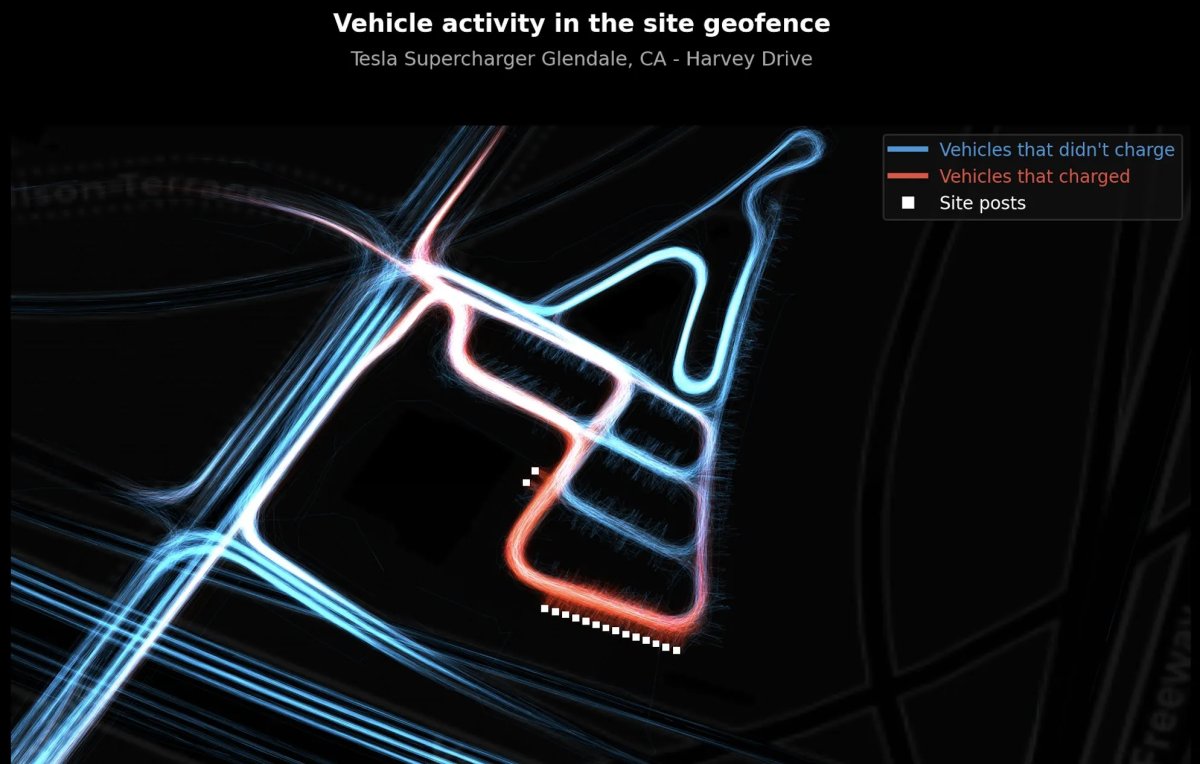
To address this, Tesla built a new machine learning model to infer a driver’s true intent to charge. The model was trained on 9 million miles of aggregated, anonymized vehicle trajectory data collected exclusively within the geofenced areas surrounding global Superchargers.
By examining how vehicles move, navigate, and park within these lots, the system can distinguish charging customers from typical retail visitors based on trajectory patterns.
The 20% Benchmark
According to Tesla, the updated software reduces queue-length estimation errors to about 20 percent.
In practice, even during the busiest holiday periods—when a site could see queues of 10 or more vehicles—the Trip Planner’s estimate would typically be off by only one or two cars. With more accurate predictions, navigation can route drivers to slightly farther but faster Supercharger locations to reduce overall travel time.
No Update Needed
Because vehicles obtain Supercharger wait times through Tesla’s APIs, no software update is required for these changes to take effect. Tesla says the rollout is underway and will likely begin at select Supercharger locations while results are evaluated before broader deployment.
Preparing for Virtual Queuing
In parallel, Tesla’s Charging Team is actively piloting a new virtual queue system designed to eliminate physical lines at busy Supercharger sites. Tesla has started building the virtual queue feature into the latest Tesla app.
Drivers will be able to join a digital waitlist through the app or from the vehicle’s display, receive real-time updates on their position, and be directed to a stall when it becomes available.
Combined with trajectory-based AI forecasting, virtual queuing aims to manage congestion effectively, including during peak holiday travel.






Share:
Tesla Cybertruck Owners Stranded at Home by Widespread PCS Failure
Tesla Battery Supplier, CATL, Unveils 3rd-Gen Shenxing LFP Battery: Charges in Under Four Minutes