
Tesla has released its 2025 Impact Report, which includes new details about the forthcoming Cybercab, a purpose-built robotaxi. The documentation provides the clearest view yet of the vehicle’s hardware and manufacturing approach.
As summarized in posts on X by longtime Tesla watcher Sawyer Merritt (@SawyerMerritt), the company describes how the two-seat design targets aggressive cost and efficiency goals, spanning structural battery cells and a rethought production system.
Next-Gen Efficiency and a Brand New Powertrain
According to the report:
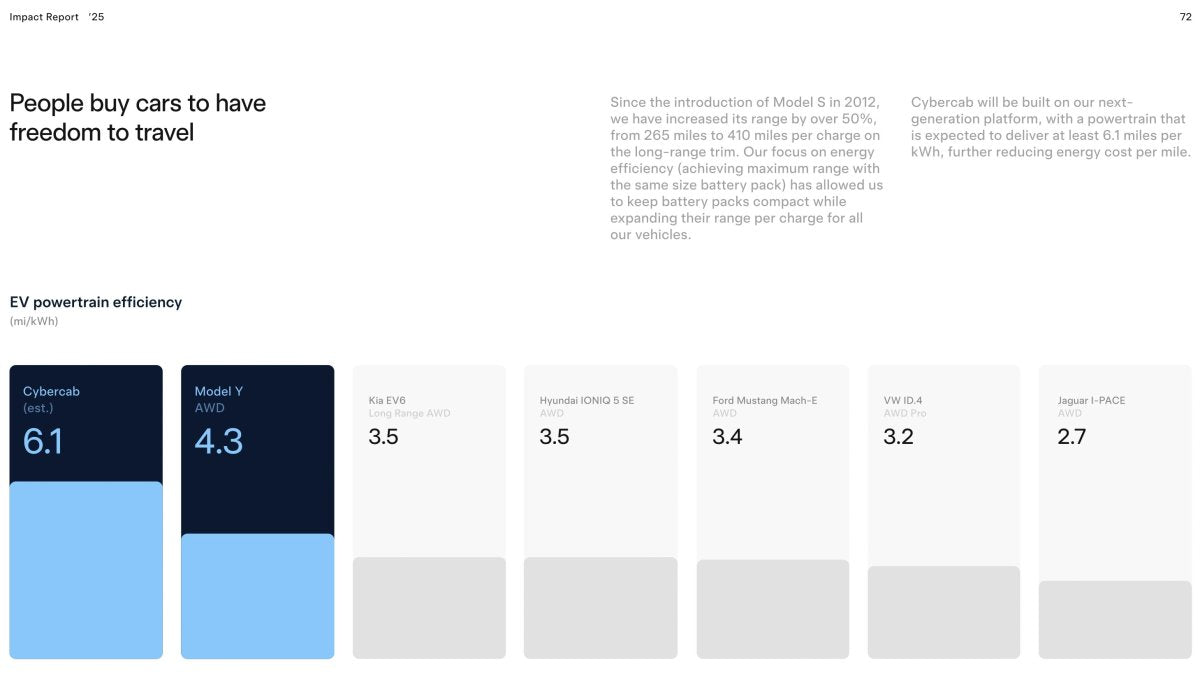
“The Cybercab will be built on our next-generation platform, with a powertrain that is expected to deliver at least 6.1 miles per kWh, further reducing energy cost per mile,”

The report compares the Cybercab’s projected efficiency with other EVs, indicating it outperforms models such as the Kia EV6 and Hyundai IONIQ 5, as well as Tesla’s Model Y AWD at 4.3 miles per kWh. The 6.1 miles per kWh figure is an estimate rather than an EPA rating; achieving it would make the Cybercab the most efficient EV to date. Tesla leadership has also suggested production units could exceed this target.
Per Tesla, the Cybercab “will further reduce GHG emissions per mile, helping to avoid nearly twice as many emissions per mile as compared to our Model 3 and Model Y vehicles.” To help meet these goals while reducing reliance on expensive supply chains, Tesla developed a new drive unit for the Cybercab that uses fewer costly, hard-to-source minerals.
Advanced 48-Volt Architecture and 4680 Cells
Drawing inspiration from the Cybertruck, Tesla says the vehicle “incorporates numerous in-house advancements including our 4680 battery cells, steer-by-wire technology and 48-volt architecture, with the latter enabling the delivery of power to different parts of the vehicle more efficiently.”
The 48-volt system replaces traditional 12-to-16-volt wiring, reducing wiring mass and complexity. Recent Cybercab documentation from Tesla indicates it is equipped with a 48-volt low-voltage lithium-ion battery, along with an SAE Level 4 'Autonomous Mode.' For high-voltage power, the Cybercab uses a 400-volt lithium-ion battery pack.

The Cybercab features a more powerful FSD computer than those in Tesla’s current consumer lineup, along with dual GPS for improved position tracking.
Unboxed Manufacturing and Painted Plastics
To enable an affordable, mass-market robotaxi, Tesla is using its “unboxed” manufacturing approach to assemble the Cybercab in parallel rather than on a traditional sequential line, reducing and optimizing the factory footprint.

The exterior avoids common bottlenecks as well. The Cybercab “is manufactured from lightweight reactive injection molded (RIM) panels that eliminate the need for a traditional paint shop.” Tesla says this purpose-built RIM process cuts cycle times from hours in a conventional paint shop to minutes by injecting color directly into the body material during molding.
Coming Soon to a Road Near You
Mass production began at Gigafactory Texas earlier this spring, and physical testing is ramping. Tesla has also started publicly testing production Cybercab units without steering wheels, pedals, or other human driving controls in Austin.
As manufacturing and validation scale, the company is moving toward a dedicated, low-cost autonomous ride-hailing fleet.


Share:
Tesla Model 2/Q: The $25,000 Car That Never Was
Exclusive: Tesla Cybercab Includes Dual GPS