
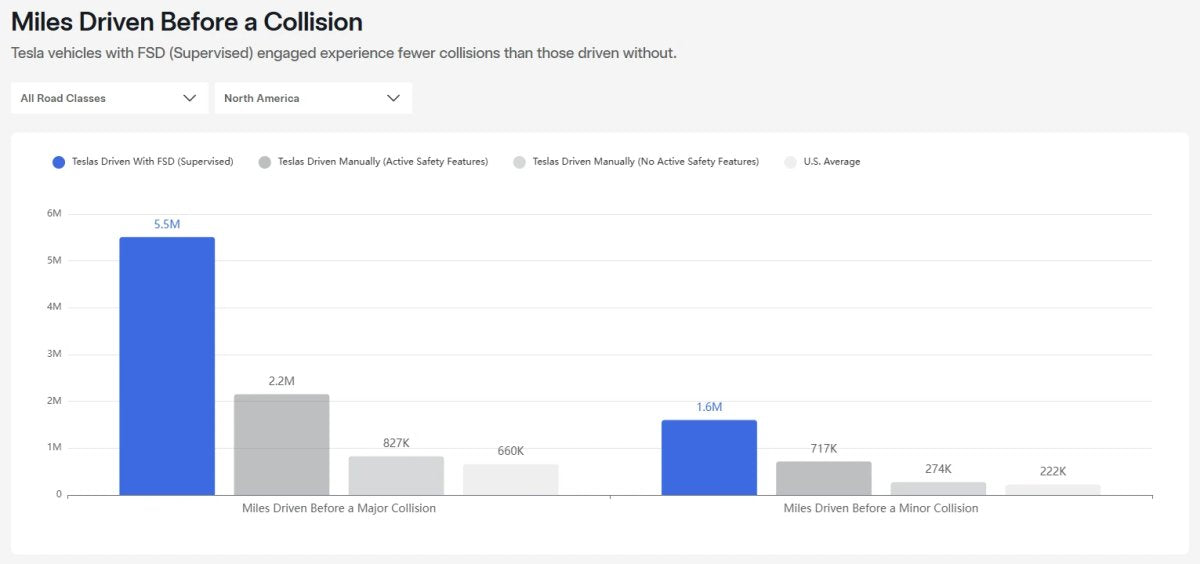
U.S. lawmakers are once again scrutinizing Tesla's Full Self-Driving (Supervised), this time challenging the company’s safety claims and urging regulators to verify the mathematical accuracy of the data Tesla cites.
According to a report from Drive Tesla Canada, Senators Ed Markey of Massachusetts and Richard Blumenthal of Connecticut sent a letter to NHTSA requesting a review of Tesla’s publicly cited FSD safety statistics. Tesla says FSD is up to 7 times safer than human driving, covering roughly 5.5 million miles before a major collision, compared to 660,000 miles for the U.S. average with manual driving. The push for a formal investigation follows recent Reuters coverage that questioned the methodology behind Tesla’s data.

Senate Pressure
They want NHTSA to expand its reporting requirements for autonomous vehicle companies and have asked the regulator to answer the following questions by July 7:
- Has NHTSA independently evaluated Tesla’s public FSD safety claims, including claims that FSD is seven or ten times safer than human driving, for statistical validity or methodological soundness?
- Has NHTSA requested, as part of any ongoing investigation, that Tesla provide the underlying data, assumptions, crash definitions, exposure metrics, and methodology used to generate its public FSD safety statistics? If so, please provide the date of each request and describe Tesla’s response.
- Has NHTSA evaluated Tesla’s use of a five-second disengagement window in its FSD safety calculations, despite the SGO’s 30-second reporting window? If so, what conclusions has NHTSA reached?
- Has NHTSA evaluated whether Tesla’s reliance on automated telemetry may omit crashes or safety incidents when connectivity is unavailable or vehicle communication systems are damaged? If so, what conclusions has NHTSA reached?
Senator Markey has been a longtime, outspoken opponent of FSD. This is also far from Tesla’s first interaction with U.S. regulators over its driver-assistance software. Earlier this year, Tesla retired its Autopilot branding after the California DMV concluded it was misleading and threatened Tesla with a sales ban in the state unless it took corrective action.
Independent Backing in Europe
While U.S. politicians remain skeptical, international regulators have presented a different view. The Dutch Transport Minister recently defended the Netherlands’ approval of FSD, noting that the decision relied on independent RDW testing rather than Tesla’s own metrics.

He said vehicles operating on local roads have accumulated 24 million kilometers (15 million miles) with no noteworthy incidents. This aligns with recent Tesla data indicating that Full Self-Driving is 3.5 times safer than human driving in the Netherlands.
Fighting Restrictions in New Jersey
This federal scrutiny arrives as a separate state-level battle unfolds in New Jersey. Tesla has launched a direct advocacy push to oppose state bills S. 1677 and A. 3968, which would impose rigid limits on autonomous vehicle testing and operations.
Tesla is warning owners that the draft rules would create barriers so severe that true driverless deployment would remain illegal in the state. The petition argues that instead of prioritizing actual performance, the bill introduces anti-competitive roadblocks that will cause the region to fall behind.

This stands in contrast to other states. For instance, Tesla has already managed to self-certify FSD and its Robotaxi vehicles as Level 4 autonomy-compliant in Texas. It also recently launched its commercial Robotaxi service in Dallas and Houston, offering fully unsupervised, uncrewed rides in both cities. NHTSA has confirmed it is reviewing the lawmakers' letter, while individual states continue to dictate how quickly Tesla’s driverless fleet can expand.


Share:
Exclusive: Tesla's Android App is Getting Live Activities-Style Notifications
Former Tesla Exec is Building the Home Heat Pump Musk Promised