
To Lease or Buy: A Definitive Tesla Purchasing Guide
Choosing whether to lease or buy a vehicle once centered on interest rates, residuals, and monthly payments. With vehicles advancing rapidly, the way you obtain a Tesla also reflects a view on how its technology will evolve.
With confirmation that next-generation AI5 hardware is delayed until at least mid-2027 and the introduction of lease buyouts, the landscape has shifted.
This guide reviews total cost of ownership, technology timelines, and the advantages and drawbacks of purchasing or leasing a Tesla to help you select the right approach.
The AI5 Factor
Over the past year, the prevailing wisdom was “lease, don’t buy,” based on expectations that the AI4 hardware in current vehicles would become outdated by AI5 in late 2025 or early 2026. That timetable has changed significantly.
Tesla has indicated that AI5 likely won’t ship until late 2027, and that the Cybercab would launch with the current generation AI4 hardware instead. In other words, AI4 is expected to remain the standard for the foreseeable future (at least until AI4+).
This lowers much of the technology risk of purchasing. Buying a Tesla now is less like grabbing a smartphone just before a new model and more like choosing a mature platform with a long supported lifespan.
The 2026 Pricing Matrix

The estimates below use standard U.S. pricing for 2026, comparing a 72-month loan to a 36-month lease with 10,000 miles per year. Taxes and regional incentives are excluded.
| Vehicle Model | Purchase Price | Est. Loan | Est. Lease |
|---|---|---|---|
| Model 3 Premium AWD | $46,490 | $639/mo ($3,250 down, 0.99%) | $449/mo ($3,000 down) |
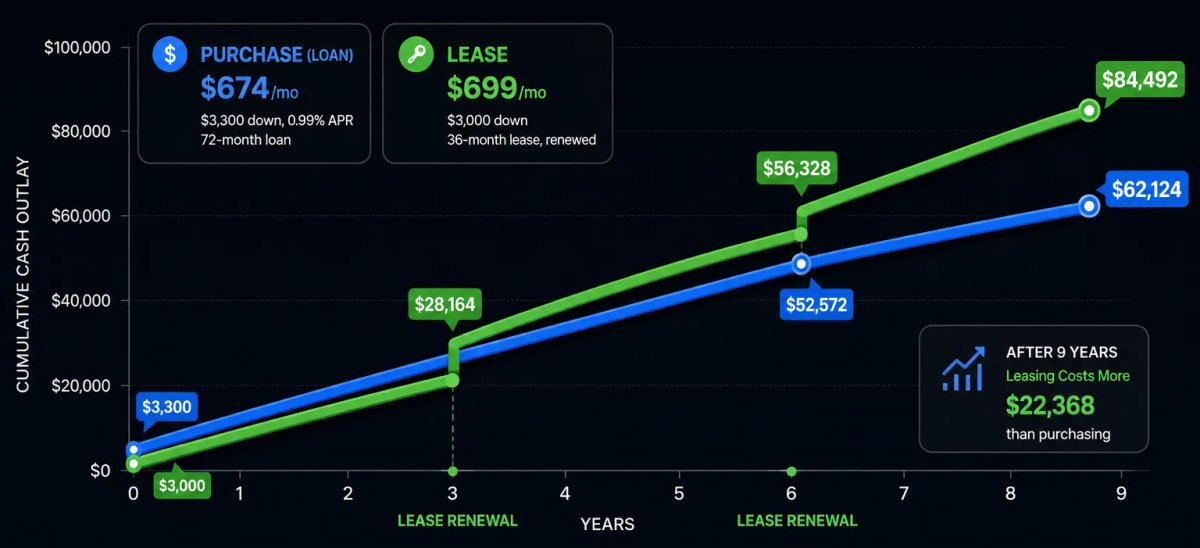
| Model Y Premium AWD | $48,990 | $674/mo ($3,300 down, 0.99%) | $699/mo ($3,000 down) |
| Cybertruck AWD | $79,990 | $1,270/mo ($4,050 down, 5.34%) | $949/mo ($5,000 down) |
Understanding Lease Mileage
Leasing often yields a lower monthly payment but comes with strict mileage limits.
Tesla offers leases at 10,000, 12,000, and 15,000 miles per year, with rates that vary based on the residual value at lease end. Additional mileage may be available for purchase depending on your region.
If you exceed the mileage allowance, you must either buy extra miles if offered in your area or pay the contract’s overage fee, typically $0.25 per mile. For example, driving 5,000 miles over a 10,000-mile lease would result in $3,750 in penalties.
The Breakeven Analysis
Examining total cost of ownership over six years reveals clear patterns. For the first three years, leasing usually costs less. When the lease ends around year three, expenses jump due to a potential new down payment and a new lease.
By year six, a purchased vehicle is typically paid off, reducing monthly payments to zero, excluding maintenance and insurance. If you plan to keep your Tesla beyond the breakeven point, purchasing tends to come out ahead.
This is even more compelling with Tesla’s Extended Service Agreements and upcoming additional battery warranty plans, which aim to lower the risk of major repairs by extending warranty coverage on key components.
Lease Buyout
Tesla permits customers to buy out their leases at the end of the term. This provides flexibility for lessees who decide to keep their vehicle after 36 months. You can purchase the car at its residual value (set when you sign the lease), either paying cash or financing the lower amount through a third party.
This option suits drivers who want to try an EV or a new vehicle without taking on the commitment of buying upfront, while still retaining the ability to keep the car at the contract’s end.
Insurance & Customization
Leases generally require higher liability limits for insurance, depending on jurisdiction, which can slightly raise premiums compared to state-minimum coverage for purchased vehicles. If Tesla Insurance is available in your area, rates are standardized based on safety scores rather than ownership or leasing status, which may be advantageous, especially if you’re using FSD.
Customization is also more restrictive on a lease. You typically cannot tint windows, install PPF, or swap parts unless you plan to remove them before returning the vehicle.
When you purchase, the car is yours to modify as you like—whether that’s a color-changing wrap or upgraded tires and wheels for better grip on track or trails.
The Verdict
For most shoppers considering the Model 3 or Model Y, purchasing remains the strongest financial choice. With the AI5 transition now pushed to 2027, the risk of near-term obsolescence is greatly reduced, making these vehicles a safe bet.
If you drive more than 15,000 miles a year or intend to own past the breakeven horizon, buying helps you build equity, customize freely, and avoid lease mileage penalties.
Leasing still has merits: you get the latest model roughly every three years, and you’re shielded from potential out-of-warranty repair costs.




Teilen:
Watch Tesla's Cybercab Drive Itself Out of the Factory [VIDEO]
Tesla FSD Expansion History: Where It’s Live and What’s Next