
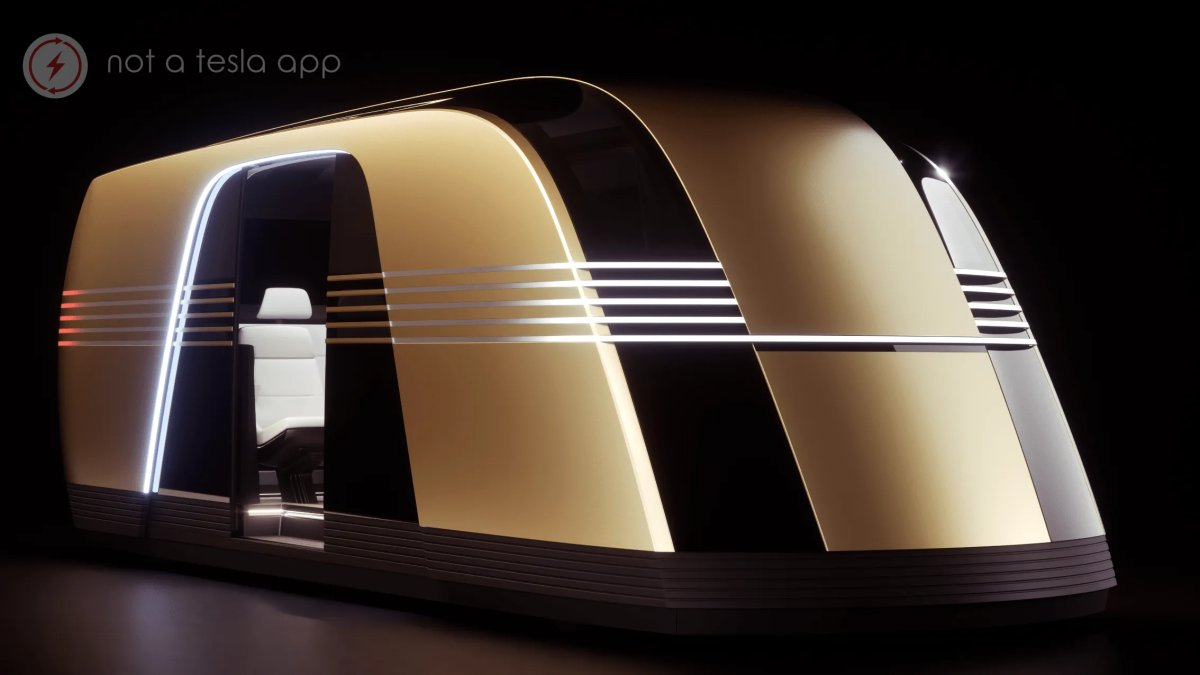
Tesla Secures New Robovan Design Patent

Tesla is moving to safeguard its vision for autonomous mass transit with a newly granted design patent that covers the exterior of the Robovan concept, securing intellectual property for the autonomous high-capacity vehicle.
According to a breakdown shared by @tslaming on X, Tesla received U.S. Design Patent No. US D1138869 S on August 4. The company originally filed the patent in October 2024, around the time it first publicly displayed the Robovan concept. The filing credits Chief Designer Franz von Holzhausen and team members Julien Bilodeau, Ian Kettle, and Joseph Robinson.
Art Deco Inspiration and a Faceless Capsule
Patent drawings highlight design choices that make Tesla’s people-mover stand out. The uninterrupted exterior reads more like a moving lounge or a futuristic tram than a traditional commercial van.


Influenced by Art Deco streamliner trains and buses, the body incorporates rounded corners, sweeping horizontal accent lines, and fully enclosed wheel wells. With the wheels and undercarriage set deep within the lower body panels, the vehicle presents a floating, hovercraft-like profile above the road.
The profile is symmetrical and faceless: there is no conventional grille, hood, side mirrors, or driver cockpit. A dark, continuous glass beltway wraps the upper cabin, with curved termination points to visually break up the vehicle’s mass. Near-vertical front and rear end caps are used to maximize interior volume for passengers or cargo.


Unlike the sharp, planar, stainless-steel geometry of the Cybertruck, the Robovan emphasizes soft slopes and continuous curvature.
Expanding the Autonomous Fleet
The patent supports many details first shown when Tesla unveiled the Robovan concept at the We, Robot event in 2024. Built without a front windshield or traditional driver controls, the high-capacity shuttle is designed to carry up to 20 passengers or be adapted for commercial cargo. Large glass sliding doors provide access to the cabin.

Tesla has adopted a bold, gold-heavy “cyber” aesthetic across its future autonomous lineup. Beyond mass transit, leadership has hinted at autonomous RVs and school bus versions based on the Robovan platform. The architecture can also be configured for personal use, though it remains unclear whether that would include traditional pedals and steering controls.
Development of the larger Robovan has taken a backseat as Tesla prepares to launch the Cybercab, which started mass production back in April. Securing patent rights underscores that Tesla still intends to translate its retro-futuristic mass-transit vision into a production reality.


Teilen:
The $99/Month Ransom: Why Tesla Owners Are Revolting Over FSD Pricing
EVIO Rolling Out 22 Tesla Superchargers Site Locations