
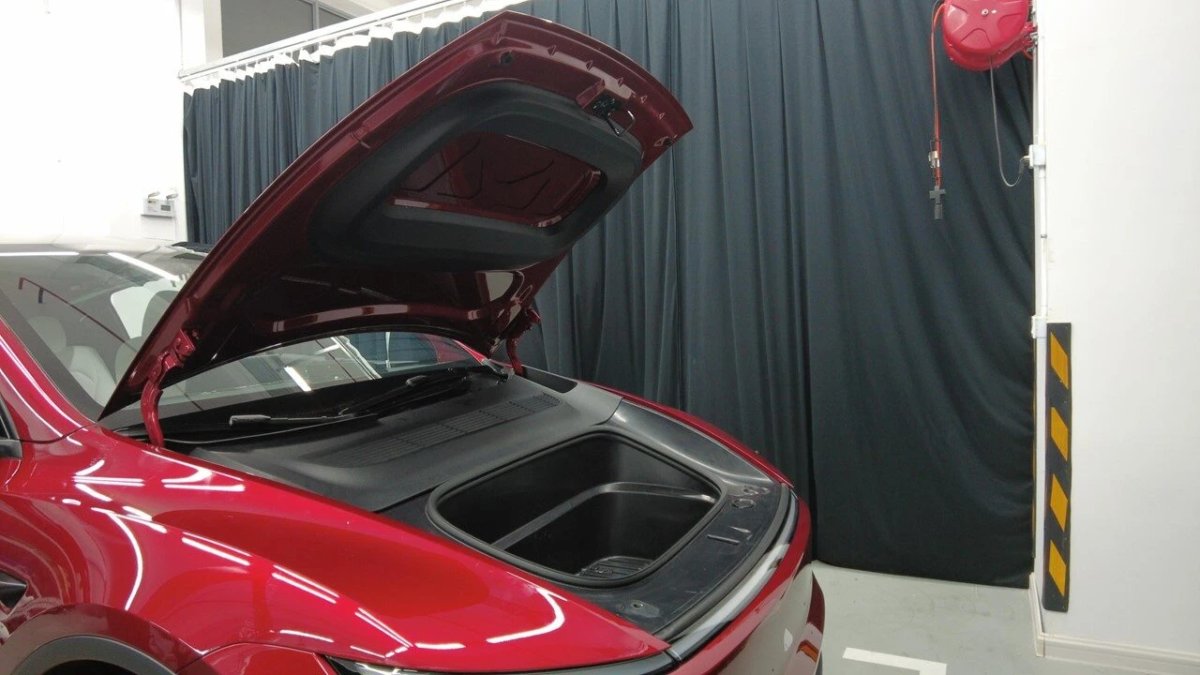
Tesla recently expanded vehicle-to-load support to the Model Y Premium, but there’s a catch. Only recently manufactured vehicles include the updated PCS hardware. Some Model Ys built as late as May 2026 are incompatible, with the transition appearing to have occurred around June. Tesla has now published a service procedure that details how an older Model Y can be converted from its original PCS1 hardware to PCS2 Lite.

Tesla Publishes a Model Y PCS2 Retrofit
Tesla’s new PCS1 to PCS2 Lite retrofit procedure was released last month and remains labeled as a draft, although Tesla says it has been validated. Tesla has not announced a customer retrofit program or stated that Service Centers will perform the upgrade solely to add V2L. Given the complexity of the retrofit and the cost of the vehicles, it’s unlikely to be offered to customers.
The document confirms that replacing the older hardware is technically possible.
The Retrofit Is Difficult
This is far more involved than swapping an accessory. The procedure contains 344 steps and requires placing the vehicle on a lift, isolating the high-voltage battery, draining and refilling coolant, opening the battery’s ancillary bay, modifying wiring, and replacing the PCS. It also calls for high-voltage protective equipment, resistance testing equipment, and several Service Mode and Toolbox routines.
The public procedure does not currently provide a clearly visible total labor time, so there isn’t an authoritative number of hours to assign to the retrofit. The scope makes it a service-level repair rather than a typical DIY project.
Parts Needed for the V2L Retrofit
V2L support centers around the newer PCS2, part number 2100145-N0-E, which allows the vehicle to convert DC to AC in both directions. Tesla’s Parts Catalog currently lists the unit at approximately $1,750.
The procedure also calls for PCS2-specific hardware, including a new 12V DC harness, an AC filter harness, and revised inlet and outlet coolant hoses.
The PCS alone makes this an expensive upgrade before labor and additional parts are even considered.

Cheaper Alternatives
If you need a 110-volt outlet in the vehicle, consider a 12V inverter that adds a couple of outlets and USB ports. It’s very affordable at about $50, and you can use the outlets inside the vehicle while driving, instead of connecting an adapter to the vehicle’s charge port.
The downside is that these inverters are typically rated for about 200 watts, compared to the 2,400 watts of Tesla’s V2L solution. That rating is still sufficient for chargers, laptops, and similar devices, but it won’t power items such as power tools, portable heaters, and air conditioners.
There are also pricier third-party solutions that mimic Tesla’s outlet adapter by connecting to the charge port. They avoid the newer PCS requirement by integrating an external inverter, which makes them bulkier than Tesla’s outlet adapter.
These products cost about $800, but they can deliver the same 24,000 watts as Tesla’s outlet adapter.
What the Retrofit Actually Adds
With this retrofit, the Model Y Premium can use Tesla’s $80 Outlet Adapter with a Gen 3 Mobile Connector to provide up to 20 amps at 120 volts (2.4 kW) from the vehicle’s battery.
However, this does not provide the Model Y with the Cybertruck’s full Powershare capabilities. Cybertruck can provide up to 11.5 kW for home backup and includes additional 120V and 240V outlets. Model Y’s implementation is limited to powering devices through the charge port.
For most owners, spending well over $1,750 plus labor simply to gain a 2.4 kW outlet may be difficult to justify. Publishing an official retrofit procedure at least confirms that the hardware can be upgraded.






Teilen:
Tesla Is Auctioning Off Stockpiles of Model S and Model X Parts
Tesla Cybercab Launch Event Announced — Win an Invitation