
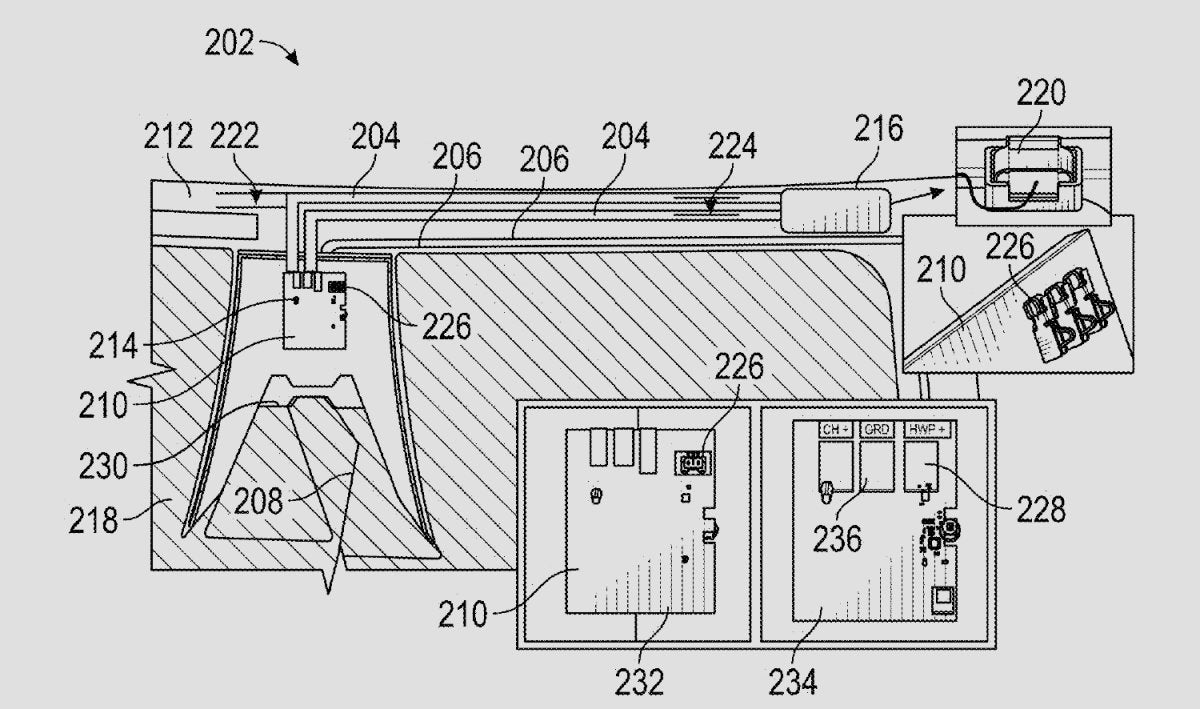

Tesla filed a patent application published on December 4, 2025 titled Printed Circuit Glass that describes replacing conventional wiring harnesses by printing conductive traces directly onto the windshield, effectively turning the glass into a structural circuit board.
The filing US 2025/0368012 A1 outlines a system in which electrical wires are substituted with conductive traces applied to the glass surface.
How It Works
The patent’s central change is swapping physical cables for screen-printed conductors. It describes applying a conductive paste composed of silver, an inorganic ceramic frit, and a liquid medium to a glass substrate in a defined pattern.
After application, the glass and paste are fired at temperatures exceeding 600°C, curing the paste and fusing the silver and ceramic into the glass surface. Unlike traditional defroster lines—which are designed for high resistance to generate heat—these printed traces are engineered for extremely low resistance so they can transmit power and data efficiently with minimal energy loss.
Improved Camera Housing
The patent’s primary use is powering the increasingly complex sensor suite at the top of the windshield. It explicitly mentions powering the ADAS cameras, rain sensors*, heating elements for the wiper’s “parked” position, and an electronchromic rearview mirror.
The application also notes that printing power traces onto the glass—likely hidden behind the black ceramic border—would allow devices to be placed in optically optimal positions without routing a physical cable to each device. That flexibility could substantially reduce the size of the bulky plastic housing currently found behind the rearview mirror.
There simply would not be a bundle of power and data cables to hide there; the connections would be nearly invisible across the windshield instead.
While the Model X will soon be discontinued, this patent would have greatly benefited that vehicle because it would no longer need the wire running down the center of its large windshield.
The patent explicitly mentions rain sensors, even though Tesla has not included them for years. These are likely there as an example, rather than a future use.
Printed Benefits
Beyond appearance, moving to solid-state wiring offers clear reliability advantages. Wiring harnesses in the headliner are a common source of rattles and vibration noise—an issue eliminated when the trace is fused to the glass.
The patent states that Tesla’s testing shows the silver traces retain full integrity across a temperature range from -40°C up to +108°C (-40°F to 226°F), at any humidity level.
Because the traces are sealed inside laminated windshield glass or printed on the cabin side, they are also protected from corrosion and physical damage.
Using Glass as a Circuit Board
The most significant assembly benefit is on the production line. Traditional wiring harnesses are floppy, hard to route, and difficult for robots to handle; they often require manual labor to clip in place and route through pillars and firewalls. Replacing loose wires with rigid, printed electrical paths is analogous to moving from loose wiring to circuit boards.
Integrating the electrical paths into the rigid windshield turns it into a plug-and-play structural module. A robot arm can install a windshield with pre-printed circuits in a single motion and connect it to the vehicle’s main power and data using a simple spring contact or connector pad, removing the need for a person to plug in a harness.
These designs currently exist in a patent application, but Tesla has begun testing the product’s durability and usability. The approach also aligns with Tesla’s plans for a faster, more automated parallel production line through the Cybercab’s unboxed manufacturing strategy.
By converting a passive component like the windshield into an active element of the electrical architecture, Tesla could reduce parts count, lower labor, and increase automation potential. However, as with many early patents, the technology remains some distance from actual production.


Teilen:
China Announces Ban on Electric Door Handles, Forcing Tesla to Redesign Model 3 and Model Y
Tesla Announces Q4 2025 Supercharger Site Winners