
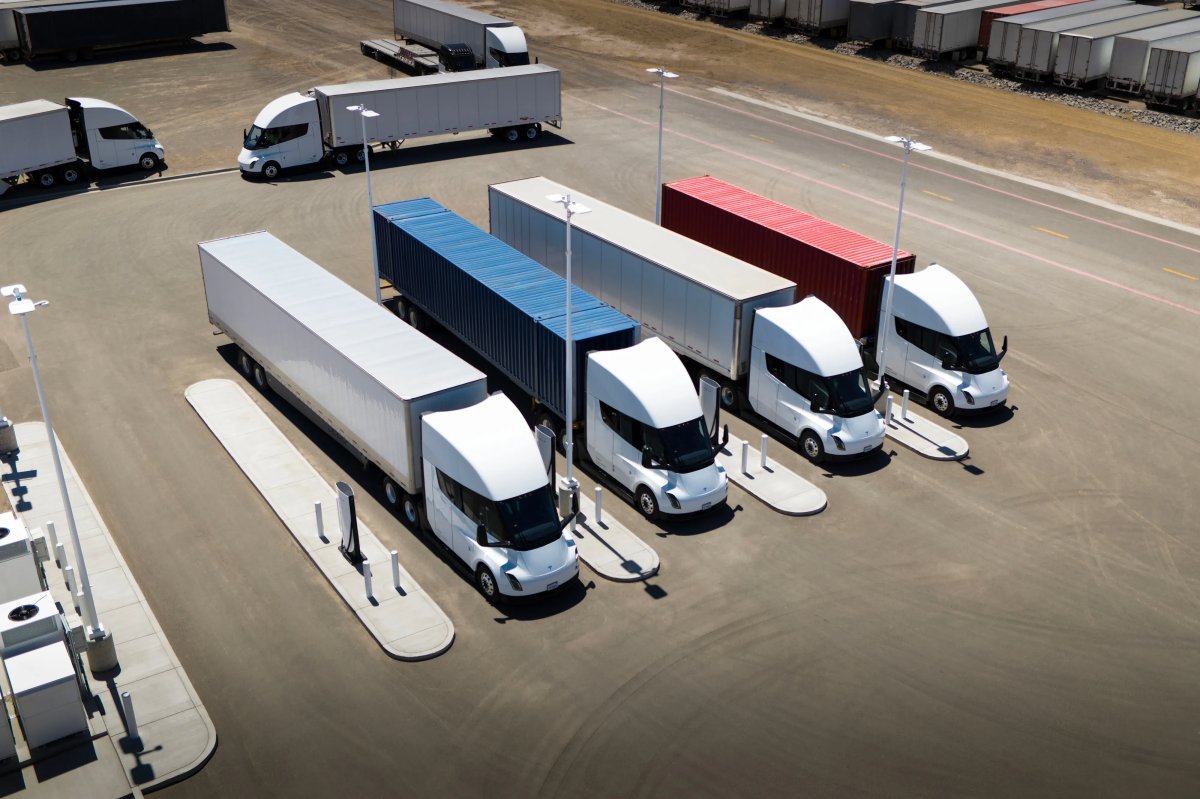

California’s Hybrid and Zero-Emission Truck and Bus Voucher Incentive Program (HVIP) is officially first-come, first-served, but allocation data indicates the state is channeling a significant share of support toward a single model that has not yet reached volume production.
According to data reported by the LA Times, California has tentatively assigned approximately $165 million in vouchers specifically for the Tesla Semi. For comparison, the next largest recipient—Canadian bus manufacturer New Flyer—has secured about $68 million.
This approach allows Tesla to secure a sizable portion of funding ahead of broader availability, reflecting a bet that the Semi can scale in line with the state’s heavy-trucking decarbonization goals.
The “Free Truck” Math
HVIP vouchers for the Tesla Semi range from $84,000 to $351,000 per vehicle, depending on the operator’s status and fleet size.
While Tesla has not officially released pricing, documents obtained by the LA Times suggest a price of $260,000 for the Standard Range and $300,000 for the Long Range variant. If those figures prove accurate, a fleet operator qualifying for the maximum incentive could effectively acquire a Tesla Semi at no net cost—or even at a “profit” on paper—as the vouchers would cover more than 100% of the capital cost.
This additional funding could be used to incentivize the adoption of MCS 3.2, the Megachargers required to keep semis charged and on the road at the fastest possible speeds.
Freezing Out the Competition
The allocation has stirred controversy among competitors, who argue that reserving so much money for Tesla—while its Class 8 electric truck remains in a pilot phase—ties up funds that could reduce emissions immediately.
They note that manufacturers such as Volvo, Daimler, and New Flyer have vehicles rolling off assembly lines today, but their order books are smaller than the large fleet-scale reservations Tesla is accumulating.
No major logistics providers have signed contracts comparable to the agreement between DHL and Tesla for potentially hundreds of Class 8 trucks.
The Long Game
Regulators are focused beyond near-term delivery counts. Meeting the state’s emissions goals will require replacing diesel trucks by the thousands. Legacy manufacturers have shown they can produce electric trucks, but only in limited volumes.
State officials have indicated that many of these outstanding Tesla orders are expected to be fulfilled in late 2026. The strategy prioritizes higher-volume deliveries later over a smaller stream of competitor trucks available today.






Teilen:
Tesla May Turn the Cybertruck Into an Autonomous Delivery Van
Tesla Adds Interactive Vehicle Screens to Select Showrooms [VIDEO]