
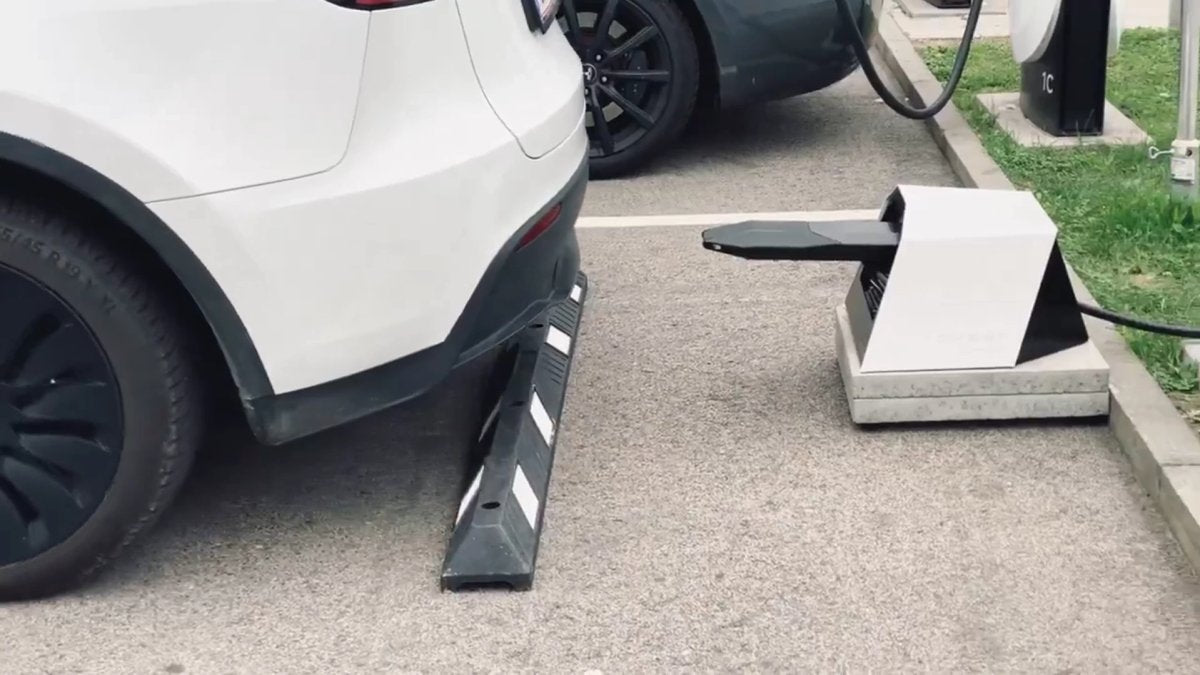

For driverless robotaxis, charging must happen without human involvement. One Austrian company, Volterio, has demonstrated a passive conductive docking system ahead of an official solution from Tesla. In a video posted on X by @Chris_01___, a Model Y reverses onto a ground-mounted Supercharger port to begin charging. Here’s how the system was described:
“An automated, passive NACS-docking solution, whereas the Robotaxi just reverses onto the docking station would cost a fraction of a wireless system, does 250 kW and the manual charging would still remain. Compensates laterally +/- 100 mm misalignment.”
In the demo, the car backs into a space, and an automated ground probe mates with a custom port that replaces the Model Y’s rear tow hitch.
An automated, passive NACS-docking solution, whereas the Robotaxi just reverses onto the docking station would cost a fraction of a wireless system, does 250 kW and the manual charging would still remain. Compensates laterally +/- 100 mm misalignment @Tesla @elonmusk @robotaxi pic.twitter.com/vzXY8zIpgr
— Chris (@Chris_01___) August 15, 2026
Passive Conductive Docking vs. Inductive Charging Pads
For autonomous fleets, a passive dock tackles practical issues cleanly. Since a robotaxi does not need a trailer hitch, the rear receiver area can be repurposed as a protected connection point. The vehicle simply backs into the spot until the dock engages, enabling up to 250 kW of DC fast charging without human assistance or moving robotic arms.
While third parties explore mechanical docking, Tesla is pursuing inductive wireless charging pads.
Robotaxi wireless charging
— Tesla (@Tesla) October 18, 2024
No hands required pic.twitter.com/XL746DkGhb
Tesla is constructing large charging hubs for its Robotaxi fleet as it prepares to deploy the purpose-built Cybercab, including one in Austin that features 80 wireless chargers in the site plans. Regulators have also approved the technology, with Tesla receiving FCC approval for wireless Cybercab charging earlier this year.
Tesla has not yet publicly debuted its wireless charging system. On efficiency, the company previously said its in-house inductive setup achieves “well above 90%” efficiency.
Efficiency is well above 90%
— Tesla (@Tesla) October 19, 2024
Ramping Fleet Tech Ahead of the Cybercab Reveal
The emergence of alternative automated charging approaches coincides with a pivotal week for Tesla’s autonomy plans. Tesla has already started adding Cybercabs to its Robotaxi fleet ahead of the official Cybercab launch event this Thursday in Austin. The first public Cybercab rides are widely expected later this week.

Although Tesla has been testing steering wheel-less Cybercabs on public roads for months, production units still include a hidden NACS charge port for wired charging. Early commercial operations will likely continue to use manual plug-ins until wireless hubs come online.
Whether via passive mechanical docking or high-efficiency wireless pads, eliminating cables is essential to keep driverless fleets operating continuously without human intervention.


Teilen:
Tesla Starts Adding Cybercabs to Robotaxi Fleet
Tesla Cybercab Can Be Driven Using Just the Screen [VIDEO]