
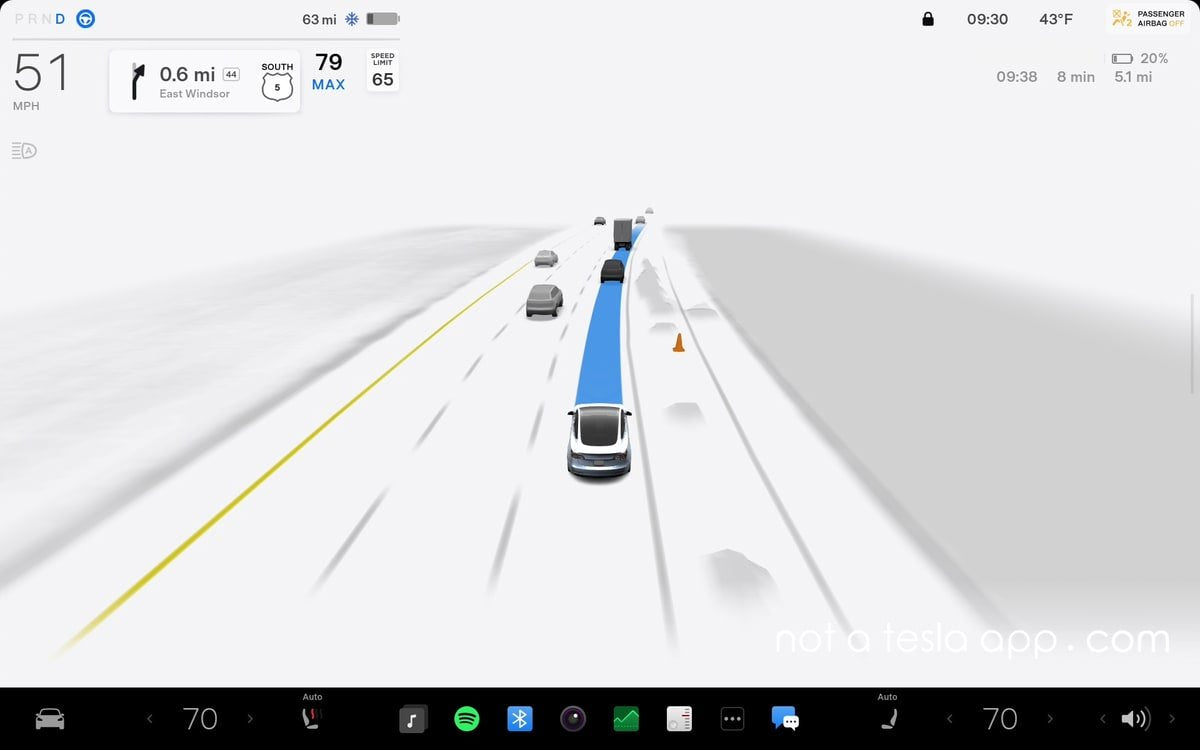

Elon Musk confirmed that Tesla’s Full Self-Driving (Supervised) is shifting from a single generalized driving approach to one that adapts to each driver. While the system has previously handled identical road situations with a common logic loop, upcoming releases will let the underlying neural networks learn from an individual driver’s habits.
The confirmation followed a discussion on X about a recurring issue where the car unexpectedly leaves carpool lanes. Tesla enthusiast and FSD user @wholemars highlighted that it’s frustrating when FSD exits an HOV or express lane and then gets stuck in traffic while cars in the far-left lane move past. Musk responded: “The car will start to remember your specific interventions and match each person’s individual preferences.”
Managing the Carpool Lane Problem
Owners have long reported instances where FSD exits a carpool lane and merges into regular traffic. Tesla provides a high-occupancy vehicle (HOV) lane preference under Controls > Navigation > Use HOV Lanes. You can also turn this on or off via standard Tesla voice commands (simply say “Turn on HOV lanes”). Recent updates split the setting into three choices: Auto determines if you meet time, location, and occupancy rules using cabin cameras and maps before routing through an HOV lane, Yes forces the car to use the lanes whenever available, and No disables them entirely.
Even with these options, FSD may still leave HOV corridors earlier than desired. By adapting to a driver’s manual corrections, repeated takeovers in similar lane-exit situations will be logged so the system can adjust its planning to avoid repeating the behavior. This aligns with Musk’s recent hint that future versions of FSD will learn from and mimic your parking preferences, helping the car pull into the preferred spot at frequent destinations such as home, the office, or kids’ school.

Teaching FSD to Learn From Its Mistakes
Tesla recently added an FSD disengagement menu that appears every time you take over the wheel from the software. Feedback from this flow may help inform which types of interventions the company targets first, enabling FSD to learn from them and avoid them. Parking is by far the most common cause of FSD disengagements, so improvements in parking are likely to arrive first under these new capabilities.

Teaching the system to remember and reproduce driver corrections should reduce the biggest friction points, especially during parking. If FSD can reliably handle tight home garages (including preferred orientation and spacing) and learn a driver’s usual spot in an apartment complex or parking garage, owner interventions should drop significantly.
According to internal data, FSD is already more energy efficient than humans. Next, it will learn from drivers’ preferences and habits to further reduce the need for input. Musk did not provide a rollout window for these capabilities, only that they are coming. Tesla is expected to release the next major consumer branch, version 15, later this year or early next year, with a 10x upgrade in model parameters.


Condividi:
Tesla Releases Q2 2026 Earnings Estimates from Analysts
Tesla Must Recall 20,000 Vehicles Over Bright Headlights