
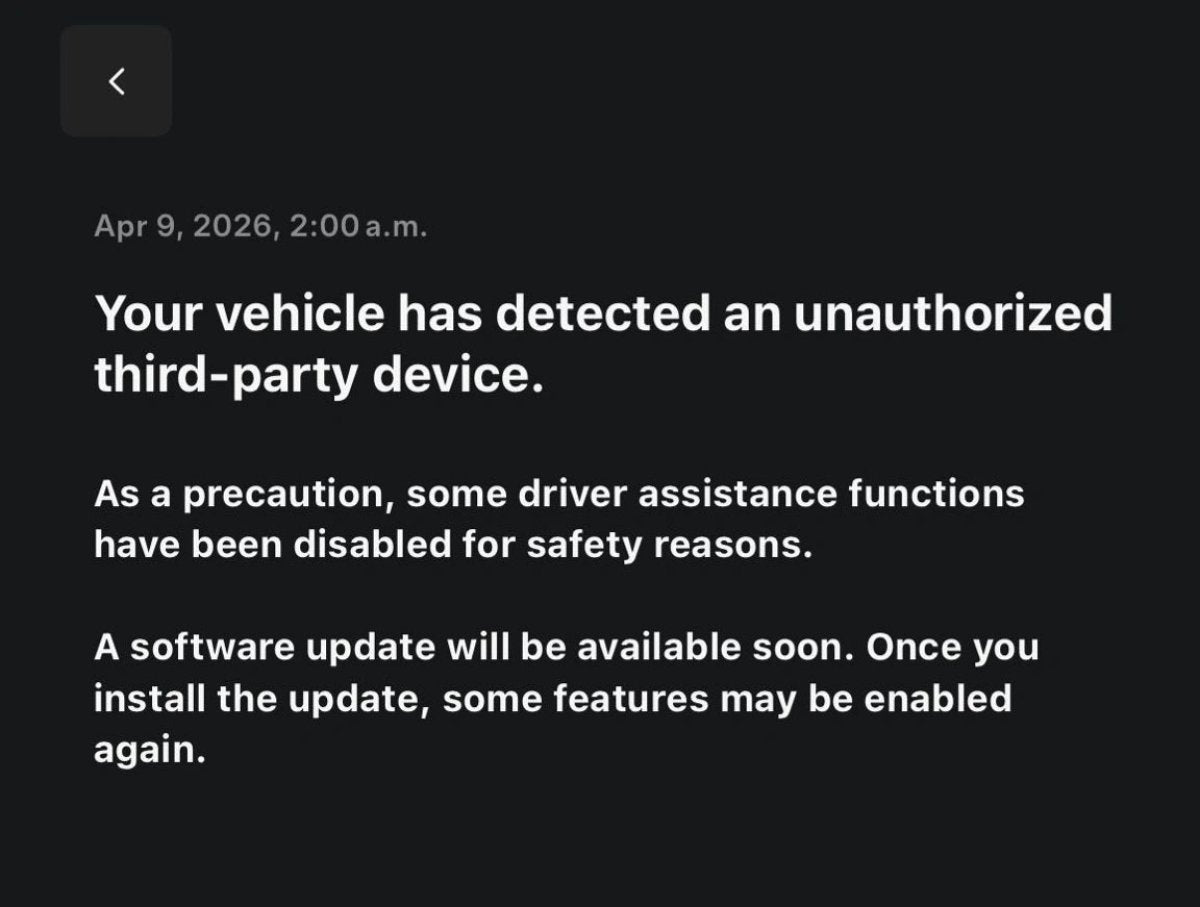

Tesla has begun shutting down the “jailbreak” workaround for Full Self-Driving. After months of drivers using unauthorized hardware to bypass regional restrictions and enable FSD (Supervised) where it is not officially supported, the company is now remotely disabling access for vehicles identified with these cheat devices. The action is being applied globally, impacting owners in Europe, South Korea, China, Turkey, and other regions where third-party tools were used to force-activate FSD.
An in-app notification shared by Tesla enthusiast Omar Qazi (@wholemars) displays the message now reaching affected owners: "Your vehicle has detected an unauthorized third-party device. As a precaution, some driver assistance functions have been disabled for safety reasons." The notice also states that a "software update will be available soon" to potentially restore some functions, without giving a timeline.
How the "Jailbreak" Works
The hardware involved consists of small, USB-like modules that typically cost about €500. They plug into a Tesla’s Controller Area Network (CAN) bus—the system that coordinates functions such as steering and acceleration. By intercepting CAN signals, the devices can trick the vehicle into bypassing Tesla’s geofencing and software locks.
This practice has been especially common in Europe amid years of regulatory red tape. Many European customers paid thousands for FSD years ago but have seen deadlines slip without a sanctioned release. Tesla maintains these devices are a "cybersecurity threat" that could introduce exploitable vulnerabilities.
Severe Consequences and Legal Risks
Tesla is not limiting its response to warnings; it is revoking access via over-the-air controls. In China, some owners report being blocked from using FSD entirely, even if they purchased the package legitimately. The company’s position is that using these tools makes the owner "100% liable for any accident that occurs" and permits Tesla to deny future warranty repairs.
The risks are even higher in South Korea. The Ministry of Land, Infrastructure and Transport classifies these modifications as a criminal offense under the Automobile Management Act. Using a "jailbreak" tool there can result in up to two years in prison or fines of roughly $13,500 USD. The feature is already available on the Model S/X in South Korea and is likely only months away from an official rollout on the Model 3/Y.
The Path to Official Release
The referenced "software update" is expected to patch the specific vulnerabilities exploited by these devices, preventing their use. Although the wait has been lengthy, the global FSD roadmap is progressing. Landmark approval in the Netherlands is anticipated as soon as tomorrow, April 10, which could trigger a wider rollout across the EU.
Tesla is prioritizing its official, unsupervised vision. As the software advances, enforcement against third-party hacks is set to continue. Considering the potential for warranty denial, legal penalties, and the possibility of remote FSD deactivation, these €500 devices carry significant risks.








Condividi:
Tesla is Secretly Working On a New, Smaller SUV
Elon Musk: FSD 10x Parameter Upgrade Now Coming With v15