
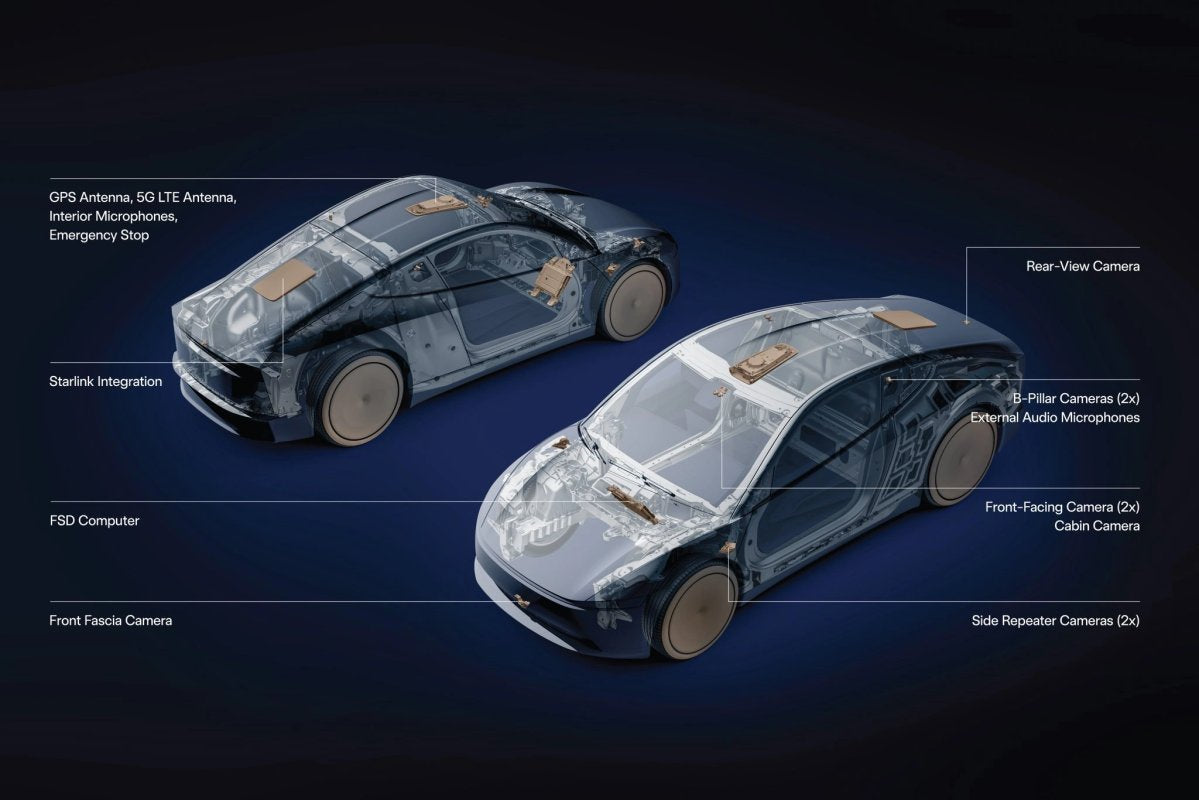

Tesla has confirmed that its purpose-built robotaxi, the Cybercab, will integrate SpaceX hardware, including a Starlink V5 dish. Prototypes with Starlink terminals have been seen on public roads, and the company’s latest reveal makes the setup official.
A schematic shared on X by the official @tesla account highlights the Cybercab with an integrated Starlink V5 dish, plus eight external cameras, an FSD computer, and GPS/LTE antennae. The same schematic was also photographed in person by @Starscream_SJC at a newly reopened Tesla showroom in San Jose, California, next to a production Cybercab on display without steering wheels or pedals.
Not Required for Driving, But Critical for Coverage
Following the post, questions surfaced about why an autonomous vehicle would need satellite internet. Tesla AI Chief Ashok Elluswamy clarified the role of connectivity:
"It is still not required for safe operation of the vehicle. Connectivity is primarily meant for navigation, customer service and, in general, fleet management."
The Cybercab already includes dual GPS for redundancy and precise positioning, along with standard 5G cellular modems for navigation, while the next-generation FSD computer (which is more powerful than anything currently available on Tesla’s consumer models) handles the driving tasks. Elluswamy’s remarks indicate the Starlink-based setup reflects a design Tesla has finalized for situations where the fleet needs more bandwidth than standard 5G LTE can provide, rather than equipment currently installed on production Cybercabs.
Even so, maintaining a robust link to operations is important for a vehicle that lacks a steering wheel or pedals. If the Cybercab encounters an issue or a complex scenario it cannot resolve, a low-latency connection allows remote human monitors to review camera feeds and offer real-time guidance. A vehicle-mounted satellite dish also keeps the car reachable in cellular dead zones.
Hardware Choices and Rollout Timing
The implementation uses the Starlink V5 dish, unveiled by SpaceX last week, mounted to the rear liftgate over the trunk storage area. Starlink V5 is 48% smaller by area and 62% lighter than the V4 dish, while drawing half the power.
Instead of the portable “Mini” terminal designed for mobility, Tesla chose a full-sized residential-tier form factor. The Starlink Mini is slated to receive a built-in battery for standalone use with the next hardware refresh, but Tesla determined the larger unit delivers the performance balance required for vehicle mounting.
The Cybercab is moving toward public deployment, with large numbers of production units seen staging at Gigafactory Texas as Tesla ramps public validation of the final steering wheel-less design. It is also set to begin offering autonomous rides across the Giga Texas campus to employees ahead of its public debut, and the addition of Starlink helps ensure the driverless fleet remains connected wherever it operates.


Condividi:
Tesla Starts Rolling Out New Version of FSD v14 Lite With New Features
Over 200 Tesla Cybercabs Spotted at Giga Texas