
SpaceX is rapidly iterating its satellite internet hardware to deliver a smaller and more efficient setup for stationary users. With more than 10,000 satellites currently in orbit providing global coverage, the company is focusing on making the Starlink user terminal more capable, portable, and simple to manage.
Starlink officially unveiled its next-generation kit, saying the new system is built to provide reliable, high-speed home internet while improving on the model it replaces. According to the announcement, the Starlink V5 terminal has a smaller form factor and lighter design with better power efficiency than the Starlink V4 dish.
The next generation Starlink Kit is designed to deliver reliable, high-speed home internet. Starlink V5 has a smaller form factor and lightweight design with greater power efficiency than the Starlink V4.
— Starlink (@Starlink) July 14, 2026
With speeds up to 375+ Mbps, Starlink V5 delivers seamless connectivity… pic.twitter.com/0dorU6n0oD
Next-Gen Performance Gains
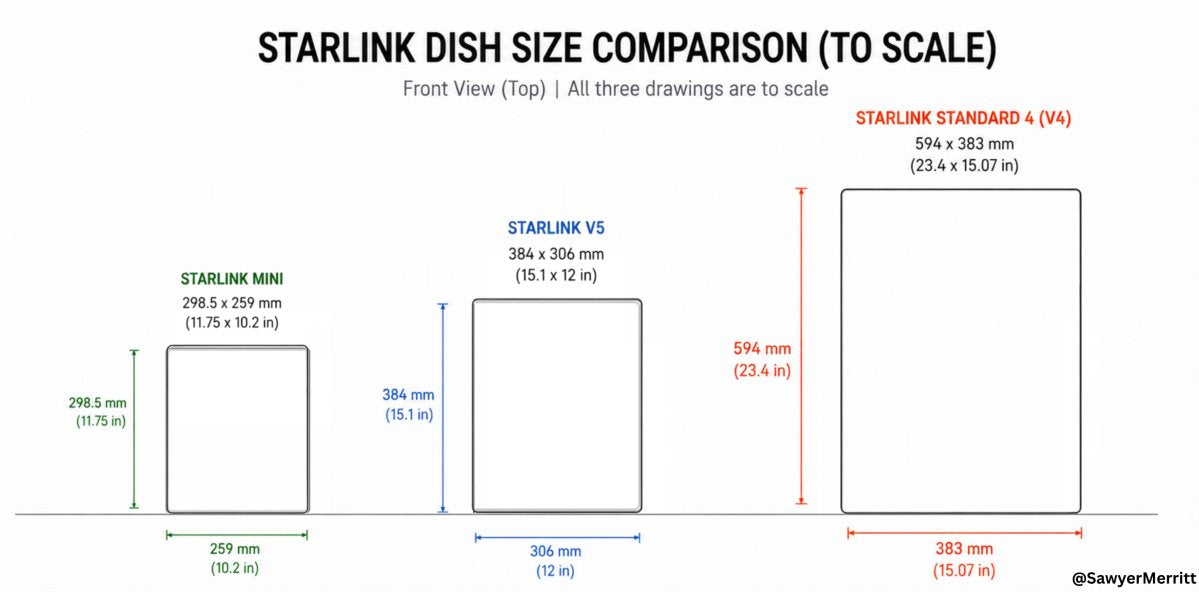
The new user terminal surpasses the V4 in nearly every way while being substantially smaller. By area, the V5 is nearly half the size of its predecessor and is notably lightweight.
Tesla and SpaceX watcher Sawyer Merritt (@SawyerMerritt) shared a to-scale comparison on X illustrating how much the footprint has shrunk, noting that the V5 dish is closer in size to—and even lighter than—the portable Starlink Mini rather than the V4 it replaces.

Despite the smaller receiver, the system supports download speeds up to 375+ Mbps for everyday browsing, heavy video streaming, and online gaming.
The V5 dish also addresses a key pain point by drawing 50% less power than the older model, bringing average consumption to 35-50W. It further boosts weather durability with an operational wind resistance rating of 165 mph compared to the V4’s 60 mph.
Comparing Starlink V5, V4, and Mini
Starlink’s updated Standard kit is rolling out to select launch zones now, with wider availability to follow as V5 production ramps.

| Specification | Starlink V5 (New) | Starlink V4 | Starlink Mini |
|---|---|---|---|
| Dimensions | 384 x 306 mm | 594 x 383 mm | 298.5 x 259 mm |
| Weight | 2.4 lb | 6.4 lb | 2.43 lb |
| Orientation | Software Assisted Manual Orienting | Software Assisted Manual Orienting | Software Assisted Manual Orienting |
| Power Draw (Avg) | 35-50W | 75-100W | 20-40W |
| Field of View | 110 degrees | 110 degrees | 110 degrees |
| Weather Rating | IP67 Type 4 | IP67 Type 4 | IP67 Type 4 |
| Snow Melting | 40 mm/hour | 40 mm/hour | 40 mm/hour |
| Operating Temp | -30°C to 50°C | -30°C to 50°C | -30°C to 50°C |
Preparing for Gigabit Speeds
The debut of this smaller residential terminal comes as Starlink targets gigabit-level performance, and the hardware appears positioned to accommodate that additional network capacity.


Gigabit performance will help narrow the gap with terrestrial fiber, but the capability is not expected to unlock until Starlink deploys next-generation V3 satellites in significant numbers. SpaceX plans to launch the first test batch of Starlink V3 satellites on its next Starship flight test, slated for later this week, paving the way for the future of space-based connectivity.











Condividi:
Tesla Is Refunding Incorrect Supercharger Fees in Some Areas
Our New Tesla Events Page