
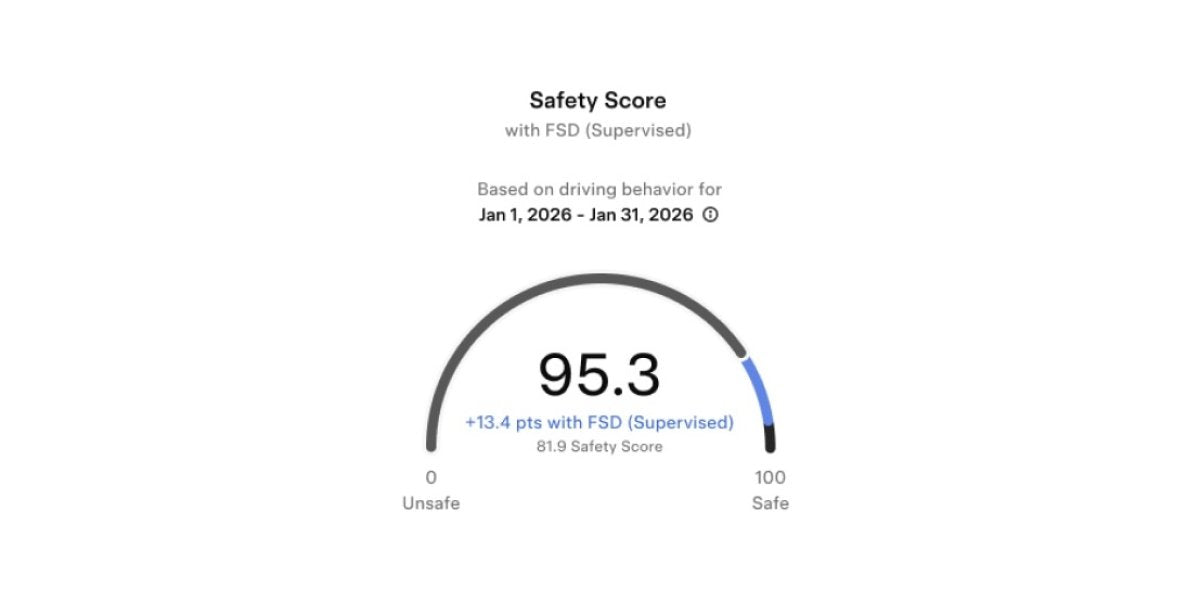

Tesla introduced Safety Score 3.0 for its in-house insurance program, adding a significant incentive to use FSD (Supervised) while driving.
According to an announcement on X, "With the latest version of Safety Score (v3.0), every mile you drive with FSD Supervised enabled will receive a score of 100," the company noted. Assigning a perfect score to each FSD mile is designed to reduce monthly premiums when the system remains active.
New Predicted Collision Frequency Formula
Safety Score 3.0 updates the Predicted Collision Frequency formula. The factors remain familiar—such as excessive speeding and hard braking—but their weights have changed. Some now carry more influence, while others count less than under the previous model.
Hard Braking and Excessive Speeding now have greater impact on the Safety Score in version 3.0.
Aggressive Turning, Unsafe Following Distance, Forced FSD Disengagement, Late-Night Driving, and Unbuckled Driving now have less impact.
The score now displays tenths, providing more precise results.
| Factor | Safety Score 3.0 | Safety Score 2.2 | Change |
|---|---|---|---|
| Hard Braking | x 1.25903299 | x 1.23599110 | ↑ |
| Aggressive Turning | x 1.00776995 | x 1.01219290 | ↓ |
| Unsafe Following Time | x 1.00189173 | x 1.00271921 | ↓ |
| FSD (Supervised) Disengagement | x 1.18097634 | x 1.32343362 | ↓ |
| Late-Night Driving | x 1.03013387 | x 1.03231810 | ↓ |
| Excessive Speeding | x 1.03980607 | x 1.02439511 | ↑ |
| Unbuckled Driving | x 1.01098983 | x 1.01151237 | ↓ |
A New Formula for Risk
Since launching in 2019, Tesla Insurance has used real-time driving behavior to set rates. Beyond traditional demographics, it tracks metrics like hard braking, aggressive turning, and unsafe following distances (in states where this tracking is permitted). These feed into a 0–100 Safety Score; the higher the score, the lower the premium.
Tesla Insurance already offered discounts for FSD users, but with Safety Score 3.0, manual and assisted driving are fully separated. Manual miles are evaluated for errors, while any mile driven with FSD (Supervised) is automatically recorded as a perfect 100. This produces a weighted average that "allows you to maintain a higher average safety score over time, resulting in lower monthly insurance premiums." In some cases, the insurance savings from this FSD benefit may approach the cost of a monthly FSD subscription.
Data-Driven Discounts
The update is informed by 26.5 billion miles of real-world driving data, which Tesla used to refine its Predicted Collision Frequency (PCF) model and better capture risk patterns. For example, version 3.0 adjusts how late-night driving is measured to align more closely with when accidents occur.
Core metrics affecting the score—such as collision warnings, hard braking, and seatbelt use—now apply only to manually driven miles. External insurers have taken similar positions; third-party providers like Lemonade have begun offering substantial discounts for FSD-driven vehicles, citing improved safety versus human driving.
Limited Rollout and Availability
For now, this Safety Score 3.0 benefit is available only for new policies in select states: Indiana, Tennessee, Texas, Arizona, Virginia, and Illinois. Owners in Tennessee are among the first to gain from the change.
Florida is currently excluded from the FSD-mileage perk, though it remains a priority market after becoming the first new state to receive Tesla Insurance in more than three years. As additional data is gathered in the initial states, broader availability to existing policyholders and other regions is expected.
By linking safety to costs, the program encourages careful manual driving and greater use of FSD. As the software advances with version 14 (and soon 15), insuring a Tesla could become increasingly inexpensive when the system handles more of the driving.







Partager:
US Mobile Bundles Starlink Internet and Unlimited Cell Plan for Under $50
Tesla Improves Auto Windshield Wipers, More Changes Coming In FSD V14.3