
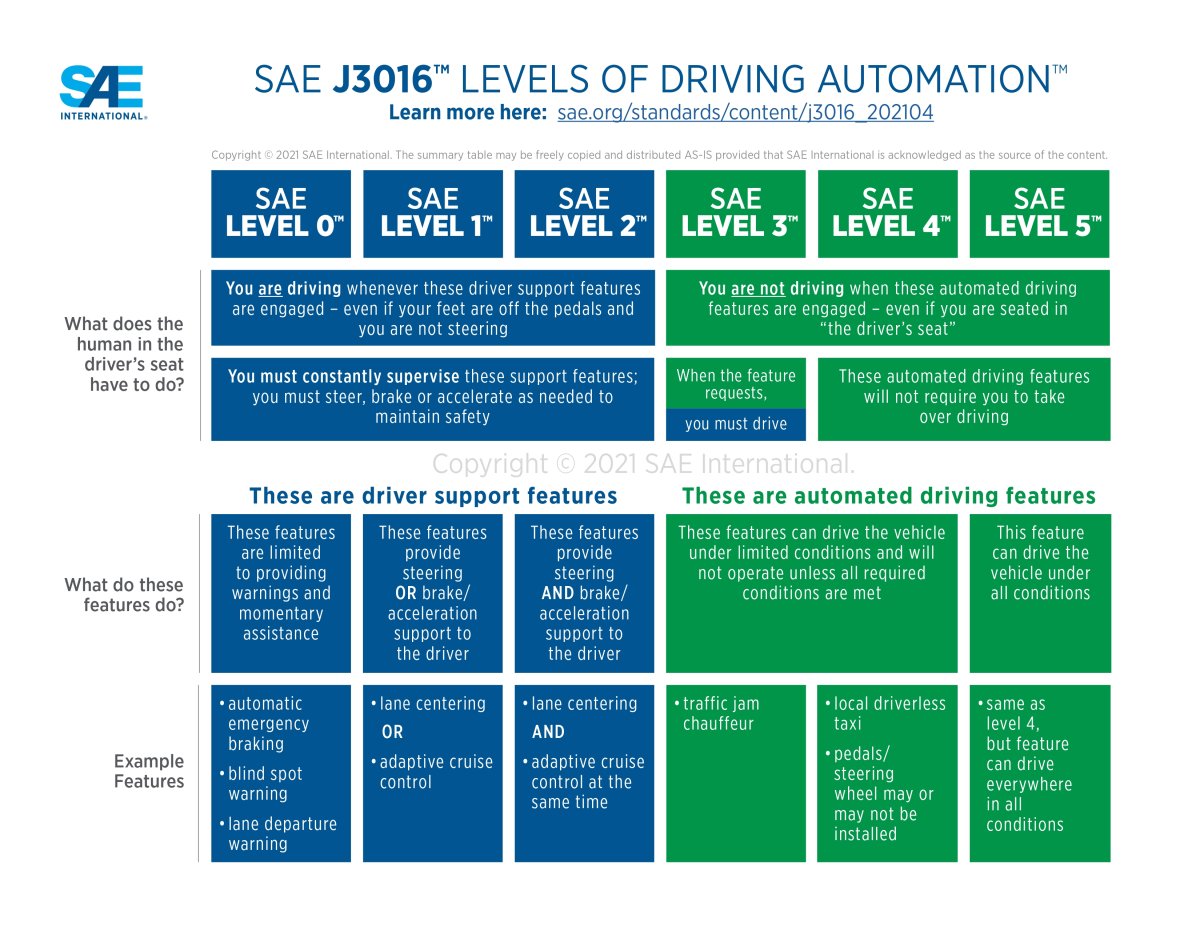
The automotive sector grapples with a gap between promotional language and the engineering reality of today’s systems.
Manufacturers, from legacy OEMs to companies like Tesla, Rivian, Zoox, and Waymo, often use terms such as “autonomous,” “self-driving,” and “robotaxi.” These labels can blur what the technology actually does. To provide clarity and inform policy worldwide, SAE International and the International Organization for Standardization (ISO) maintain the SAE J3016 classification.
People commonly reference these categories as “Level 2,” “L3,” or “L4/L5,” along with concepts like operational design domains. J3016 defines those levels and terms; it is not a subjective rating of a system’s capabilities such as FSD. Instead, it is an engineering standard that strictly partitions responsibilities between the human operator and the vehicle’s software. The framework defines six SAE levels, broadly split between the blue advanced driver support features and the green automated driving features.
How Do the Levels Work?
Two core terms underpin the entire J3016 taxonomy: the Dynamic Driving Task (DDT) and the Operational Design Domain (ODD).
The DDT includes all real-time activities needed to drive on public roads safely. It comprises operational subtasks (for example, lateral control to keep lane position and longitudinal control for acceleration and braking) and tactical subtasks (such as planning maneuvers, navigating intersections, and detecting and responding to objects and events). The DDT excludes higher-level strategic choices like selecting a destination or scheduling a route.
The ODD specifies the exact conditions under which a given driving automation feature is intended to function. It can include geofenced areas, time-of-day limits, roadway requirements (such as access-controlled highways), weather constraints, and prerequisites like clearly visible lane markings.

Driver Support: Level 0 to Level 2
In the lower half of the SAE spectrum, the person behind the wheel remains in control, and the technology functions as an assistant. The human is legally responsible for the vehicle’s actions at all times.
Level 0: No Driving Automation
At Level 0, the human driver executes the entire DDT, including steering, braking, and acceleration. A vehicle at this level may include advanced safety features like Automatic Emergency Braking, Blind Spot Warnings, and Lane Departure Warnings, but it is still considered L0.
Level 1: Driver Assistance
Level 1 introduces ODD-specific control of either lateral or longitudinal motion, but not both simultaneously. A typical example is adaptive cruise control, where the vehicle handles acceleration and braking while the human continues to steer.
Level 2: Partial Driving Automation
Level 2 is the upper boundary of human-supervised driving. Here, the system simultaneously manages both lateral and longitudinal vehicle motion.
Consumer-facing systems such as Tesla’s Full Self-Driving (Supervised) fit into this category today. Even if an L2 system can navigate city streets, make turns, and change lanes, it remains limited in handling objects and events outside its operational domain (for example, edge cases).
Because L2 software cannot guarantee a response to every unforeseen situation, the human must continuously supervise and be ready to take over immediately. Under Level 2, “you are driving” even if your hands and feet are off the physical controls.

Level 3 and the Fallback User
Transitioning from Level 2 to Level 3 shifts both legal liability and operational authority. This is likely one of the major reasons Tesla has not yet pursued a level 3 system in certain scenarios. At Level 3, the system becomes an Automated Driving System (ADS). When a Level 3, 4, or 5 feature is engaged, the software performs the entire DDT, so the person in the vehicle is no longer actively driving.
Level 3: Conditional Autonomy
Level 3 permits the occupant in the driver’s seat to stop monitoring the roadway. They may legally look away—such as reading or viewing a secondary screen—while the system performs the driving task within a limited ODD, like dense highway traffic.
Mercedes-Benz deployed a commercial Level 3 system, Drive Pilot, in select markets before later canceling the program due to its extremely limited ODD.
The key caveat at Level 3 is the DDT fallback. Although the system manages typical operations, it does not guarantee it can independently resolve a major vehicle failure or an unexpected exit from its ODD.
Consequently, Level 3 requires a receptive “fallback-ready user” in the driver’s seat. If the system encounters a problem it cannot resolve, it issues a formal “request to intervene,” giving the human several seconds to reorient and assume control. If the human does not respond, the vehicle applies a baseline failure mitigation strategy, such as bringing the car to a controlled stop within its current lane of travel.
True Autonomy: Level 4 and Level 5
At the top of the J3016 standard, the expectation of emergency human intervention is removed whenever the automation is active.
Level 4: High Driving Automation
The technical boundary between Level 3 and Level 4 is automated management of the DDT fallback. A Level 4 system is designed to handle the full driving task and to resolve failures without human assistance.
If a Level 4 vehicle experiences a catastrophic tire blowout or a sudden whiteout snowstorm, it does not call for human help; instead, it executes its own fallback protocol to reach a “minimal risk condition,” such as pulling onto a clear shoulder and activating hazard lights.
Because a human is never expected to take over, anyone inside a Level 4 vehicle is legally a passenger. This underpins modern robotaxi services. Companies like Waymo and Zoox operate at Level 4 within carefully geofenced city areas. Similarly, Tesla has recently achieved state-level commercial authorization to operate driverless vehicles in Texas, self-certifying its dedicated robotaxi software stack to Level 4 capability.
The primary limitation of Level 4 is not safety but reliance on a constrained ODD; the vehicle cannot function outside its approved geofences.
Level 5: Full Autonomy
Level 5 is the culmination of autonomous driving. It is the counterpart to a Level 0 human driver, performing the entire DDT and handling all fallback scenarios across an unlimited domain.
To meet Level 5, an ADS must be capable of driving anywhere on public roads in all environmental and traffic conditions that a typically skilled human driver could reasonably handle.
There are no geographic limits, weather exclusions, or software-imposed regional geofences. If a vehicle’s operation is restricted to certain countries or highway systems because of mapping or software boundaries, it does not satisfy the literal Level 5 criteria.
Given the immense complexity of covering every real-world edge case globally, true Level 5 capability remains a future target rather than something available to the public today. Recently, Tesla self-certified its robotaxi vehicles in Texas as Level 4, and that remains its goal for consumer vehicles going forward.










Partager:
Tesla Chief Designer Says Next-Gen Roadster is Coming 'Very Soon'
Tesla FSD (Supervised) Officially Approved in Denmark