
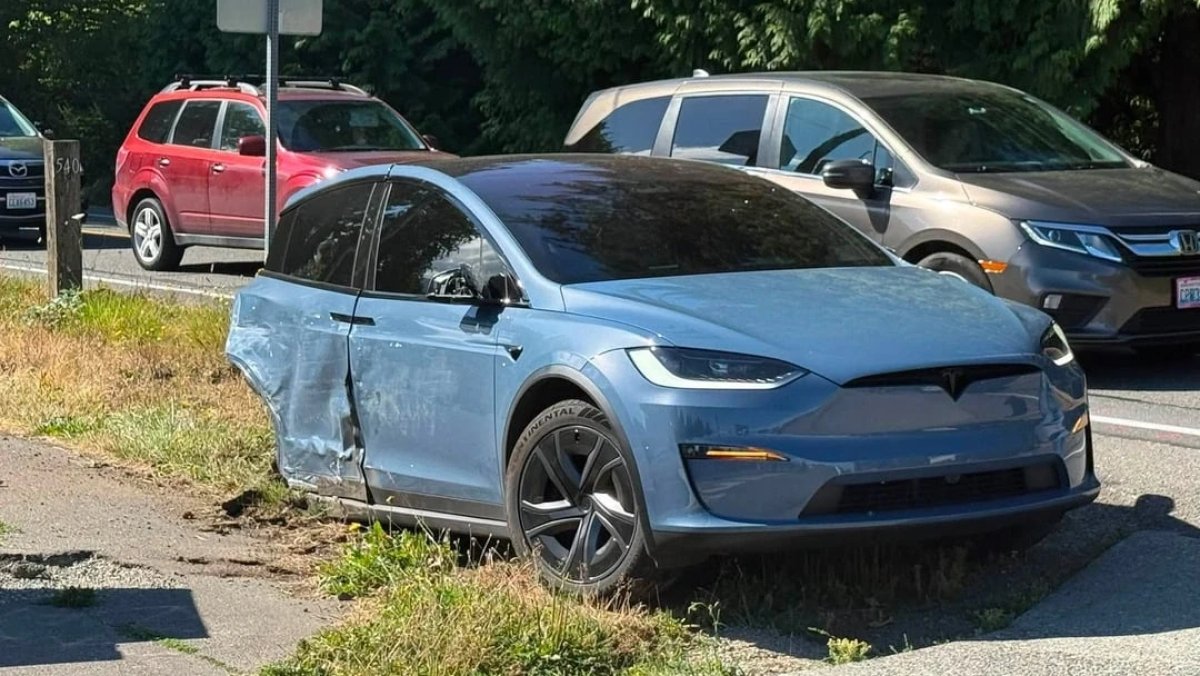

Vehicles are engineered to withstand major crash forces, yet real-world impacts can still produce startling outcomes. Earlier this week, a Frost Blue Metallic Model X was involved in a severe collision that resulted in the entire rear third of the vehicle being torn off.
Photos from the scene posted on Reddit by /u/gxpls3 show the rear assembly — including the trunk hatch, rear axle, and both rear wheels — lying completely separated on the pavement, several yards from the rest of the SUV.
The crash occurred in the Seattle area. The original poster relayed details from a nearby resident, who said:
“Somehow the Tesla made contact with another vehicle, veered off into the ditch. The sheer weight and velocity of the Tesla as it crashed in the ditch made the vehicle break into two parts. The speed limit on the road is only 35 mph.”


Ditch Impact Shears Rear Frame
Early information indicates the Model X made contact with a Cadillac SUV before leaving the roadway and entering a nearby ditch at an unknown speed. The sudden change in momentum in the ditch, combined with the heavy battery pack architecture, created enough rotational force to separate the rear quarter from the main chassis.
Remarkably, despite the dramatic damage, everyone involved is safe. The vehicle also did not catch fire — notable because nickel-based battery chemistries used in most Model X builds are more prone to thermal runaway and fire risks than the lithium iron phosphate (LFP) batteries Tesla mostly uses today.

What a Frost Blue Model X (usually) looks like
Tesla’s Industry-Leading Safety Saves Lives
Automotive safety engineering depends on crumple zones that dissipate kinetic energy before it reaches occupants, while keeping the passenger compartment rigid so surrounding structures deform or detach instead. What can look like catastrophic damage is often the vehicle doing its job by sacrificing exterior components to protect people inside.
In this case, part of the rear passenger area was breached. If this had been a three-row Model X (both six- and seven-seat configurations have a three-row seating layout) with occupants in the rearmost seats, a break like this could have been extremely dangerous.
Even though Tesla officially closed Model S and Model X orders earlier this year, the SUV follows the same core structural safety philosophy as the mass-market Model 3 and Model Y. Tesla’s commitment to 5-star crash safety remains a benchmark not just among EVs but across the entire automotive industry.
That all occupants survived a crash violent enough to split a heavy SUV’s frame apart serves as another real-world demonstration of Tesla’s passenger protection in severe impacts.





Teilen:
Canada Invests $10.9M CAD in EV Chargers and Education
Tesla Upgrades Cybertruck Underbody With Carbon Fiber