
SpaceX is rapidly updating its Starlink hardware for travelers, campers, and other mobile users who need connectivity on the go. While the “Standard” residential kit is intended for stationary setups, the portable Mini terminal is receiving a major update that makes it a fully self-contained unit.
According to leaks from Oleg Kutkov (@olegkutkov), SpaceX has begun producing the second-generation Starlink Mini. In posts sharing specifications and hardware diagrams on X, Kutkov revealed that the “Starlink Mini 2” is entering production with a built-in battery. Adding an internal power source is a significant change from the original Mini and affects how users can deploy the hardware in remote areas.
Starlink Mini 2 is finally entering production, with a built-in battery now confirmed.
— Oleg Kutkov 🇺🇦 (@olegkutkov) July 19, 2026
The current hardware revision is mini2_prod1.
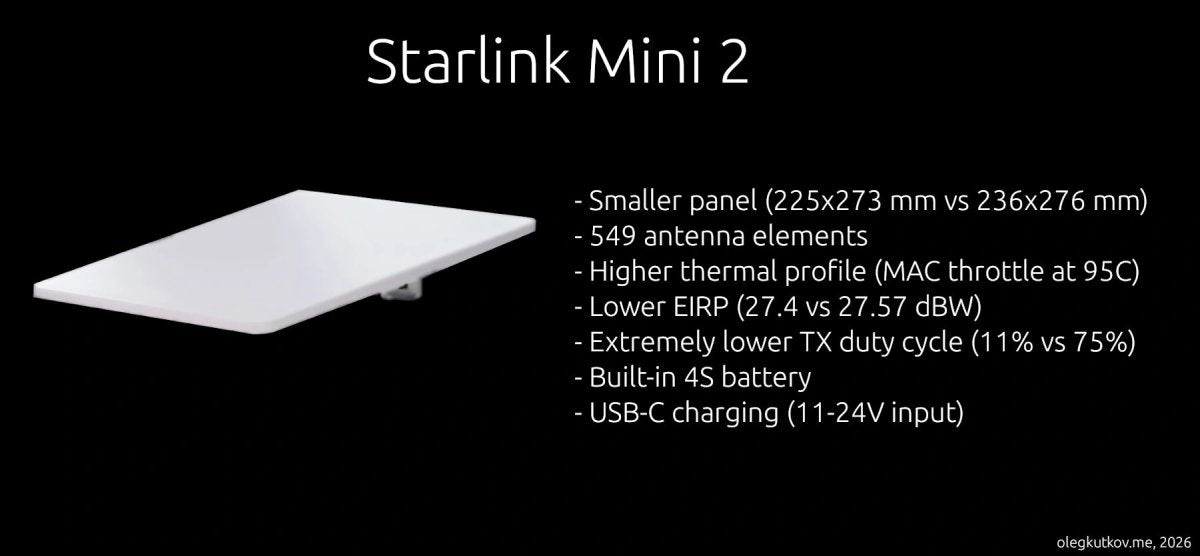
The new terminal is slightly smaller than the original Starlink Mini. Its panel PCB measures 225 × 273 mm, compared with 236 × 276 mm for Mini 1.… pic.twitter.com/7qBtl5ZYR4
Shrinking the Dish and Adding a Battery
The upcoming second-generation hardware, tracked as mini2_prod1, further reduces the antenna panel’s footprint. As detailed by Kutkov, the new terminal is slightly smaller than the original Starlink Mini. Its PCB measures 225 × 273 mm, compared with 236 × 276 mm for the earlier dish.

SpaceX unveiled the new V5 standard Starlink dish just days ago, which is closer in size to the original Mini than the V4 residential dish. For a product line focused on portability, a smaller receiver better fits in a backpack.

The Mini V2 continues to use the same “Catapult” SoC as the first model. The key addition is a built-in 4S lithium battery, managed by a BQ40Z-series Battery Management System (BMS) chip, with charging over USB-C (11-24V input range). The initial leaks do not specify the internal battery’s capacity or expected runtime, and it’s also unknown how much power the new Starlink Mini will draw. More details are likely to come from future leaks or an official announcement.
Trade-offs For Unplugged Connectivity
Operating solely on the internal battery demands strict power management. To keep consumption low, SpaceX is reducing the transmit duty cycle from 75% to 11%. This helps the dish stay within tight electrical limits, though it may also reduce uplink speeds for users running heavy uploads.
The new Mini retains an integrated GPS that is configured for in-motion use, making it suitable for mounting on vehicle roofs. Thermal throttling ceilings rise to 95°C and 99°C, up from 79°C and 83°C on the original. There is no official availability date yet, but entering mass production indicates the launch is close, and discounts on the original Mini may appear as inventory is cleared ahead of the new model.






Teilen:
Tesla FSD V14 Lite for HW3 Vehicles Begins Public Rollout
Tesla Starts Rolling Out New Version of FSD v14 Lite With New Features