
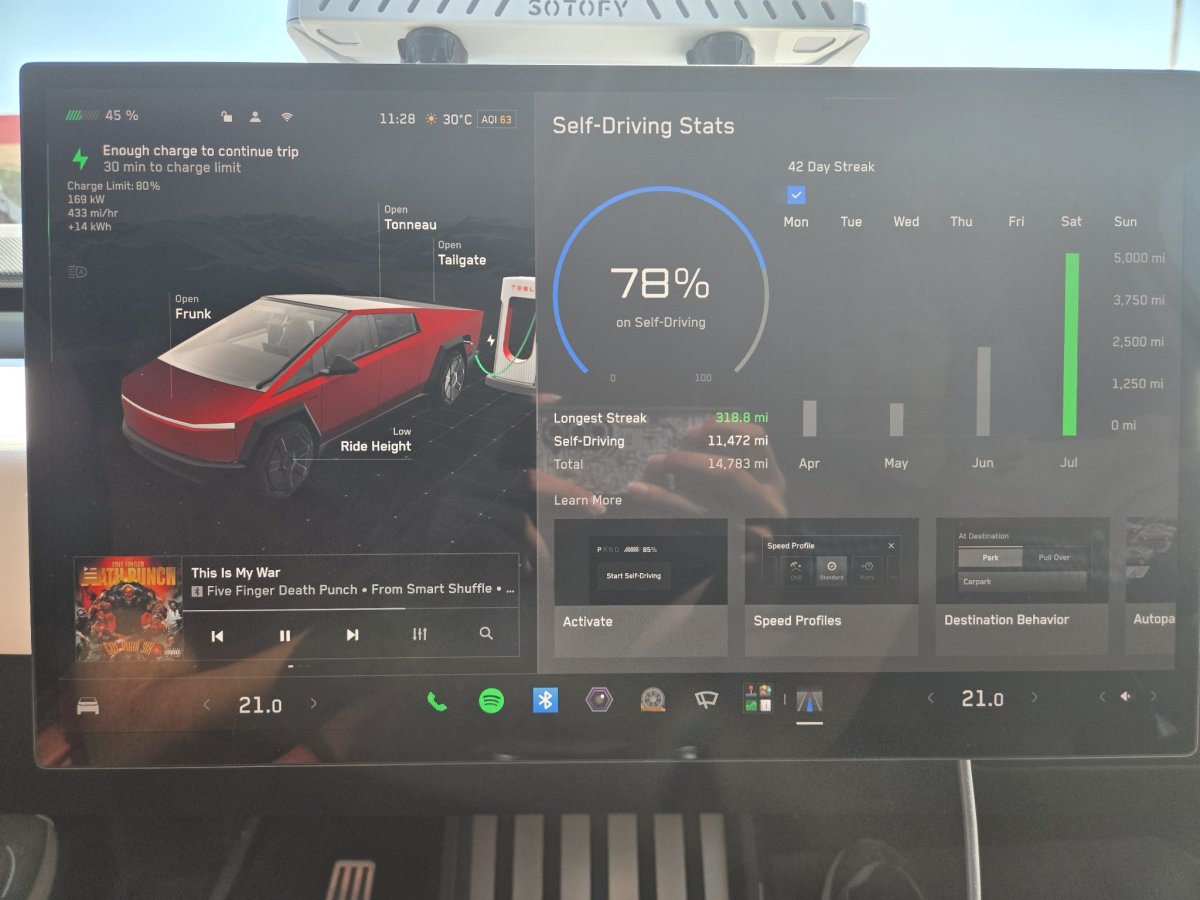
Debate over whether FSD is ready to run without supervision has intensified since the release of FSD v14. Much of the discussion weighs government testing results against owners’ real-world experiences.
On a recent trip, nearly 8,000 miles were logged in a Cybertruck, departing from Ottawa, Ontario, to Los Angeles, California, and back, visiting many major national parks along the way. The drive exposed FSD to a cross-continent mix of terrain, traffic laws, and unfamiliar local intersections.
This raises two questions: Is FSD already suitable for unsupervised use in certain regions, and if not, should Tesla begin by enabling eyes-off highway driving?
North America in a Nutshell
A core challenge for autonomous systems is the trade-off between specificity and generalization. Services such as Waymo can perform strongly in well-known urban zones but often need extra training or mapping to adapt to new road types or regions. By contrast, FSD aims to operate on any road, anywhere.
Across the trip, the Cybertruck handled high-speed, open highways in the American Midwest as well as tight, unforgiving switchbacks in the Rocky Mountains. In cities, it coped with dense, erratic conditions on Chicago’s highways, the six-lane roads of Las Vegas, and the heavy traffic in Los Angeles. Unusual intersections—including criss-cross highway-to-road interchanges in Nevada—did not cause issues. Taken together, these results support the premise that Tesla’s generalization strategy is working very well.
The Safety Metric and Sole Intervention
The decisive metric for dropping the “Supervised” label is safety-critical interventions. Over nearly 8,000 miles across multiple U.S. states, there was a single safety-critical intervention.

Just as notable as the low disengagement count is the cause of that intervention: it was prompted by the actions of a human driver—not by a software problem, a mapping mistake, or a treacherous mountain pass. Managing sharp Yosemite switchbacks and then seamlessly handling dense Los Angeles traffic without a system-initiated safety failure suggests the system is getting close to unsupervised readiness.
Finalizing Convenience
The drive was not completely frictionless, but the remaining issues were predominantly convenience-related rather than safety-critical.
First, driving modes—Mad Max, Hurry, Standard, Chill, and Sloth—still need refinement, especially around speed control, and Tesla has stated that it’s not going back. The modes sometimes exceed posted limits and at other times lag behind traffic. For example, when traveling in California to the Grand Canyon on Route 66, FSD would not go faster than 45 mph in a 55 zone on Standard or Hurry, but would run at 70 mph on Mad Max—either 10 mph below the posted limit or 25 mph above.

Second, highway navigation occasionally selected incorrect exits. These were safe maneuvers but introduced extra time and distance on long segments.
Third, parking remains a challenge for a large vehicle like the Cybertruck. FSD sometimes attempted to back into closed charging stalls (despite the new 3D site maps showing closures), and when it did choose an active stall, it sometimes stopped too far away to connect. This behavior was especially common at older V2 Supercharger posts with short cables, which are widespread in the Midwest. These are annoyances that may require manual adjustment rather than deal-breakers.
The Show Must Go On
Overall, the current complaints are largely surface-level bugs: speed mode quirks, routing detours, and parking behavior. They affect trip efficiency, ride quality, and driver patience but do not implicate FSD’s physical safety.

Offroading does indeed count against FSD streaks and % on FSD.
Because FSD is effectively generalized, it can interpret unfamiliar regional traffic rules, handle varied terrain, and react to human unpredictability across the United States.
Robotaxi
Tesla has taken a cautious approach to the Robotaxi rollout in Austin and more recently in other parts of Texas and Florida, evaluating each area, adding training where helpful, and confirming that FSD can manage those roads reliably.
That leads to the open question: when will consumers gain access to the same level of autonomy that robotaxis have in select regions, and should Tesla apply similar validation and additional training to highways across North America?



Teilen:
Tesla Roadster Is ‘Very Soon,’ Franz Says as 10-Year Anniversary Approaches
Tesla Cybercab’s Front Light Bar Appears to Be RGB After New Purple Sighting