
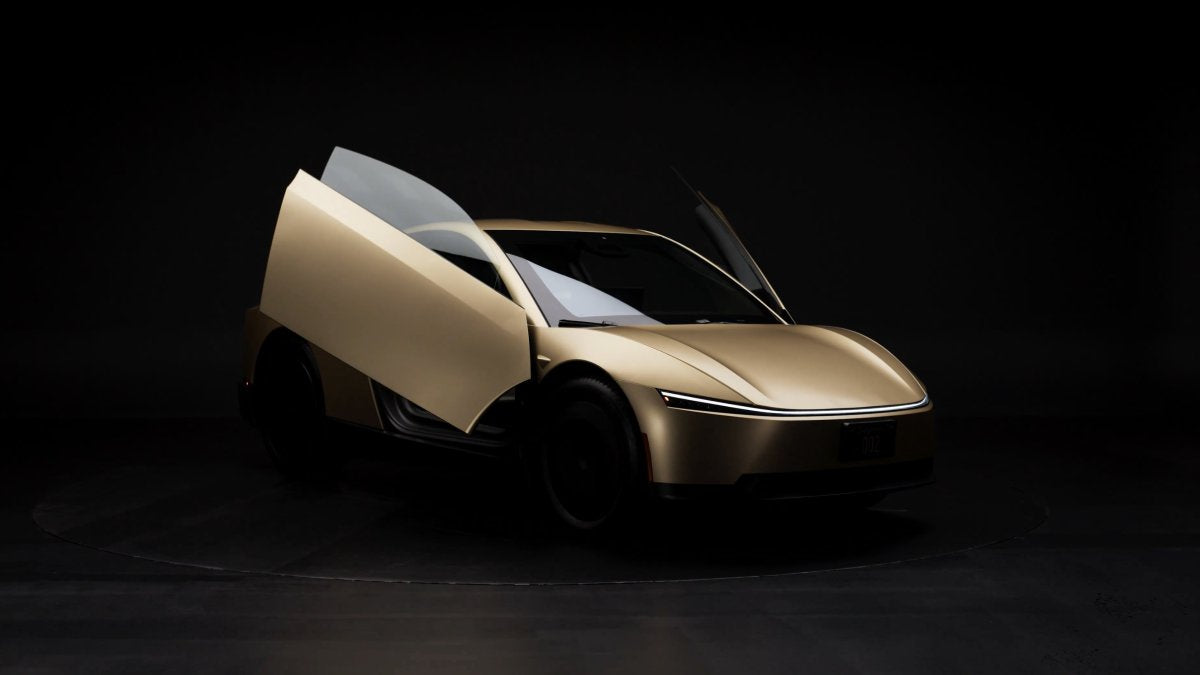

When Elon Musk responded to a user who called the Cybercab a piece of art by saying, “And there is so much to this car that is not obvious on the surface,” he appeared to be pointing to the many design and engineering choices that aren’t visible at first glance.
The Cybercab’s smooth plastic exterior draws attention, but the key innovations lie beneath those panels. From changes to the factory process to the vehicle’s wiring and structural choices, the Cybercab consolidates a decade of engineering efficiencies.
Here’s a closer look at what’s under the skin.
The Unboxed Assembly
The single biggest change is how the Cybercab will be manufactured. It serves as the flagship for a new Unboxed Assembly process: a modular approach that replaces the traditional linear painted-shell production line to cut cost and build time.
Instead of moving a painted body down a single line, the vehicle will be assembled on parallel lines that produce sub-assemblies — front, rear, sides and floor — which are snapped together at the end. This lets more workers or robots work on different modules at once, reducing the factory footprint and speeding up production.
48V Architecture & Etherloop
The Cybercab is expected to use a 48-volt low-voltage architecture, a system pioneered on the Cybertruck. By increasing the low-voltage bus from the industry-standard 12V to 48V, the wiring harness can be made much smaller.
Operating at 48V also enables data-over-power with Etherloop, removing long runs of heavy copper wiring. The result is a lighter vehicle that is simpler to manufacture, easier to automate and simpler to service remotely.
Structural Battery Pack
The vehicle also uses a structural battery pack concept, integrating cells directly into the chassis — likely using the 4680 cell format. Embedding the battery into the structure increases rigidity and crash protection, making the cabin safer and stronger.
Inductive Charging
The Cybercab will not include a traditional charging port; instead, it will rely on inductive charging to replenish its battery. That removes the need for physical charging cables and complex “charging snakes,” with optimal positioning and docking handled by FSD.
Inductive charging was originally intended to debut with the Cybertruck but was later canceled; the Cybercab is expected to be the first, and possibly the only, vehicle in this lineup to adopt the system.
Paint-Infused Plastics
The Cybercab’s exterior panels are made from paint-infused plastic. Because the color is embedded throughout the material, scratches won’t reveal a different underlying color, and panels can be swapped out without needing a traditional paint shop or additional finishing.
Serviceability & Cleanability

Design choices inside the Cybercab prioritize fast cleaning and easy servicing. A personal car is parked about 95% of the time, while a Robotaxi runs roughly 95% of the time; that operational profile demands interiors that can be cleaned quickly and serviced at centralized urban hubs.
With wireless charging and robotic cleaning available on site, day-to-day maintenance could be handled by employees or by Optimus robots, enabling rapid turnover and continuous operation.


Teilen:
Tesla Announces FSD Purchase Option Will Go Away Next Month — Here’s Why
Tesla’s Lithium Refinery Enters Production — Eliminates Hazardous Byproducts and Reduces Costs