

@TailosiveEV
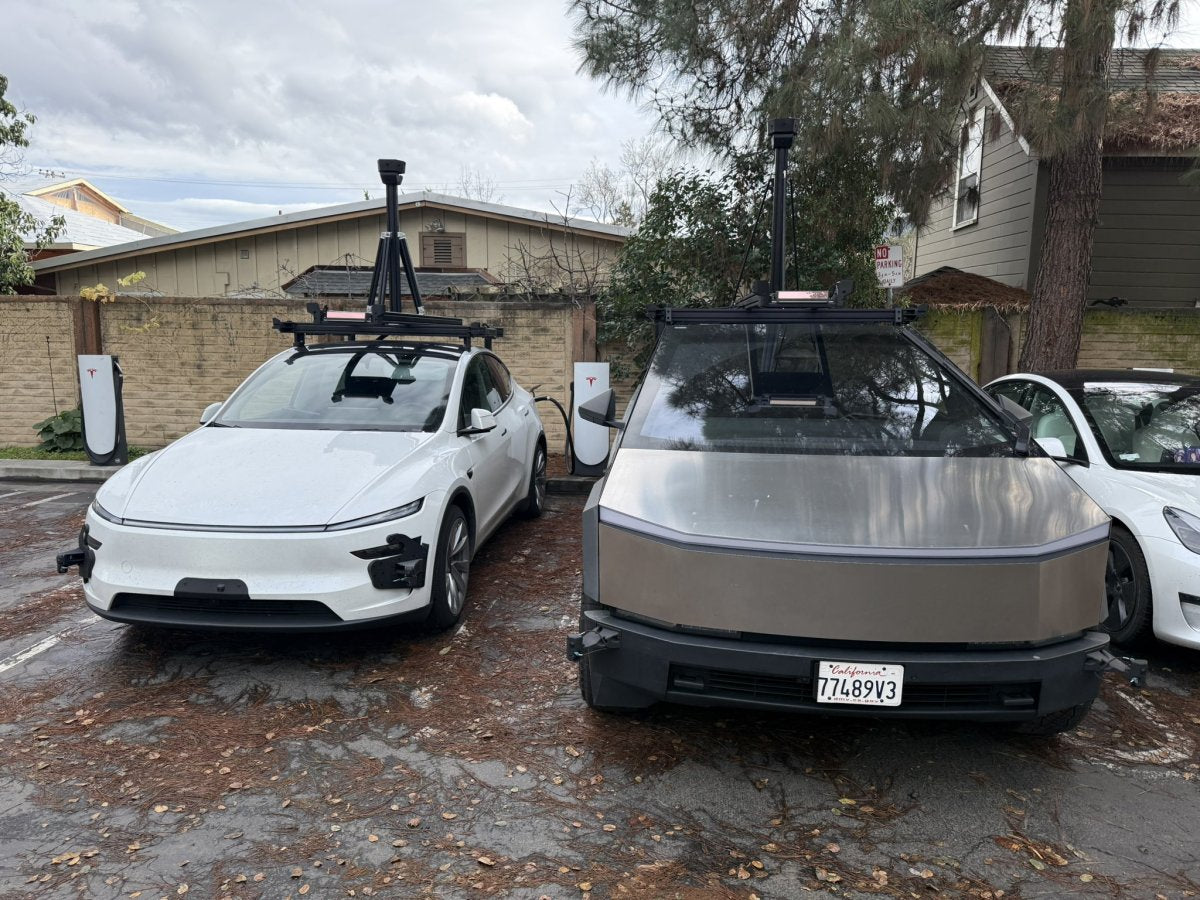
A new set of Tesla engineering validation vehicles was spotted in Los Gatos, California, showing unusual hardware changes. Unlike the standard validation mules seen in past years—typically fitted with roof-mounted LiDAR rigs for ground-truthing—these examples, a Cybertruck and a Model 3, carry a custom camera rig mounted at the front bumper corners.

@TailosiveEV
The temporary-looking brackets position wide-angle cameras low to the ground and angled outward. While Tesla routinely trials new sensors, placing cameras at these corner locations—covering frontal blind spots that are tough to capture with the current camera layout—indicates the company is collecting targeted data to address two key problems: Summon and Banish.
Ground Truth
Tesla’s vision approach depends on occupancy networks—software that predicts objects in blind spots by remembering what the car observed seconds earlier. That memory is especially important for the Cybertruck because the front-facing cameras can’t see certain areas around the bumpers.
Memory alone is insufficient for the precise low-speed maneuvers required by Summon and Banish. By combining these low-mounted corner cameras with high-fidelity roof LiDAR, Tesla appears to be building a new ground-truth dataset: a pixel-accurate representation of the area immediately around the bumper.
That dataset can train FSD’s neural networks to better infer obstacle distance and volume within the blind zone. In short, Tesla is teaching its systems to predict objects in the “void” where production cameras have no direct view, reducing the risk of clipping obstructions during tight maneuvers.
The Banish Bottleneck
The need for this testing is twofold. Banish is a core capability for Robotaxi and FSD Unsupervised, and the Cybertruck remains the only vehicle in Tesla’s lineup that lacks Actually Smart Summon.
Much of the fleet now runs FSD v14, but Actually Smart Summon still operates on an older legacy stack that hasn’t been migrated into the unified end-to-end neural network. That legacy code depends heavily on Autopilot routines that were not ported to the Cybertruck.
Banish lets a car drop you at a door and then autonomously roam a parking lot to find a spot. The feature—promised in earlier FSD releases—demands the vehicle handle complex, unpredictable parking-lot traffic without a human behind the wheel, leaving no room for error.
To avoid accidents, Tesla’s forward-vision models must reach millimeter-level precision in the frontal blind spots so Banish and Smart Summon can operate safely.
A Glimpse of Future Hardware?
Even though the brackets in these photos look temporary, the testing raises the question of whether Tesla will add dedicated corner cameras in future hardware revisions or solve the issue via software alone.
Rivals such as Lucid and Rivian use additional cameras, radar, or ultrasonic sensors to cover these blind areas. Tesla previously removed ultrasonic sensors to cut cost and complexity and to reduce sensor conflicts; relying only on high-mounted cameras has proven challenging.
Requests for front bumper cameras have long been made because such cameras would eliminate the forward blind spot and let vehicles see around obstructions at intersections earlier. Currently, a vehicle often must move forward enough for the B-pillar cameras to obtain a clear view.
That said, a retrofit or sudden mid-cycle refresh adding corner cameras appears unlikely. This activity is most likely a data-collection effort aimed at improving software performance on existing hardware.




Share:
Tesla’s Mars Mode Easter Egg: Latest Additions
Tesla Has an Emergency Brake: Here's How to Use It