
Tesla Is Auctioning Off Stockpiles of Model S and Model X Parts

Tesla buys vehicle components in bulk, and the availability of those parts often dictates when hardware updates reach production. That’s why new hardware frequently appears mid-cycle: the company tends to exhaust existing stock before switching, even if the updated components are already on hand.
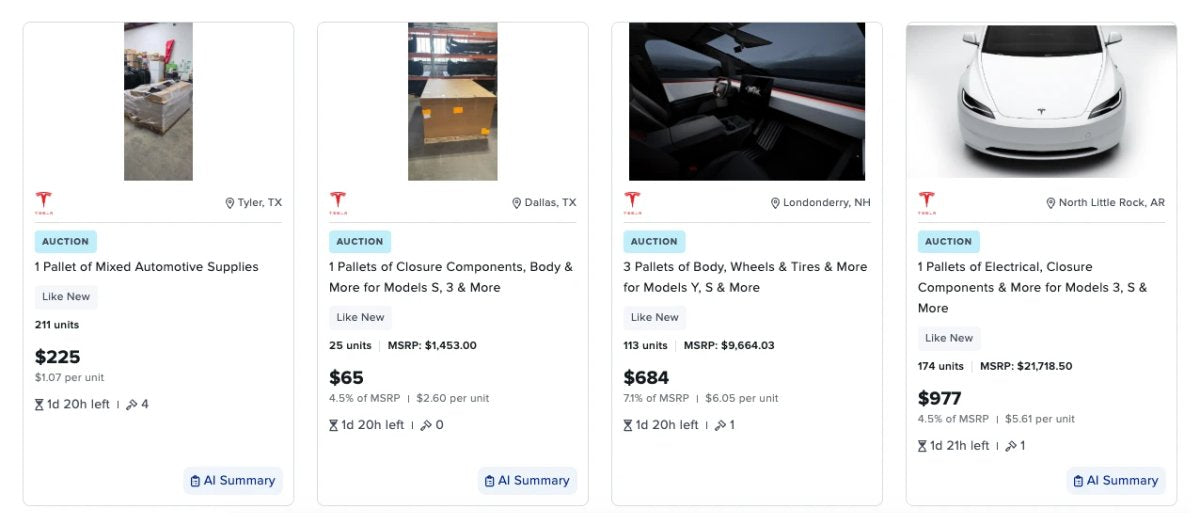
With Model S and Model X manufacturing now concluded and the Fremont assembly lines removed, Tesla has started clearing out surplus. Large quantities of new, unused Model S and Model X components are being listed through B-Stock’s liquidation storefront.
Parts by the Pallet


The auctions aren’t intended for individuals seeking single items. Tesla is offering pallets with hundreds of parts, making them better suited to repair shops, resellers, and parts distributors.
One current Model S auction includes 171 center-console assemblies and other components with an MSRP of $114,875. At the time of writing, bidding was only $175. Another auction contains 775 Model X interior-pillar components valued at $270,645, with bidding starting at $100.
Other listings include six pallets of Model X exterior lighting and chassis parts with an $87,870 MSRP, and nine pallets containing more than 10,000 Model S/X electrical components valued at $842,390. Auction prices typically change substantially near the end of the auction.
The parts will likely end up with repair shops, parts resellers, and eventually owners over time.
Model S and Model X Production Has Ended
Tesla formally ended production of the two vehicles in 2026. As Tesla executives later explained, the aging architecture was becoming increasingly costly to update to meet newer crash-safety requirements, and Tesla also needed the Fremont factory space for Optimus production.
Tesla subsequently removed the Model S and Model X production equipment in just 46 days, clearing the factory floor for its Optimus manufacturing operation.
Tesla has also said it plans to open-source Model S and Model X design and software materials, which could eventually make it easier for third parties to understand the vehicles and produce replacement components.
Tesla Still Needs to Support Existing Vehicles
Selling excess inventory doesn’t mean Tesla is disposing of every spare component. Hundreds of thousands of Model S and Model X vehicles are still on the road, including the recently delivered Signature series (everything unique about these vehicles) and other vehicles with active warranties.
Tesla’s basic vehicle warranty lasts four years or 50,000 miles, while Model S and Model X battery and drive units are covered for eight years or 150,000 miles. Tesla therefore still needs the ability to perform covered repairs during those warranty periods, although federal law does not require an automaker to maintain every replacement part for a fixed number of years after a model is discontinued.
The B-Stock auctions appear to be a way for Tesla to unload inventory it no longer expects to need in those quantities now that Model S and Model X production has ended.








Share:
Tesla’s Lost ‘Back to the Future’ Easter Egg: What It Did and Why It Disappeared
Tesla Publishes Vehicle-to-Load (V2L), PCS Retrofit Procedure, But Is It Worth It?