
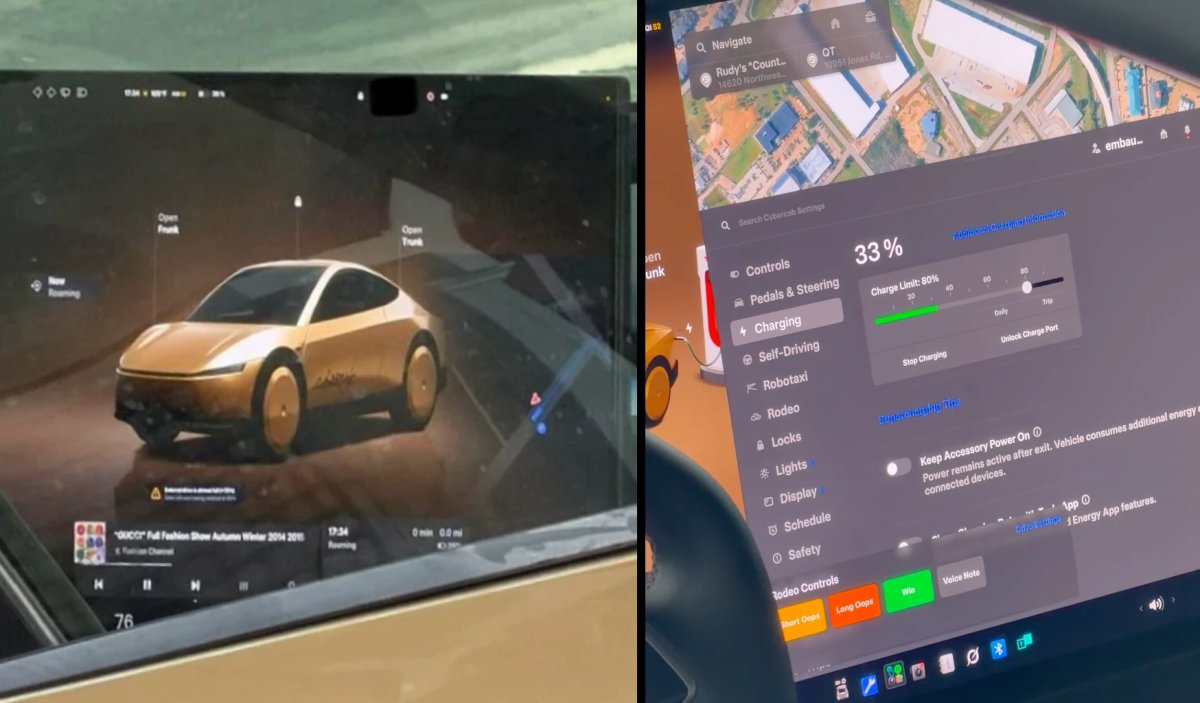

Tesla’s Cybercab was recently seen running its native in-car interface, offering a closer look at software that passengers typically do not access. The layout closely resembles other Tesla interfaces, while Cybercab riders are expected to primarily use the simplified Robotaxi interface that emphasizes destination, ETA, map, media, and passenger controls instead of exposing the vehicle’s full settings.
What’s New in the UI

The native layout looks familiar: the main visualization shows a gold Cybercab on a gold-toned background, and the Controls menu is similar to current vehicles with a few differences. Turn-signal icons remain visible in the top status bar even when the signals are inactive, and a dedicated windshield-wiper button likely opens wiper controls. The Controls menu adds two items—Robotaxi and Rodeo—and although their contents are not shown, Rodeo appears intended for employees to provide feedback on Robotaxi performance. Separate Rodeo Controls also appear along the bottom of the display, with large buttons labeled Short Oops, Long Oops, Win, and Voice Note, plus a shortcut to drive settings.
New Split Screen Maps?

The Controls menu opens in a split-screen layout, keeping part of the map visible above the settings instead of covering it completely. It is unclear whether this behavior will apply to other apps such as Spotify. If it extends more broadly, it would mark a change from the current production version.
New ‘Roaming’ Status
A separate view displays the full-screen vehicle visualization with a new “Now” status set to “Roaming.” This is the first time “roaming” has appeared, which likely implies the Cybercab is traveling without a rider and without an exact destination. Instead of remaining in place after a drop-off, the vehicle could move toward more populated or congested areas even before another ride is confirmed. By anticipating when and where the next passenger will be, Tesla can reduce wait times and keep robotaxis busier throughout the day.
Tesla Employees Are Rating Cybercab Trips

Tesla is also collecting detailed feedback during Cybercab testing. During an employee ride, the display showed a web-based evaluation form with a 10-star ride rating and several yes-or-no questions. One visible question asks whether the trip is acceptable for unsupervised cars. The evaluation is part of employee testing at Gigafactory Texas before rides open to the public, and Tesla began preparing employee rides earlier this summer. These tools and controls provide a rare look at what happens during robotaxi or new-vehicle testing.




Share:
Tesla Model Y L Beats Range Estimates in Real-World Test
Tesla Officially Confirms Semi Launch in Europe