
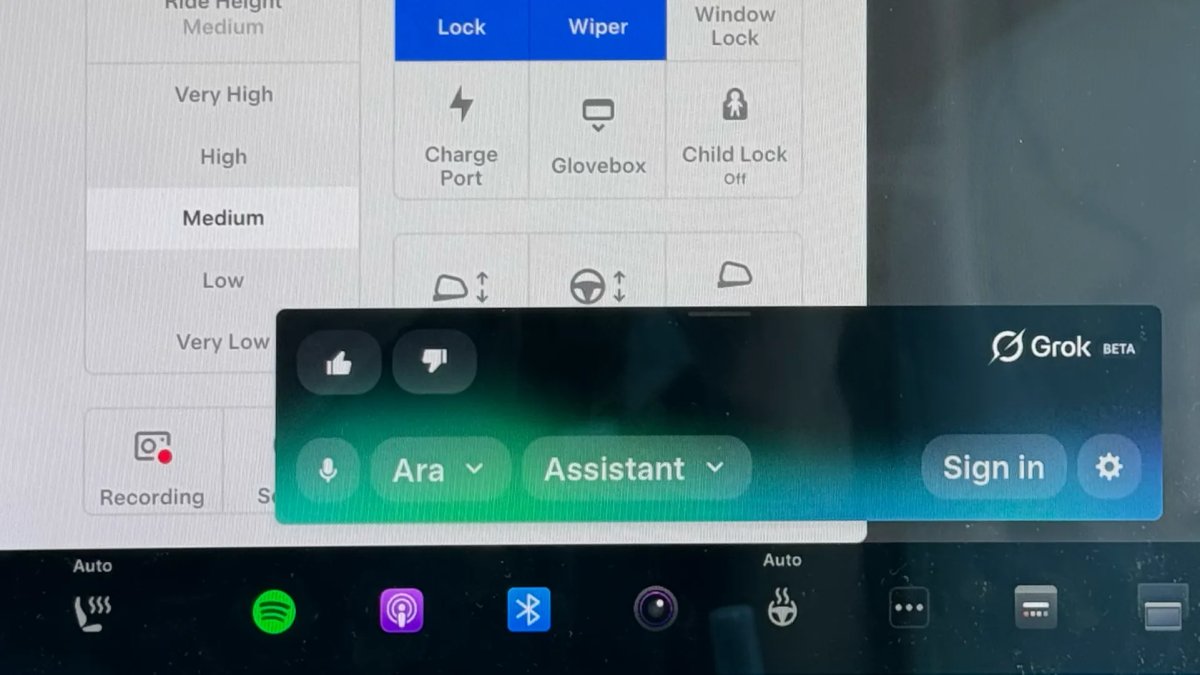

Conversational control in Teslas is poised to shift from rigid commands to natural dialogue. The in-cabin AI is progressing quickly, and the next milestone is linking SpaceXAI’s Grok chatbot (check out their new logo) directly to driving behavior.
Tech reporter and Tesla owner @ChrissGPT recently highlighted limitations with Full Self-Driving on X, writing: “FSD would be twice as useful in neighborhoods if I could actually talk to the car and tell it which driveway to pull into, the same way I would with a person driving me home.” He added that being able to describe the destination house, have FSD pull up to it, and remember it for next time would be a major improvement. Tesla AI chief Ashok Elluswamy replied with a concise confirmation: “Working on it.”
Working on it.
— Ashok Elluswamy (@aelluswamy) July 8, 2026
Smarter Navigation and Location Reminders
Grok made its automotive debut last summer, enabling natural-language requests such as open-ended questions, fact lookups, and quick current-events summaries.
Capabilities expanded soon after. Tesla added comprehensive Grok navigation commands so owners could add waypoints and modify routes mid-trip. More recently, the Spring 2026 Update introduced location-based reminders, enabling prompts like “remind me to get my gym bag out of the trunk when I get home.” Integrating Grok with the driving stack is the next logical step.

Real-Time Navigation Nudges
Elluswamy’s confirmation follows Elon Musk’s note last month that Grok voice controls for FSD should be available “in about 3 months or so,” suggesting a potential release in fall 2026. Musk first acknowledged early in the year that controlling FSD with Grok was planned, and the latest remarks indicate steady progress.
Today, some drivers can influence FSD’s path at an intersection by toggling the turn signal. With Grok integration, you’ll be able to simply speak instructions such as, “Take a left at the upcoming stop sign instead of going straight,” or “Navigate to Costco and park away from other cars.”
Hardware 3
While HW3 is separate from the infotainment processor, most HW3 vehicles include the Intel infotainment unit, which does not currently support Grok.
With Tesla’s release of FSD v14 Lite, HW3 becomes much more capable, but this also means that HW3 vehicles with Intel may not see support for this upcoming feature.
However, there were rumblings that Intel vehicles would receive Grok in the future, so that possibility remains open. Another possibility is that when HW3 vehicles get an FSD computer upgrade in the future, they could also receive an updated infotainment computer, since the two are closely coupled.
Solving FSD’s Parking Problems
The planned capability would address the awkward last yards of a trip. FSD v14.1 added Parking at Destination options, but they remain limited, and pulling up to an exact drop-off can still feel clunky. Recent FSD updates show ongoing work in this area, and allowing a passenger to verbally guide the vehicle to a precise driveway would be a major improvement. Musk has also said that FSD will soon remember your parking habits at frequent destinations like home and the office.

This could eventually become a standout feature for Tesla’s Robotaxi service, letting riders add a stop, switch to a preferred route, or describe the exact building for drop-off using voice.
There’s no firm public release date yet, and the “in about 3 months or so” target could slip, but the team’s public confirmation indicates the framework is under active validation. After this ships, a likely follow-on would be giving Grok direct control of cabin features so owners can open windows, enable Pet Mode, or adjust HVAC using everyday conversation.


Share:
SpaceX Unveils New xAI Logo
Tesla FSD Is More Energy Efficient Than Human Drivers